
Chinese Researchers Unveil Glasses-Free 3D Display That Feels Like Magic

The Future of Screens Is Here - And It Doesn't Need Glasses

Remember that mesmerizing scene in The Three-Body Problem where the universe flashes before a character's eyes? What seemed like science fiction just became reality through EyeReal - a new glasses-free 3D display developed by Chinese researchers that's turning heads in the tech world.
Image

Seeing Is Believing

At first glance, EyeReal looks like a standard 24-inch monitor. But when powered on, it creates stunning three-dimensional images that float naturally in space. "The effect is like looking through a window into another world," explains Dr. Li Wei, the 26-year-old Fudan University doctoral student who led the project with Shanghai AI Lab collaborators.

What sets EyeReal apart isn't just its ability to project 3D images without glasses - though that's impressive enough. The system tracks your eye movements in real time, adjusting the image so it remains crystal clear even as you shift position. Traditional 3D displays often suffer from blurring or ghosting if you move your head; EyeReal maintains perfect clarity across a remarkable 100-degree viewing angle.

How It Works

The magic happens through an ingenious combination of computational optics and AI:

  • Multi-layer liquid crystal panels create light fields that mimic how objects reflect light in real space
  • Advanced eye-tracking ensures images stay locked to your perspective as you move
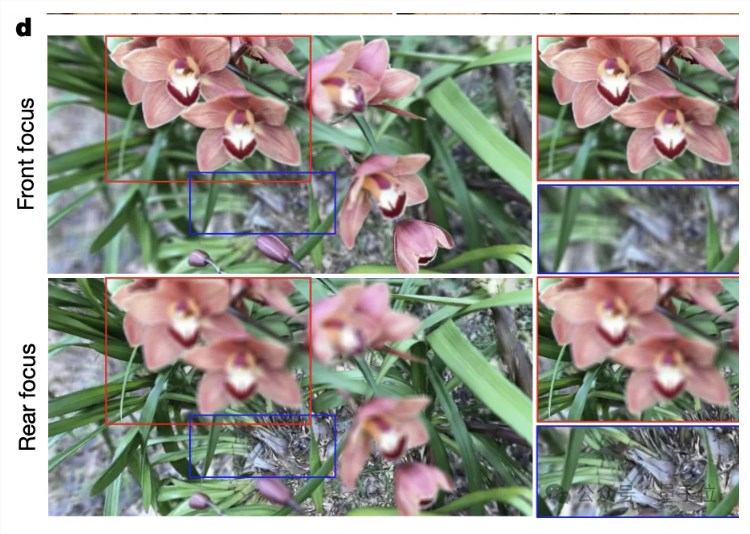
  • "Focus parallax" technology naturally blurs background elements when you focus on foreground objects - just like human vision

The result? A viewing experience so comfortable you could watch for hours without eye strain or dizziness - common problems with current 3D tech.

Big Potential in a Small Package

While earlier holographic displays could only show images the size of a fingernail, EyeReal creates vivid 3D scenes across 0.1-0.2 square meters. The team achieved this thousand-fold improvement using dynamic space-bandwidth optimization - essentially teaching the system to work smarter with limited physical resources.

Potential applications read like a sci-fi wishlist:

  • Medical imaging where surgeons could examine floating 3D scans during procedures
  • Virtual reality without bulky headsets or motion sickness
  • Next-gen gaming with true holographic displays
  • Architectural visualization letting clients walk around virtual buildings

The research appears in Nature, with prototypes already demonstrating commercial viability. As Dr. Li puts it: "We're not just improving existing technology - we're redefining what screens can do."

Key Points:

  • Glasses-free 3D display with natural depth perception
  • 100° viewing angle maintains clarity as you move
  • Focus-adjusting images reduce eye strain
  • Compact size (24-inch) with large effective display area
  • Potential applications from medicine to entertainment

Enjoyed this article?

Subscribe to our newsletter for the latest AI news, product reviews, and project recommendations delivered to your inbox weekly.

Weekly digestFree foreverUnsubscribe anytime

Related Articles

Meta's Pixio Rewrites the Rules: Simple Approach Beats Complex AI in 3D Vision
News

Meta's Pixio Rewrites the Rules: Simple Approach Beats Complex AI in 3D Vision

Meta AI's new Pixio model proves simplicity can outperform complexity in computer vision. By enhancing an older masking technique and training on diverse web images, Pixio achieves better 3D reconstruction than larger models—all while avoiding benchmark 'cheating.' The breakthrough suggests we might have overcomplicated visual AI.

December 29, 2025
ComputerVisionMetaAI3DReconstruction
VideoPipe: The Lego-Style Toolkit Revolutionizing Video AI Development
News

VideoPipe: The Lego-Style Toolkit Revolutionizing Video AI Development

VideoPipe, an innovative open-source framework, is changing how developers build video AI applications. By breaking down complex computer vision tasks into modular 'building blocks,' it lets creators assemble custom solutions in minutes rather than days. Supporting everything from traffic analysis to creative face-swapping apps, this toolkit handles multiple video formats and integrates cutting-edge AI models effortlessly. With over 40 ready-to-use examples, even beginners can quickly prototype professional-grade video intelligence systems.

December 29, 2025
ComputerVisionAIDevelopmentOpenSourceTools
Alibaba's Qwen3-VL Outperforms Rivals in Spatial Reasoning Tests
News

Alibaba's Qwen3-VL Outperforms Rivals in Spatial Reasoning Tests

Alibaba's Qwen3-VL vision model has taken the lead in spatial reasoning benchmarks, scoring 13.5 points on SpatialBench - significantly ahead of competitors like Gemini and GPT-5.1. The model introduces innovative features like 3D detection upgrades and visual programming capabilities, with practical applications already being tested in logistics and smart ports. While still far from human performance (80 points), this advancement marks important progress toward more spatially-aware AI systems.

November 26, 2025
ComputerVisionAIResearchSpatialComputing
Tencent's Compact OCR Breakthrough: Small Model, Big Results
News

Tencent's Compact OCR Breakthrough: Small Model, Big Results

Tencent has unveiled HunyuanOCR, a surprisingly powerful open-source OCR model packing state-of-the-art performance into just 1 billion parameters. This lightweight solution outperforms bulkier competitors in document parsing and multilingual translation while handling everything from receipts to street signs. Its end-to-end design delivers accurate results faster than traditional approaches.

November 25, 2025
OCRTencentComputerVision
Tsinghua & Kuaishou Breakthrough: SVG Model Boosts AI Training by 6200%
News

Tsinghua & Kuaishou Breakthrough: SVG Model Boosts AI Training by 6200%

Researchers from Tsinghua University and Kuaishou's Ling team have developed a revolutionary SVG diffusion model that achieves a 6200% training efficiency improvement and 3500% faster generation speeds compared to traditional VAE models. The innovation addresses long-standing semantic entanglement issues in image generation while maintaining superior output quality.

October 29, 2025
GenerativeAIComputerVisionDeepLearning
ByteDance Launches Seed3D 1.0: A Breakthrough in 3D Generation
News

ByteDance Launches Seed3D 1.0: A Breakthrough in 3D Generation

ByteDance's Seed team has unveiled Seed3D 1.0, a cutting-edge large model capable of generating high-quality 3D models from single images. The model excels in geometry, textures, and materials, offering potential applications in embodied intelligence and robotics. It outperforms larger industry models in comparative evaluations.

October 23, 2025
AIComputerVisionMachineLearning