
Tsinghua & Kuaishou Breakthrough: SVG Model Boosts AI Training by 6200%

Revolutionary AI Model Shatters Efficiency Barriers

In a landmark collaboration, Tsinghua University and Kuaishou's Ling team have unveiled the SVG (VAE-free latent diffusion model), marking a potential paradigm shift in generative AI technology. Their breakthrough addresses fundamental limitations plaguing current Variational Autoencoder (VAE) systems while delivering unprecedented performance gains.

The Decline of Traditional VAE Models

VAE technology has increasingly struggled with "semantic entanglement" - where modifying one image feature inadvertently alters unrelated characteristics. This phenomenon creates distorted outputs when attempting targeted edits (e.g., changing a cat's color while preserving its expression).
Image

Architectural Innovations Behind SVG

The research team implemented three key technical advancements:

  1. Semantic Extraction: Employed DINOv3 pre-trained models for precise feature separation through large-scale self-supervised learning
  2. Detail Preservation: Designed lightweight residual encoders to maintain intricate visual elements without semantic interference
  3. Feature Fusion: Developed novel distribution alignment mechanisms ensuring harmonious integration of semantic and detail features

The approach fundamentally rethinks latent space construction, eliminating compromises between generation quality and computational efficiency.

Image

Benchmark-Defying Performance

The SVG model demonstrates extraordinary capabilities across multiple metrics:

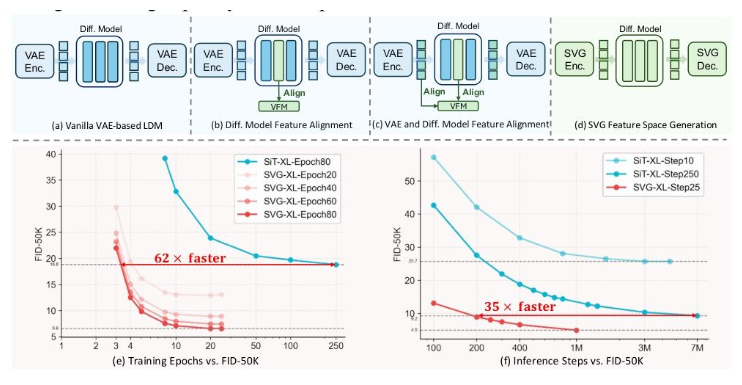
  • Achieved FID score of 6.57 on ImageNet after just 80 training cycles (versus hundreds typically required)
  • Requires fewer sampling steps while maintaining superior image clarity
  • Features direct applicability to downstream tasks (classification, segmentation) without fine-tuning
  • Demonstrates strong generalization across multimodal generation scenarios

The paper reveals particularly impressive comparisons against conventional approaches: | Metric | SVG Improvement | |--------|----------------| | Training Efficiency | +6200% | | Generation Speed | +3500% | | FID Score Advantage | >40% better |

Future Implications & Availability

This technological leap promises transformative applications across:

  • Real-time content generation platforms
  • Professional creative tools
  • Automated visual design systems The research paper detailing these findings is publicly available on arXiv.

Key Points:

  • SVG model eliminates VAE's semantic entanglement limitation
  • Combines DINOv3 semantic extraction with novel residual encoding
  • Delivers order-of-magnitude improvements in speed and efficiency
  • Maintains backward compatibility with existing workflows
  • Opens new possibilities for real-time generative applications

Enjoyed this article?

Subscribe to our newsletter for the latest AI news, product reviews, and project recommendations delivered to your inbox weekly.

Weekly digestFree foreverUnsubscribe anytime

Related Articles

News

Kuaishou's AI Video Tool Hits $240M Annual Revenue Milestone

Kuaishou's video generation AI, Kling, has reached impressive financial heights just 19 months after launch. The platform now generates over $20 million monthly, serving 60 million creators worldwide. Its success stems from continuous innovation, including breakthrough multimodal video capabilities that solve persistent industry challenges.

January 14, 2026
GenerativeAIVideoCreationTechGrowth
News

Tencent's 'Upset Frog' Lets Gen Z Play Storyteller with AI

Tencent is testing an innovative mini-program called 'Upset Frog' that blends AI storytelling with user interaction. Unlike passive content platforms, it lets young users shape narratives through choices and commands, creating a social space around collaborative storytelling. While still in testing, this experiment could redefine digital entertainment for the TikTok generation.

January 9, 2026
GenerativeAIInteractiveMediaTencent
Youdao's AI Pen Now Explains Math Problems Like a Human Tutor
News

Youdao's AI Pen Now Explains Math Problems Like a Human Tutor

NetEase Youdao has upgraded its AI Q&A Pen with China's first video explanation feature. Instead of static answers, it generates personalized whiteboard-style tutorials that adapt to students' needs - even responding to requests like 'make it funnier.' The pen combines two AI models to create dynamic lessons, marking a shift from text-based learning to interactive video tutoring.

January 6, 2026
EdTechGenerativeAISmartLearning
Meta's Pixio Rewrites the Rules: Simple Approach Beats Complex AI in 3D Vision
News

Meta's Pixio Rewrites the Rules: Simple Approach Beats Complex AI in 3D Vision

Meta AI's new Pixio model proves simplicity can outperform complexity in computer vision. By enhancing an older masking technique and training on diverse web images, Pixio achieves better 3D reconstruction than larger models—all while avoiding benchmark 'cheating.' The breakthrough suggests we might have overcomplicated visual AI.

December 29, 2025
ComputerVisionMetaAI3DReconstruction
VideoPipe: The Lego-Style Toolkit Revolutionizing Video AI Development
News

VideoPipe: The Lego-Style Toolkit Revolutionizing Video AI Development

VideoPipe, an innovative open-source framework, is changing how developers build video AI applications. By breaking down complex computer vision tasks into modular 'building blocks,' it lets creators assemble custom solutions in minutes rather than days. Supporting everything from traffic analysis to creative face-swapping apps, this toolkit handles multiple video formats and integrates cutting-edge AI models effortlessly. With over 40 ready-to-use examples, even beginners can quickly prototype professional-grade video intelligence systems.

December 29, 2025
ComputerVisionAIDevelopmentOpenSourceTools
Shanghai Expands AI Landscape with Nine New Registered Services
News

Shanghai Expands AI Landscape with Nine New Registered Services

Shanghai continues to lead China's generative AI development, adding nine newly registered services to its growing ecosystem. The city now boasts 139 approved AI applications across diverse sectors, all undergoing strict compliance checks. Authorities emphasize transparency, requiring clear labeling of registered services to help users identify vetted AI products.

December 24, 2025
GenerativeAITechRegulationShanghaiTech