
SenseTime's New AI Model Outperforms GPT-5 in Spatial Intelligence

SenseTime Breaks New Ground with Spatial Intelligence AI

In a move that could reshape how artificial intelligence interacts with physical spaces, Chinese tech giant SenseTime has launched its SenseNova-SI model series - and the results are turning heads across the industry. These open-source models aren't just keeping pace with global leaders; they're setting new benchmarks.
Image

Closing the Spatial Gap

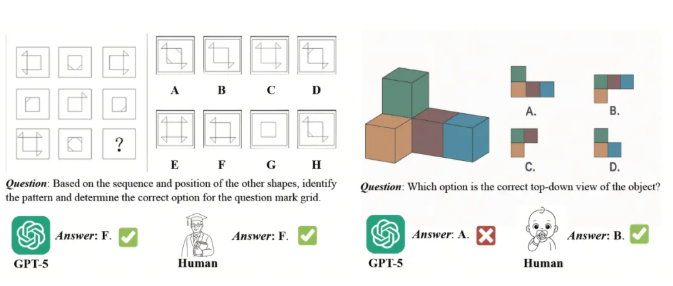
While current AI models excel at language tasks and logical reasoning, they've consistently struggled with spatial understanding - that crucial ability to comprehend and navigate three-dimensional environments. "We recognized this as a fundamental limitation," explains Dr. Li Wei, SenseTime's lead researcher on the project. "True embodied intelligence needs to understand space as humans do."

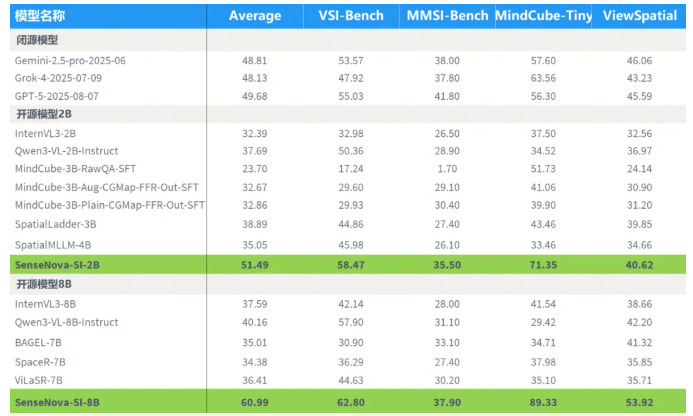
The solution? A systematic training approach leveraging massive datasets specifically designed to enhance spatial cognition. The results speak for themselves: the flagship SenseNova-SI-8B model achieved an impressive 60.99 average score on spatial intelligence benchmarks, outperforming both open-source competitors like Qwen3-VL-8B and proprietary systems including OpenAI's GPT-5.
Image

More Than Just Numbers

What makes this breakthrough particularly noteworthy isn't just the superior performance metrics - it's how SenseTime achieved them. Their methodology focuses on six core aspects of spatial intelligence:

  • Measurement: Precise distance and size estimation
  • Reconstruction: Building mental models of environments
  • Relationships: Understanding how objects interact spatially
  • Perspective: Interpreting scenes from different viewpoints
  • Deformation: Recognizing altered or distorted spaces
  • Reasoning: Drawing logical conclusions about spatial arrangements

The implications extend far beyond academic benchmarks. Autonomous vehicles could navigate complex urban environments more safely. Robotics systems might manipulate objects with human-like precision. Even augmented reality applications could see dramatic improvements.

Setting New Standards

Alongside the model release, SenseTime introduced EASI (Evolutionary Assessment for Spatial Intelligence), an open evaluation platform designed to establish consistent metrics for measuring spatial understanding in AI systems.

The company has made both their models and evaluation tools publicly available through GitHub (https://github.com/EvolvingLMMs-Lab/EASI), signaling a commitment to advancing the field collectively rather than through proprietary silos.

The rapid progress suggests we may be approaching a tipping point where AI systems can understand and interact with physical spaces nearly as well as they process language - potentially opening doors to applications we've only begun to imagine.

Enjoyed this article?

Subscribe to our newsletter for the latest AI news, product reviews, and project recommendations delivered to your inbox weekly.

Weekly digestFree foreverUnsubscribe anytime

Related Articles

News

Claude AI Spots 100 Firefox Flaws in Record Time

In a cybersecurity breakthrough, Mozilla partnered with Anthropic's Claude AI to uncover over 100 Firefox vulnerabilities within two weeks. The AI detected 14 critical security risks along with numerous lesser issues, demonstrating superior efficiency compared to traditional testing methods. These findings have already been patched in Firefox's latest update.

March 9, 2026
CybersecurityAI InnovationBrowser Safety
Microsoft Unveils Phi-4: A Nimble AI That Sees and Thinks Like Humans
News

Microsoft Unveils Phi-4: A Nimble AI That Sees and Thinks Like Humans

Microsoft has introduced Phi-4-Reasoning-Vision-15B, a groundbreaking open-source AI model that combines visual perception with deep reasoning capabilities. Unlike traditional models, Phi-4 actively analyzes images while understanding context, enabling developers to create smarter applications from data analysis to UI automation. Its unique dual-mode operation switches between rapid response and thoughtful analysis as needed.

March 5, 2026
Microsoft AIComputer VisionMultimodal Models
Smartphones Become AI Data Collectors with Ant Digital's Neck-Mounted Hack
News

Smartphones Become AI Data Collectors with Ant Digital's Neck-Mounted Hack

Ant Digital's Tianji Lab has turned everyday smartphones into powerful data collectors for AI training. Their innovative neck-mounted bracket system captures first-person video at a fraction of traditional costs, solving one of embodied intelligence's biggest challenges. Early tests show dramatic improvements - robot task success rates jumped from 45% to 95% when supplemented with this new data source.

March 3, 2026
Embodied IntelligenceAI TrainingComputer Vision
Sakana AI's Tiny Plugin Could Revolutionize How AI Handles Massive Documents
News

Sakana AI's Tiny Plugin Could Revolutionize How AI Handles Massive Documents

Tokyo-based Sakana AI has unveiled groundbreaking technologies that could solve large language models' notorious 'memory anxiety.' Their Text-to-LoRA and Doc-to-LoRA systems enable AI to digest lengthy documents in under a second, shrinking memory requirements from gigabytes to mere megabytes. This breakthrough promises to make customizing AI models dramatically cheaper and more accessible.

February 28, 2026
AI InnovationMachine LearningNatural Language Processing
News

Anthropic Gives Claude Vision with Vercept Acquisition

AI startup Anthropic has acquired computer vision company Vercept, equipping its Claude AI with advanced visual understanding capabilities. The deal brings cutting-edge UI recognition technology that outperforms competitors, marking a major step toward creating AI assistants that can truly navigate digital environments like humans. With this move, Anthropic solidifies its position as a leader in the race to develop practical AI agents.

February 27, 2026
Artificial IntelligenceComputer VisionTech Acquisitions
Google's Gemini 3.1 Pro Outshines Competitors With Breakthrough Reasoning Skills
News

Google's Gemini 3.1 Pro Outshines Competitors With Breakthrough Reasoning Skills

Google has unveiled Gemini 3.1 Pro, its most advanced AI model yet, showcasing remarkable improvements in logical reasoning and problem-solving. The new architecture delivers more than double the performance of its predecessor in critical tests, even surpassing GPT-5.2 in some benchmarks. Beyond raw power, Gemini 3.1 Pro introduces innovative multimodal capabilities, handling ultra-long contexts and generating visual representations of complex concepts.

February 24, 2026
AI InnovationGoogle TechMachine Learning