
Google's Gemini 3.1 Pro Outshines Competitors With Breakthrough Reasoning Skills

Google Raises the Bar With Gemini 3.1 Pro AI Model

In what could be a game-changer for artificial intelligence, Google has introduced Gemini 3.1 Pro, showcasing dramatic improvements that leave competitors scrambling to catch up. This isn't just another incremental update - it represents a fundamental shift in how AI approaches complex reasoning tasks.
Image

The tech giant broke from tradition with its version numbering system, signaling something special with the ".1" designation rather than sticking to its usual half-step increments. This change reflects substantial architectural improvements under the hood.

Benchmark-Busting Performance

When put through rigorous testing, Gemini 3.1 Pro delivered jaw-dropping results:

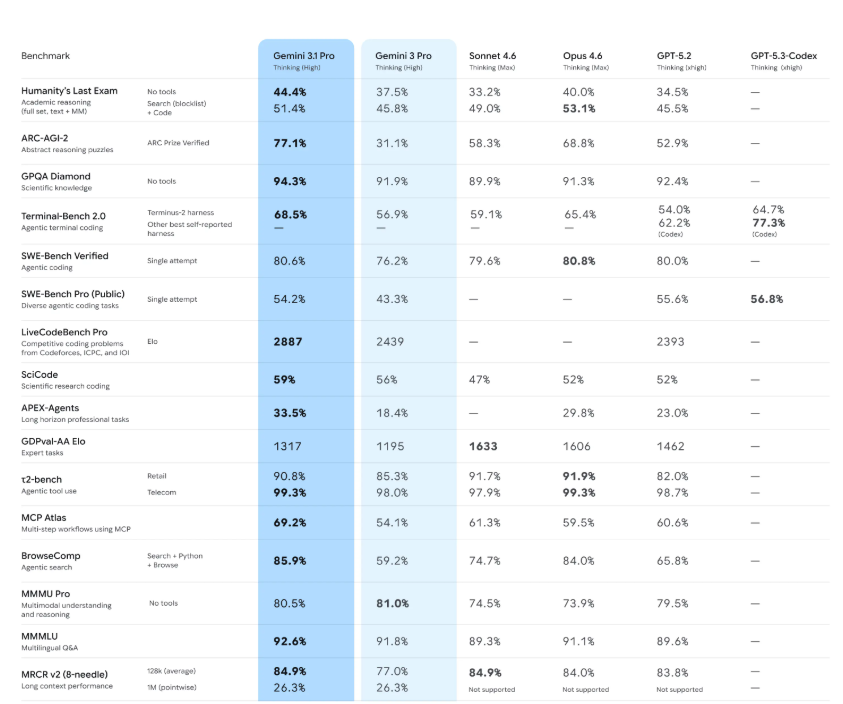
  • 77.1% score on the challenging ARC-AGI-2 test - more than double its predecessor's performance
  • 44.4% accuracy on the notoriously difficult HLE assessment (often called "humanity's final exam")
  • Clear superiority over rival models GPT-5.2 and Claude Opus 4.6 in multiple categories

What makes these numbers particularly impressive? They demonstrate genuine progress toward artificial general intelligence (AGI), moving beyond simple pattern recognition to actual reasoning ability.

More Than Just Brainpower

The model's capabilities extend far beyond test scores:

  • Processes up to 1 million Tokens of context - enough for entire books or lengthy technical documents
  • Converts abstract concepts into interactive charts and SVG animations automatically
  • Seamlessly integrates with Google's ecosystem including Gemini app and NotebookLM Developers itching to experiment can access it through Google AI Studio today.

The breakthrough comes from what Google calls its "Core Intelligence" architecture, specifically designed to enhance logical thinking and problem-solving abilities rather than just expanding knowledge bases.

What This Means For Users

The implications ripple across industries:

  • Researchers gain powerful tools for analyzing complex data sets visually
  • Content creators can transform dense information into digestible formats effortlessly
  • Businesses obtain smarter assistants capable of nuanced understanding Perhaps most exciting? We're seeing real progress toward AI that doesn't just recall information but actually thinks through problems.

Key Points:

  • 🚀 Reasoning leap: More than doubles previous model's performance in critical tests
  • 🧠 New architecture: Core Intelligence design focuses on genuine problem-solving
  • 📊 Multimodal mastery: Handles massive contexts while generating visual outputs

Enjoyed this article?

Subscribe to our newsletter for the latest AI news, product reviews, and project recommendations delivered to your inbox weekly.

Weekly digestFree foreverUnsubscribe anytime

Related Articles

Meituan CEO Unveils AI Vision: Digitizing the Real World
News

Meituan CEO Unveils AI Vision: Digitizing the Real World

At Meituan's annual management meeting, CEO Wang Xing outlined an ambitious AI strategy that could redefine how businesses operate. Comparing AI's transformative potential to the leap from 'monkeys to flowers,' Wang emphasized digitizing physical-world data as crucial infrastructure. The company has already launched 'Wen Xiao Tuan,' an AI search tool leveraging its local services database, signaling a shift toward practical AI applications that bridge digital and physical realms.

March 13, 2026
AI InnovationDigital TransformationLocal Services Tech
Xie Saining's Team Unveils Solaris: A Breakthrough in Multi-User Video AI
News

Xie Saining's Team Unveils Solaris: A Breakthrough in Multi-User Video AI

Xie Saining's research team has launched Solaris, the world's first multi-user video world model, powered by Kunlun Wanzhi's Matrix-Game2.0. This innovative technology enhances player interaction in environments like Minecraft, outperforming previous solutions. The release coincides with a major funding milestone for Xie's AI company, AMI, highlighting the growing importance of world models in advancing artificial general intelligence.

March 11, 2026
AIMachine LearningVirtual Worlds
News

AI Pioneer Yann LeCun Secures $1 Billion for His Next Big Bet

Yann LeCun, the Turing Award-winning AI researcher, has raised over $1 billion for his new venture Advanced Machine Intelligence. The startup aims to move beyond today's language models by developing systems that can truly reason and understand the physical world. With backing from major investors, LeCun's company could reshape industries from robotics to healthcare.

March 10, 2026
Artificial IntelligenceTech StartupsMachine Learning
OpenClaw's Game-Changing Update: GPT-5.4 Support and Smarter AI Agents
News

OpenClaw's Game-Changing Update: GPT-5.4 Support and Smarter AI Agents

The open-source AI project OpenClaw just dropped its biggest update yet, bringing native GPT-5.4 support that outperforms competitors like Claude Code. The 2026.3.7 version introduces revolutionary 'memory hot-swapping' technology, solving long-standing fragmentation issues in smart agents. From coding to stock analysis, this update transforms OpenClaw from a developer's toy into a true virtual employee that never stops working.

March 9, 2026
AI DevelopmentOpenClawGPT-5
News

Mac Mini's Hidden Power: How Engineers Unlocked AI Training on Apple's M4 Chip

In a surprising breakthrough, engineers have cracked open Apple's Neural Engine capabilities, revealing that Mac Minis can do far more than just run apps. By reverse-engineering the M4 chip with Claude AI's help, researchers discovered these compact machines can efficiently train AI models - challenging the need for expensive GPU setups. The findings show energy efficiency up to 80 times better than professional-grade hardware, potentially democratizing AI development.

March 9, 2026
Apple SiliconAI HardwareMachine Learning
News

Claude AI Spots 100 Firefox Flaws in Record Time

In a cybersecurity breakthrough, Mozilla partnered with Anthropic's Claude AI to uncover over 100 Firefox vulnerabilities within two weeks. The AI detected 14 critical security risks along with numerous lesser issues, demonstrating superior efficiency compared to traditional testing methods. These findings have already been patched in Firefox's latest update.

March 9, 2026
CybersecurityAI InnovationBrowser Safety