
Sakana AI's Tiny Plugin Could Revolutionize How AI Handles Massive Documents

Sakana AI Cracks the Code on AI Memory Limitations
Image

Imagine feeding War and Peace to an AI model in less time than it takes to sneeze. That's essentially what Sakana AI's new technology achieves. The Tokyo startup's breakthrough could finally solve one of artificial intelligence's most persistent headaches: how to handle massive documents without breaking the bank or slowing to a crawl.

The Memory Dilemma Solved

For years, developers faced an impossible choice when working with large documents:

  • Option A: Jam everything into the chat window and watch response times plummet while memory usage soars
  • Option B: Spend thousands fine-tuning specialized models for each new task

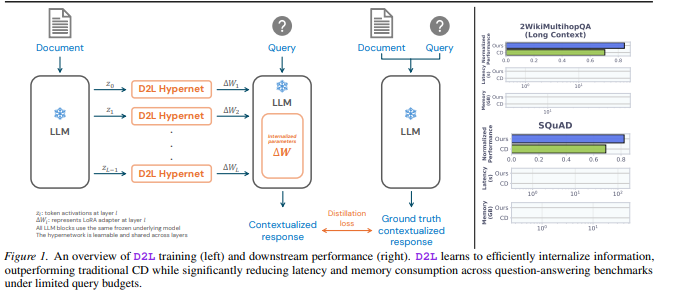
Sakana's solution? A clever pre-training approach that generates ultra-lightweight plugins called LoRAs (Low-Rank Adaptations). These tiny add-ons - some smaller than your average smartphone photo - give existing models new capabilities without expensive retraining.

Doc-to-LoRA: Shrinking Gigabytes to Megabytes

The star of Sakana's show is Doc-to-LoRA (D2L), which performs what can only be described as digital alchemy:

  • Memory Miracle: Processes a 100,000-word document using just 50MB of VRAM instead of the usual 12GB+
  • Speed Demon: Completes in under a second what traditionally took nearly two minutes
  • Capacity Boost: Handles texts four times longer than standard model limits while maintaining impressive accuracy

"It's like giving your model photographic memory," explains one researcher familiar with the technology. "Except instead of remembering everything verbatim, it extracts and stores only the most useful patterns."

Text-to-LoRA: Plain English Power-Ups

The companion Text-to-LoRA (T2L) system lets users customize AI behavior using everyday language. Want your model better at math competitions? Just tell it "help me solve complex math problems" and T2L generates a specialized performance booster.

Surprisingly, these automatically generated plugins sometimes outperform purpose-built models. In testing, T2L-enhanced systems solved logic puzzles more accurately than dedicated math AIs.

Unexpected Bonus: Teaching Text Models to 'See'

Perhaps most astonishing is D2L's accidental superpower - cross-modal learning. Researchers discovered they could trick pure text models into recognizing images by mapping visual data into LoRA parameters. The result? A language model that had never seen pictures before suddenly classified images with 75% accuracy.

This happy accident suggests LoRA technology might bridge gaps between different types of AI systems, potentially paving the way for more versatile artificial intelligence.

The implications are profound:

  • Small businesses could afford customized AI assistants
  • Researchers could rapidly prototype specialized models
  • Consumers might someday personalize their chatbots as easily as installing smartphone apps

The era where only tech giants could afford tailored AI may be ending.

Enjoyed this article?

Subscribe to our newsletter for the latest AI news, product reviews, and project recommendations delivered to your inbox weekly.

Weekly digestFree foreverUnsubscribe anytime

Related Articles

News

Chinese AI Models Gain Global Edge as Usage Surges Past US Competitors

China's AI models have outpaced their US counterparts in weekly usage, marking a significant shift in the global AI landscape. Leading Chinese models MiniMax M2.5, Stephen Star Step3.5Flash, and DeepSeek V3.2 dominate the rankings, while newcomer Hunter Alpha makes an impressive debut with specialized agent capabilities.

March 16, 2026
AI TrendsChinese TechLanguage Models
Zhipu's GLM-5-Turbo Takes AI Agents to New Heights
News

Zhipu's GLM-5-Turbo Takes AI Agents to New Heights

Chinese AI firm Zhipu has unveiled GLM-5-Turbo, a groundbreaking model specifically designed for complex Agent scenarios. Unlike generic large models that stumble with lengthy tasks, this new release shines in tool calling, instruction processing, and continuous execution. Already topping domestic benchmarks with a 90% developer approval rating, it's now powering the innovative OpenClaw Box terminal while offering enterprise-grade security features.

March 16, 2026
AI AgentsZhipuAIGLM-5-Turbo
News

Meta Hits Pause on Llama4 Launch as Engineers Fine-Tune AI Model

Meta has pushed back the release of its next-generation Llama4 AI model to May, citing the need for additional technical refinements. While CEO Mark Zuckerberg remains bullish on the project, developers are wrestling with performance optimization and logical reasoning challenges. The delay highlights the growing complexity of cutting-edge AI development, though Meta promises the extra time will yield a more robust open-source offering. The company continues expanding its computing infrastructure to support what could be a game-changing release in the competitive AI landscape.

March 13, 2026
MetaLlama4AI Development
Xie Saining's Team Unveils Solaris: A Breakthrough in Multi-User Video AI
News

Xie Saining's Team Unveils Solaris: A Breakthrough in Multi-User Video AI

Xie Saining's research team has launched Solaris, the world's first multi-user video world model, powered by Kunlun Wanzhi's Matrix-Game2.0. This innovative technology enhances player interaction in environments like Minecraft, outperforming previous solutions. The release coincides with a major funding milestone for Xie's AI company, AMI, highlighting the growing importance of world models in advancing artificial general intelligence.

March 11, 2026
AIMachine LearningVirtual Worlds
News

AI Pioneer Yann LeCun Secures $1 Billion for His Next Big Bet

Yann LeCun, the Turing Award-winning AI researcher, has raised over $1 billion for his new venture Advanced Machine Intelligence. The startup aims to move beyond today's language models by developing systems that can truly reason and understand the physical world. With backing from major investors, LeCun's company could reshape industries from robotics to healthcare.

March 10, 2026
Artificial IntelligenceTech StartupsMachine Learning
OpenClaw's Game-Changing Update: GPT-5.4 Support and Smarter AI Agents
News

OpenClaw's Game-Changing Update: GPT-5.4 Support and Smarter AI Agents

The open-source AI project OpenClaw just dropped its biggest update yet, bringing native GPT-5.4 support that outperforms competitors like Claude Code. The 2026.3.7 version introduces revolutionary 'memory hot-swapping' technology, solving long-standing fragmentation issues in smart agents. From coding to stock analysis, this update transforms OpenClaw from a developer's toy into a true virtual employee that never stops working.

March 9, 2026
AI DevelopmentOpenClawGPT-5