
NVIDIA Open-Sources OmniVinci Multimodal AI Model

NVIDIA Breaks New Ground with Efficient Multimodal AI

NVIDIA Research has open-sourced its advanced OmniVinci multimodal understanding model, marking a significant leap in artificial intelligence capabilities. The model demonstrates remarkable efficiency, requiring only 0.2 trillion training tokens compared to competitors' 1.2 trillion while outperforming them by 19.05 points in benchmark tests.

Revolutionizing Multimodal Understanding

The core innovation of OmniVinci lies in its ability to simultaneously process and interpret visual, audio, and text information. This breakthrough mimics human sensory integration, enabling machines to develop more comprehensive environmental understanding.
Image

"OmniVinci represents a paradigm shift," explained Dr. Liang Zhao, lead researcher on the project. "Rather than brute-forcing performance through massive datasets, we've developed novel architectural approaches that maximize learning efficiency."

Architectural Breakthroughs

The model employs several groundbreaking technologies:

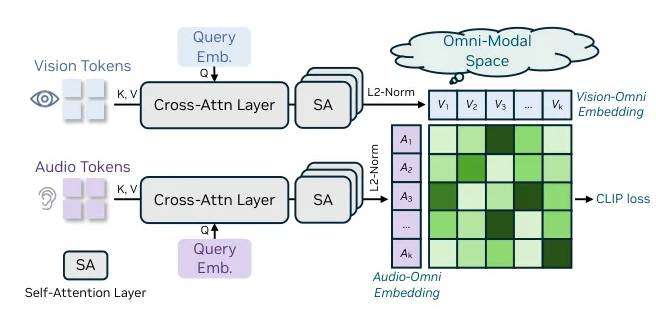
  • OmniAlignNet: Specialized module aligning visual and audio data streams
  • Temporal embedding grouping: Enhances sequential data processing
  • Constrained rotational temporal embedding: Improves time-series comprehension

These components work synergistically within a unified latent space framework, allowing seamless information exchange between modalities before feeding into NVIDIA's large language model backbone.

Two-Stage Training Approach

The research team implemented an innovative training regimen:

  1. Modality-specific pre-training: Individual optimization of visual, audio, and text processing pathways
  2. Full-modal joint training: Integrated learning that reinforces cross-modal associations

This methodology yielded surprising efficiency gains while maintaining exceptional accuracy across all tested benchmarks.

Implications for Future AI Development

The open-sourcing of OmniVinci signals NVIDIA's commitment to advancing foundational AI research while providing practical tools for developers worldwide. Industry analysts predict this technology will accelerate progress in:

  • Autonomous systems
  • Accessibility technologies
  • Content moderation solutions
  • Advanced human-computer interfaces

The GitHub repository (github.com/NVlabs/OmniVinci) has already attracted significant attention from the research community.

Key Points:

🌟 19.05-point benchmark advantage over current top models
📊 Sixfold data efficiency (0.2T vs 1.2T tokens)
🔑 Innovative architecture enables superior multimodal integration
🌐 Open-source availability accelerates industry adoption

Enjoyed this article?

Subscribe to our newsletter for the latest AI news, product reviews, and project recommendations delivered to your inbox weekly.

Weekly digestFree foreverUnsubscribe anytime

Related Articles

Moonlight AI's Kiwi-do Model Stuns With Visual Physics Prowess
News

Moonlight AI's Kiwi-do Model Stuns With Visual Physics Prowess

Moonshot AI's mysterious new 'Kiwi-do' model has emerged as a potential game-changer in multimodal AI. Showing remarkable capabilities in visual physics comprehension, this freshly spotted model appears ahead of Moonshot's planned K2 series release. Early tests suggest Kiwi-do could revolutionize how AI interprets complex visual data.

January 5, 2026
multimodal-AIcomputer-visionMoonshot-AI
vLLM-Omni Bridges AI Modalities in One Powerful Framework
News

vLLM-Omni Bridges AI Modalities in One Powerful Framework

The vLLM team has unveiled vLLM-Omni, a groundbreaking framework that seamlessly combines text, image, audio, and video generation capabilities. This innovative solution treats different AI modalities as independent microservices, allowing flexible scaling across GPUs. Early benchmarks show significant performance gains over traditional approaches, potentially revolutionizing how developers build multimodal applications.

December 2, 2025
multimodal-AIvLLMdiffusion-models
GPT-5.1 Upgrade Delivers Faster Responses and Lower Costs
News

GPT-5.1 Upgrade Delivers Faster Responses and Lower Costs

OpenAI's latest GPT-5.1 update brings smart speed adjustments and cost-saving features that developers are cheering about. The new 'adaptive reasoning' mode tailors response times to question complexity, while prompt caching cuts repetitive processing costs. Industry experts praise the improvements in AI integration and interaction quality.

November 14, 2025
GPT-5.1AI-developmentprogramming-tools
ByteDance's InfinityStar Cuts Video Creation Time Dramatically
News

ByteDance's InfinityStar Cuts Video Creation Time Dramatically

ByteDance has unveiled its InfinityStar framework, slashing video generation time to just 58 seconds for a 5-second clip. This breakthrough doesn't just speed things up - it rethinks how AI handles visual data altogether. By separating spatial and temporal elements in videos, InfinityStar delivers sharper results while using fewer computing resources.

November 11, 2025
video-generationAI-efficiencyByteDance
Meituan LongCat Unveils UNO-Bench for Multimodal AI Evaluation
News

Meituan LongCat Unveils UNO-Bench for Multimodal AI Evaluation

Meituan's LongCat team has launched UNO-Bench, a comprehensive benchmark for evaluating multimodal large language models. The tool features 44 task types across five modality combinations, with a dataset of 1,250 full-modal samples showing 98% cross-modal solvability. The benchmark introduces innovative evaluation methods and focuses initially on Chinese-language applications.

November 6, 2025
AI-evaluationmultimodal-AIMeituan-LongCat
LongCat-Flash-Omni Launches with Multimodal Breakthroughs
News

LongCat-Flash-Omni Launches with Multimodal Breakthroughs

Meituan's LongCat team has released LongCat-Flash-Omni, a cutting-edge multimodal AI model featuring 560B parameters and real-time audio-video interaction capabilities. The model achieves state-of-the-art performance across text, image, and speech tasks while maintaining low latency through innovative ScMoE architecture.

November 3, 2025
multimodal-AIreal-time-interactionScMoE