
Meta AI Launches MobileLLM-R1: A Lightweight Edge AI Model

Meta AI Introduces MobileLLM-R1 for Edge Inference

Meta AI has unveiled MobileLLM-R1, a new series of lightweight edge inference models now available on Hugging Face. These models, with parameters ranging from 140 million to 950 million, are optimized for efficient mathematical, coding, and scientific reasoning tasks while maintaining high performance with fewer than 1 billion parameters.
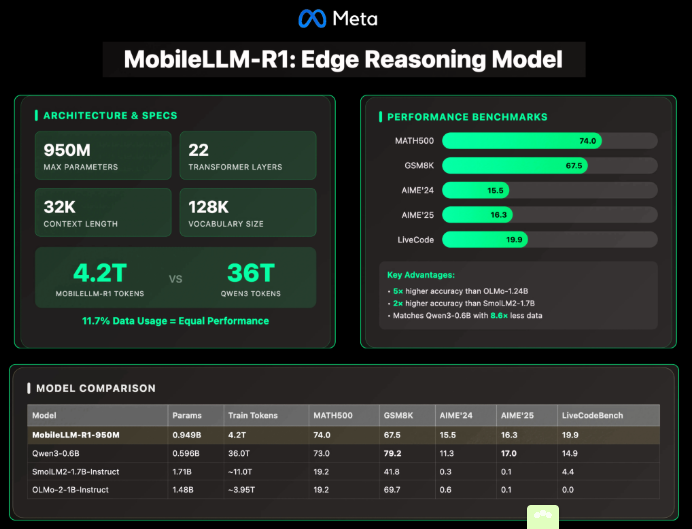
Image

Architectural Innovations

The flagship model in the series, MobileLLM-R1-950M, incorporates several architectural optimizations:

  • 22-layer Transformer structure with 24 attention heads and 6 grouped KV heads
  • Embedding dimension of 1536 and hidden layer dimension of 6144
  • Grouped query attention (GQA) to reduce computational and memory demands
  • Block-level weight sharing to minimize parameters without increasing latency
  • SwiGLU activation function to enhance small model representation

The model supports a 4K context length, with a post-training extension to 32K.

Training Efficiency Breakthrough

MobileLLM-R1 demonstrates remarkable training efficiency:

  • Trained on approximately 4.2 trillion tokens
  • Uses only 11.7% of the data compared to Qwen3's 0.6B model (trained on 36 trillion tokens)
  • Achieves comparable or superior accuracy to Qwen3 despite reduced training data

The model was fine-tuned on supervised datasets for mathematical, coding, and reasoning tasks, significantly lowering both training costs and resource requirements.

Benchmark Performance

In comprehensive testing, MobileLLM-R1-950M showed exceptional results:

  • On the MATH500 dataset:
    • ~5x more accurate than OLMo-1.24B
    • ~2x more accurate than SmolLM2-1.7B
  • Matched or surpassed Qwen3-0.6B on:
    • GSM8K (reasoning)
    • AIME (mathematics)
    • LiveCodeBench (coding)

These achievements are particularly notable given the model's significantly smaller token consumption compared to its competitors.

Limitations and Considerations

The specialized focus of MobileLLM-R1 comes with certain trade-offs:

  • Performance lags behind larger models in:
    • General conversation
    • Common-sense reasoning
    • Creative tasks
  • Usage is restricted by Meta's FAIR NC (non-commercial) license for production environments
  • The extended 32K context increases key-value cache and memory demands during inference

Industry Implications

The introduction of MobileLLM-R1 signals a growing trend toward smaller, specialized models that can deliver competitive reasoning capabilities without requiring massive training budgets. These models set new standards for deploying large language models on edge devices, particularly in mathematical, coding, and scientific applications.

The project is available at: https://huggingface.co/facebook/MobileLLM-R1-950M

Key Points:

New Model Release: Meta AI's MobileLLM-R1 series offers lightweight edge inference with parameters from 140M to 950M. ✅ Training Efficiency: Achieves superior performance using just ~11.7% of typical training data. ✅ Performance Gains: Outperforms larger open-source models in mathematical and coding benchmarks.

Enjoyed this article?

Subscribe to our newsletter for the latest AI news, product reviews, and project recommendations delivered to your inbox weekly.

Weekly digestFree foreverUnsubscribe anytime

Related Articles

Liquid AI's Tiny Powerhouses Bring Big AI to Small Devices
News

Liquid AI's Tiny Powerhouses Bring Big AI to Small Devices

Liquid AI has unveiled its LFM2.5 series - compact yet powerful AI models designed specifically for edge devices. These pint-sized performers pack surprising capabilities, from multilingual text processing to vision and audio understanding, all while running efficiently on local hardware. The open-source models already outperform competitors in benchmark tests, signaling a shift toward more accessible on-device AI.

January 7, 2026
EdgeAISmallLanguageModelsOnDeviceAI
StepStellar's New AI Research Model Delivers Top Performance at Fraction of Cost
News

StepStellar's New AI Research Model Delivers Top Performance at Fraction of Cost

StepStellar has unveiled Step-DeepResearch, a groundbreaking AI model that rivals premium commercial offerings while costing just 10% as much. With 32 billion parameters, this open-source solution excels at autonomous research and report generation through its innovative 'atomic capabilities' approach. Early tests show it outperforming many competitors despite its leaner architecture.

December 29, 2025
AIResearchCostEffectiveTechOpenSourceAI
Meta's Pixio Rewrites the Rules: Simple Approach Beats Complex AI in 3D Vision
News

Meta's Pixio Rewrites the Rules: Simple Approach Beats Complex AI in 3D Vision

Meta AI's new Pixio model proves simplicity can outperform complexity in computer vision. By enhancing an older masking technique and training on diverse web images, Pixio achieves better 3D reconstruction than larger models—all while avoiding benchmark 'cheating.' The breakthrough suggests we might have overcomplicated visual AI.

December 29, 2025
ComputerVisionMetaAI3DReconstruction
Mianbi Intelligence Secures Major Funding Boost for Edge AI Expansion
News

Mianbi Intelligence Secures Major Funding Boost for Edge AI Expansion

Chinese AI firm Mianbi Intelligence has raised hundreds of millions in new funding to accelerate development of its edge-based large language models. The company's technology is already powering smart cockpits in vehicles from Geely, Changan, and Volkswagen, offering offline AI capabilities that prioritize speed and privacy.

December 24, 2025
EdgeAIAutomotiveTechAIFunding
Google's Gemini 3 Flash: Faster, Cheaper, and Surprisingly Smarter
News

Google's Gemini 3 Flash: Faster, Cheaper, and Surprisingly Smarter

Google has unveiled Gemini 3 Flash, a lightweight AI model that's turning heads with its performance and affordability. Clocking in at three times the speed of its predecessor while slashing costs by up to 80%, this model isn't just about efficiency—it's outperforming Google's own premium offering in coding tasks. With innovative features like adjustable 'thinking levels,' developers can now balance speed against depth of analysis. This release marks a significant step toward making powerful AI tools accessible for everyday use.

December 18, 2025
AIGoogleMachineLearning
Google Colab and KaggleHub Team Up to Simplify Data Science Workflows
News

Google Colab and KaggleHub Team Up to Simplify Data Science Workflows

Google has rolled out a game-changing integration between Colab and KaggleHub, making it easier than ever for data scientists to access resources. Now with just a click, users can search datasets, models, and competitions directly within Colab notebooks—no more jumping between platforms or wrestling with API credentials. This streamlined approach removes common pain points for beginners while saving time for experienced practitioners.

December 8, 2025
DataScienceGoogleColabKaggle