
Liquid AI's Tiny Powerhouses Bring Big AI to Small Devices

Liquid AI's Compact AI Models Make Big Waves

In an era where bigger often means better in artificial intelligence, Liquid AI is taking a different approach. Their newly released LFM2.5 family proves that good things do come in small packages - especially when it comes to edge computing.

Small Models, Big Ambitions

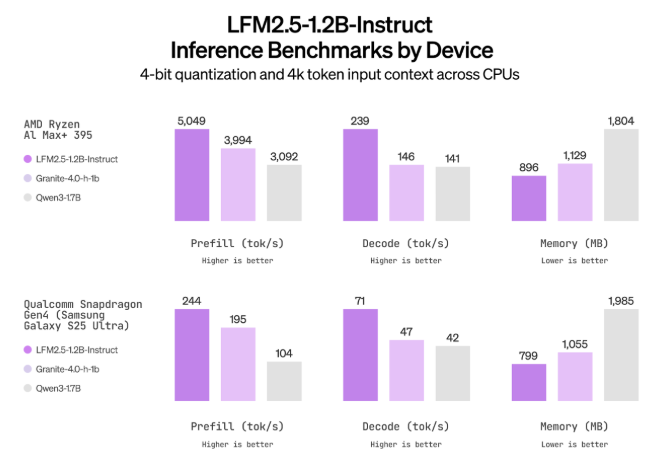
The LFM2.5 series builds on the company's existing LFM2 architecture but brings significant upgrades under the hood. What makes these models special? They're specifically engineered to run efficiently on everyday devices rather than requiring massive cloud servers.
Image

"We're seeing tremendous demand for capable AI that can operate locally," explains Dr. Sarah Chen, Liquid AI's lead researcher. "Whether it's privacy concerns or the need for real-time responsiveness, there are compelling reasons to bring intelligence directly to devices."

Technical Breakthroughs

The numbers tell an impressive story:

  • Training data nearly tripled from 10 trillion to 28 trillion tokens
  • Parameters expanded to 120 million
  • Includes specialized variants for Japanese, vision-language, and audio-language tasks

The models underwent rigorous fine-tuning through supervised learning and multi-stage reinforcement training. This focused approach helps them excel at specific challenges like mathematical reasoning and tool usage.

Benchmark Dominance

When put through their paces:

  • The general-purpose LFM2.5-1.2B-Instruct scored 38.89 on GPQA and 44.35 on MMLU Pro tests
  • Outperformed comparable models like Llama-3.2-1B Instruct by significant margins
  • Japanese-specific version shows particular strength in local language tasks

The vision-language model (LFM2.5-VL-1.6B) brings image understanding capabilities ideal for document analysis and interface reading - think smarter scanning apps or accessibility tools.

Meanwhile, the audio model (LFM2.5-Audio-1.5B) processes speech eight times faster than previous solutions, opening doors for real-time voice applications without cloud dependency.

Why This Matters

The tech industry is waking up to the limitations of cloud-only AI solutions: 1️⃣ Privacy: Keeping sensitive data local 2️⃣ Reliability: Functioning without internet connections 3️⃣ Responsiveness: Eliminating network latency 4️⃣ Cost: Reducing expensive cloud computing needs

With these open-source models now available on Hugging Face and showcased on Liquid's LEAP platform, developers worldwide can start experimenting with powerful edge AI solutions today.

Key Points:

  • Compact powerhouses: The LFM2.5 series delivers impressive performance in small packages optimized for edge devices.
  • Multimodal mastery: From text processing to image and audio understanding - all running efficiently locally.
  • Open access: Available as open-source weights encouraging widespread adoption and innovation.

Enjoyed this article?

Subscribe to our newsletter for the latest AI news, product reviews, and project recommendations delivered to your inbox weekly.

Weekly digestFree foreverUnsubscribe anytime

Related Articles

Mianbi Intelligence Secures Major Funding Boost for Edge AI Expansion
News

Mianbi Intelligence Secures Major Funding Boost for Edge AI Expansion

Chinese AI firm Mianbi Intelligence has raised hundreds of millions in new funding to accelerate development of its edge-based large language models. The company's technology is already powering smart cockpits in vehicles from Geely, Changan, and Volkswagen, offering offline AI capabilities that prioritize speed and privacy.

December 24, 2025
EdgeAIAutomotiveTechAIFunding
IBM Unveils Granite4.0Nano Series for Edge AI
News

IBM Unveils Granite4.0Nano Series for Edge AI

IBM has launched the Granite4.0Nano series, a collection of eight compact open-source AI models optimized for edge computing. These models, available in 350M and 1B parameter sizes, feature hybrid SSM and transformer architectures and are trained on over 15 trillion tokens. Released under Apache2.0 license, they offer enterprise-grade governance and support multiple runtime environments.

October 30, 2025
EdgeAIIBMResearchOpenSourceAI
Liquid AI's LFM2-8B-A1B Boosts Mobile AI Efficiency
News

Liquid AI's LFM2-8B-A1B Boosts Mobile AI Efficiency

Liquid AI launches LFM2-8B-A1B, an 8.3B parameter Mixture-of-Experts model with only 1.5B activated per token. Designed for edge devices, it achieves 3-4B-level performance while reducing computational load. The model supports multilingual processing and delivers 5x faster decoding on mobile hardware.

October 11, 2025
EdgeAIMixtureOfExpertsMobileAI
News

AI21 Unveils Open-Source Mini Language Model Jamba Reasoning3B

AI21 Labs has launched Jamba Reasoning3B, an open-source mini language model optimized for edge AI applications. Built on a hybrid state space model-transformer architecture, it offers efficient processing with a 256K token context window while running on devices like smartphones and PCs. The model outperforms larger LLMs in benchmarks and targets enterprise use cases like customer service.

October 9, 2025
AI21LabsEdgeAILanguageModels
News

OpenAI Partners with Luxshare Precision for Edge AI Devices

OpenAI has formed a strategic partnership with Chinese hardware manufacturer Luxshare Precision to develop edge AI products, including smart glasses and wearable devices. The collaboration aims to leverage Luxshare's manufacturing expertise and OpenAI's AI capabilities, with the first devices expected by late 2026. Industry analysts predict significant growth in the smart glasses market, driven by advancements in lightweight design and interaction technologies.

September 22, 2025
OpenAIEdgeAISmartGlasses
Meta AI Launches MobileLLM-R1: A Lightweight Edge AI Model
News

Meta AI Launches MobileLLM-R1: A Lightweight Edge AI Model

Meta AI has introduced MobileLLM-R1, a series of lightweight edge inference models with parameters ranging from 140M to 950M. Designed for efficiency in mathematical, coding, and scientific reasoning, these models achieve competitive performance while reducing training costs and resource requirements. The largest model, MobileLLM-R1-950M, outperforms larger models in benchmark tests despite using significantly fewer tokens.

September 16, 2025
MetaAIEdgeAILightweightModels