
Maya1 Brings Human-Like Emotion to Open-Source Speech Synthesis

Maya1: The Open-Source Speech Model That Feels Human

Imagine asking your virtual assistant to read tomorrow's weather forecast—not in that familiar robotic monotone, but with the cheerful lilt of a British twenty-something or the dramatic gravitas of a Shakespearean actor. This vision comes closer to reality with Maya1, Maya Research's new open-source text-to-speech model that blends technical sophistication with startling emotional range.
Image

How It Works: More Than Just Words

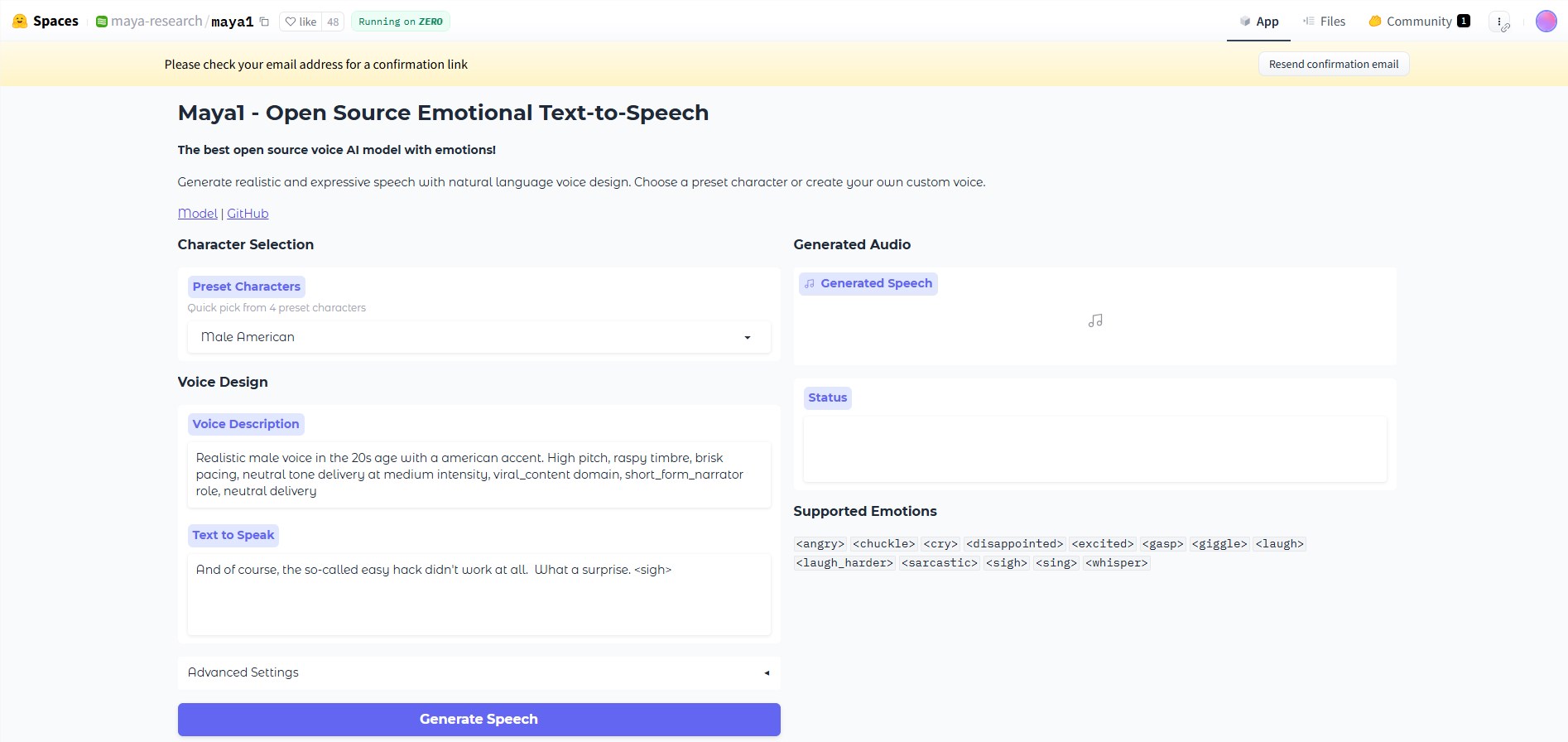
The magic happens through two simple inputs: the text you want spoken and natural language descriptions of how it should sound. Want "a demon character, male voice, low pitch, hoarse tone" reading your horror story? Done. Need an upbeat podcast narrator? Just say "energetic female voice with clear pronunciation."

What sets Maya1 apart are its emotional tags—users can insert cues like ,, or `` directly into the text. With over twenty emotions available, these subtle touches transform synthetic speech into something remarkably lifelike.

Technical Muscle Meets Practical Accessibility

Under the hood lies a decoder-only transformer architecture similar to Llama models. But instead of predicting raw waveforms—a computationally expensive process—Maya1 uses SNAC neural audio encoding for efficient processing. This clever approach enables real-time streaming at 24kHz quality on surprisingly modest hardware.

"We've optimized Maya1 to run smoothly on GPUs with just 16GB of memory," explains the development team. While professional setups might use A100 or RTX4090 cards, this lowers barriers for indie game developers and small studios exploring expressive voice synthesis.

The model trained first on vast internet speech datasets before refining its skills on proprietary recordings annotated with precise vocal descriptions and emotions. This two-phase approach helps explain why early adopters report Maya1 outperforming some commercial systems.

Applications That Speak Volumes

The implications span multiple industries:

  • Gaming: Dynamic NPC dialogue reacting authentically to player actions
  • Podcasting: Consistent narration across episodes without booking voice talent
  • Accessibility: More natural reading experiences for visually impaired users
  • Education: Historical figures "speaking" in period-appropriate voices

The Apache 2.0 license removes cost barriers while encouraging community improvements—a stark contrast to closed corporate alternatives.

Key Points:

  • 🎙️ Expressive Range: Combines text input with descriptive prompts and emotional tags for nuanced speech generation
  • Real-Time Performance: Streams high-quality audio efficiently on single-GPU setups
  • 🔓 Open Ecosystem: Fully open-source under Apache 2.0 with tools supporting easy implementation

Enjoyed this article?

Subscribe to our newsletter for the latest AI news, product reviews, and project recommendations delivered to your inbox weekly.

Weekly digestFree foreverUnsubscribe anytime

Related Articles

News

Zhipu and Huawei Team Up to Launch Open-Source Image Model on Domestic Chips

Zhipu AI and Huawei have unveiled GLM-Image, a groundbreaking multimodal model that runs entirely on China's Ascend chips. This marks a significant step in domestic AI development, combining cutting-edge image generation with complete independence from foreign hardware. The hybrid architecture blends language modeling with diffusion techniques, promising more intelligent content creation tools for Chinese developers.

January 14, 2026
AI independenceChinese techmultimodal models
Yuan3.0Flash: A Game-Changing Open-Source AI Model
News

Yuan3.0Flash: A Game-Changing Open-Source AI Model

The YuanLab.ai team has unveiled Yuan3.0Flash, a revolutionary open-source multimodal AI model that's shaking up the industry. With its innovative sparse mixture-of-experts architecture, this 40B-parameter powerhouse delivers GPT-5.1-beating performance while using significantly less computing power. What makes it special? Detailed technical reports and multiple weight versions invite developers to build upon its foundation.

December 31, 2025
AI innovationmultimodal modelsopen-source AI
Open-Source Browser Automation Tool Delivers 200 Tasks Per Dollar
News

Open-Source Browser Automation Tool Delivers 200 Tasks Per Dollar

BrowserUse's new BU-30B-A3B-Preview model is revolutionizing web automation with its cost-effective performance. This open-source solution combines human-like browsing capabilities with remarkable efficiency, processing tasks at lightning speed while keeping costs remarkably low. Developers can now access advanced browser automation without breaking the bank.

December 26, 2025
browser automationopen-source AIweb development tools
StepFun's GELab-Zero Brings Powerful AI to Your Devices
News

StepFun's GELab-Zero Brings Powerful AI to Your Devices

StepFun has unveiled GELab-Zero, its first fully open-source GUI agent that runs locally on consumer hardware. This innovative tool combines plug-and-play infrastructure with a compact 4B model, offering privacy-focused AI capabilities without the cloud. With features like one-click setup and multi-device task distribution, it's making advanced AI more accessible than ever.

December 1, 2025
open-source AIlocal inferenceGUI agents
News

DeepSeek-Math-V2 Takes on GPT-4o in Mathematical Prowess

China's DeepSeek team has unveiled their groundbreaking DeepSeek-Math-V2 model, an open-source mathematical powerhouse that rivals GPT-4o's capabilities. With innovative self-validation technology and impressive benchmark scores, this 236B parameter model is causing waves in the AI community. What makes it special? The model combines massive scale with efficiency through MoE architecture, while its dual-engine approach delivers unprecedented accuracy in mathematical problem-solving.

November 28, 2025
AI mathematicsopen-source AIDeepSeek
StepXenon's New AI Makes Audio Editing as Easy as Typing
News

StepXenon's New AI Makes Audio Editing as Easy as Typing

StepXenon has unveiled Step-Audio-EditX, a groundbreaking AI model that transforms audio editing. With natural language commands, users can now modify voices effortlessly - changing tones, adding laughs, or adjusting rhythms. The 3-billion parameter model outperforms competitors in voice cloning and emotional accuracy, supporting multiple Chinese dialects. From content creators to accessibility services, this technology opens exciting possibilities for voice manipulation.

November 10, 2025
AI audiovoice synthesisdigital content creation