
Microsoft's New AI Model Thinks Like Humans - Decides When to Go Deep

Microsoft Breaks New Ground with Self-Regulating AI Model

In a move that could change how we interact with artificial intelligence, Microsoft has released Phi-4-reasoning-vision-15B - an open-source model that decides for itself when to think deeply. This isn't your typical chatbot that plows through every question the same way; it actually evaluates task difficulty like a human would.

Smarter Thinking Through Selective Processing

The real magic lies in what Microsoft calls "adaptive thinking." Imagine asking a colleague two questions: "What's today's date?" and "Explain quantum physics." You'd expect instant answers to the first but patience for the second. Phi-415B operates similarly, conserving energy on simple queries while automatically engaging deeper circuits for complex problems.
Image

Built Lean But Performs Strong

At just 15 billion parameters - modest by today's standards - Phi-415B punches above its weight class thanks to clever engineering:

  • Multimodal mastery: Handles images, interface elements, and mathematical proofs with surprising finesse
  • Efficient training: Learned from just 200 billion high-quality tokens instead of the usual trillions
  • Local-friendly: Designed to run effectively on smaller systems where massive models struggle

The team used GPT-4o as a training assistant but cautions that real-world performance still needs thorough testing across diverse applications.

Why This Matters for Developers

While bigger models grab headlines, Phi-415B offers something potentially more valuable: practicality. Available now on Hugging Face and Microsoft Foundry, it gives developers:

The ability to deploy capable AI without massive computing resources The flexibility of multimodal processing in a relatively compact package The novelty of self-regulating complexity - no more manual mode switches between quick responses and deep analysis As open-source communities currently focus on alternatives like Qwen3.5, Microsoft's offering stands out for those prioritizing efficiency and local deployment.

Key Points:

  • 🧠 Human-like judgment
    • Automatically determines when deep reasoning is needed without user intervention
  • 🖼️ Sees and understands
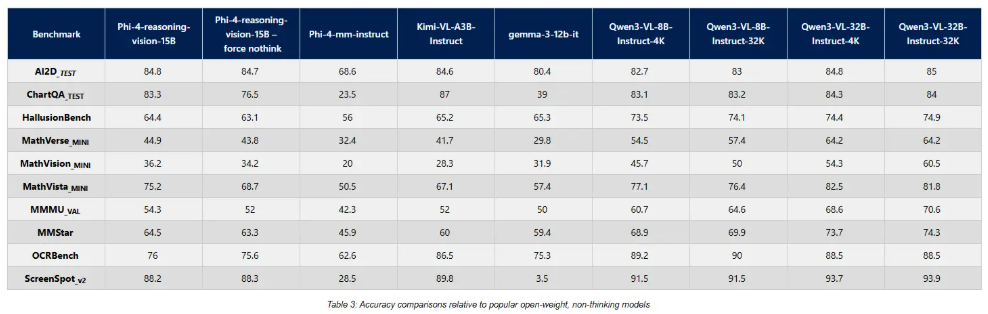
    • Strong performance on visual tasks despite smaller size
  • Lean learning
    • Achieved impressive results with fraction of typical training data
  • 💻 Developer-friendly
    • Open-source availability makes experimentation easy

Enjoyed this article?

Subscribe to our newsletter for the latest AI news, product reviews, and project recommendations delivered to your inbox weekly.

Weekly digestFree foreverUnsubscribe anytime

Related Articles

News

Google's AI Turns News Reports into Flood Warnings for Vulnerable Regions

Google has developed an innovative flood prediction system by analyzing millions of news articles with its Gemini AI. The technology transforms qualitative reports into quantitative data, creating early warnings for areas lacking traditional weather monitoring. Already implemented in 150 countries, this approach marks a breakthrough in using language models for disaster prevention while addressing global inequality in weather forecasting capabilities.

March 13, 2026
AI innovationdisaster preventionclimate technology
Google's Gemini Embedding 2 Bridges the Gap Between Machines and Human Understanding
News

Google's Gemini Embedding 2 Bridges the Gap Between Machines and Human Understanding

Google has unveiled Gemini Embedding 2, its first native multimodal embedding model that can process text, images, videos, audio, and documents simultaneously. Unlike generative models focused on content creation, this breakthrough technology helps machines truly 'understand' complex data by mapping diverse media types into unified mathematical spaces. With support for over 100 languages and combined media inputs, it promises significant improvements in search accuracy, legal research, and AI-powered analysis across industries.

March 11, 2026
AI innovationmultimodal learningmachine understanding
News

NVIDIA shakes up AI with open-source NemoClaw platform

NVIDIA is making waves with its new open-source AI agent platform NemoClaw, breaking free from hardware dependencies. Meanwhile, China celebrates a milestone in industrial communication standards, and Apple gears up for its foldable iPhone launch with boosted production targets. The tech world is buzzing with innovation as these developments signal major shifts across industries.

March 11, 2026
AI innovationtech trendsopen source
News

Shenzhen Hosts Lobster Feast with AI Twist to Boost Tech Adoption

Longgang District teams up with AI firm Kimi for an unforgettable culinary-tech fusion event. On March 14th, attendees will witness robots cooking lobster while enjoying free samples, all while learning about OpenClaw deployment. The festival offers practical benefits too - from free installation services to API discounts for businesses embracing AI transformation.

March 10, 2026
AI innovationculinary techShenzhen events
News

Alibaba's Tiny AI Model Takes On GPT-4o – And Wins

In a surprising turn of events, Alibaba's compact Qwen 3.5 model with just 4 billion parameters has outperformed OpenAI's massive GPT-4o in independent testing. This breakthrough challenges the industry's obsession with ever-larger models, proving that smarter architecture can trump sheer size. The achievement opens new possibilities for running powerful AI locally on everyday devices.

March 9, 2026
AI innovationMachine learningChinese tech
News

Lenovo's Visionary Concepts Steal the Show at MWC 2026

Lenovo turned heads at MWC 2026 with six groundbreaking concept devices that redefine how we interact with technology. From desktop robots that blink to foldable gaming handhelds, these innovations showcase practical applications of AI in work and play. The modular PC design solves the portability-power dilemma, while creative professionals get powerful new tools for 3D modeling.

March 3, 2026
future techAI innovationmodular computing