
Ant Group's Latest AI Model Breaks New Ground in Multimodal Tech

Ant Group Takes Multimodal AI to New Heights with Open-Source Release

In a move that could reshape the AI development landscape, Ant Group has made its advanced Ming-Flash-Omni 2.0 model freely available to developers worldwide. This isn't just another incremental update - it represents significant leaps in how machines understand and create across multiple media formats.
Image

Seeing, Hearing, and Creating Like Never Before

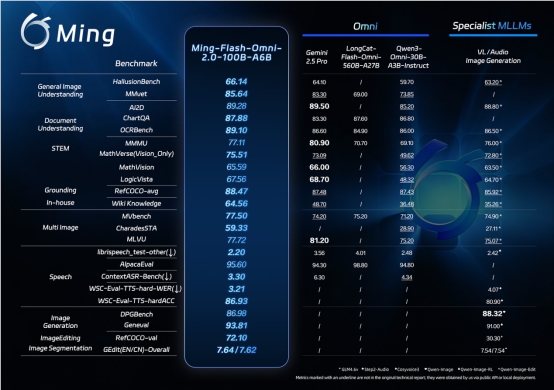
The numbers tell an impressive story: benchmark tests show Ming-Flash-Omni 2.0 surpassing even Google's Gemini 2.5 Pro in key areas of visual language processing and audio generation. But what really sets this model apart is its ability to handle three audio elements - speech, sound effects, and music - simultaneously on a single track.

Imagine describing "a rainy Paris street with soft jazz playing as a woman speaks French" and getting perfectly synchronized output. That's the level of control developers now have access to, complete with adjustments for everything from emotional tone to regional accents.

From Specialized Tools to Unified Powerhouse

Zhou Jun, who leads Ant Group's Bai Ling model team, explains their philosophy: "We're moving beyond the old trade-off between specialization and generalization. With Ming-Flash-Omni 2.0, you get both - deep capability in specific areas combined with flexible multimodal integration."

The secret lies in the Ling-2.0 architecture underpinning this release. Through massive datasets (we're talking billions of fine-grained examples) and optimized training approaches, the team has achieved:

  • Visual precision that can distinguish between nearly identical animal species or capture intricate craft details
  • Audio versatility supporting real-time generation of minute-long clips at just 3.1Hz frame rates
  • Image editing stability that maintains realism even when altering lighting or swapping backgrounds

What This Means for Developers

The open-source release transforms these capabilities into building blocks anyone can use. Instead of stitching together separate models for vision, speech, and generation tasks, developers now have a unified starting point that significantly reduces integration headaches.

"We see this as lowering barriers," Zhou notes. "Teams that might have struggled with complex multimodal projects before can now focus on creating innovative applications rather than foundational work."

The model weights and inference code are already live on Hugging Face and other platforms, with additional access through Ant's Ling Studio.

Looking Ahead

While celebrating these achievements, Ant's researchers aren't resting. Next priorities include enhancing video understanding capabilities and pushing boundaries in real-time long-form audio generation - areas that could unlock even more transformative applications.

The message is clear: multimodal AI is evolving rapidly from specialized tools toward integrated systems that better mirror human perception and creativity.

Key Points:

  • Open-source availability: Ming-Flash-Omni 2.0 now accessible to all developers
  • Performance benchmarks: Outperforms leading models in visual/audio tasks
  • Unified architecture: Single framework handles multiple media types seamlessly
  • Practical benefits: Reduces development complexity for multimodal projects
  • Future focus: Video understanding and extended audio generation coming next

Enjoyed this article?

Subscribe to our newsletter for the latest AI news, product reviews, and project recommendations delivered to your inbox weekly.

Weekly digestFree foreverUnsubscribe anytime

Related Articles

Microsoft's New AI Model Thinks Like Humans - Decides When to Go Deep
News

Microsoft's New AI Model Thinks Like Humans - Decides When to Go Deep

Microsoft just unveiled Phi-4-reasoning-vision-15B, an open-source AI model that mimics human decision-making by choosing when to think deeply. Unlike typical models that require manual mode switching, this 15-billion-parameter wonder automatically adjusts its reasoning depth based on task complexity. Excelling in image analysis and math problems while using surprisingly little training data, it could revolutionize how we deploy lightweight AI systems.

March 5, 2026
AI innovationMicrosoft Researchlightweight models
News

Google's AI Turns News Reports into Flood Warnings for Vulnerable Regions

Google has developed an innovative flood prediction system by analyzing millions of news articles with its Gemini AI. The technology transforms qualitative reports into quantitative data, creating early warnings for areas lacking traditional weather monitoring. Already implemented in 150 countries, this approach marks a breakthrough in using language models for disaster prevention while addressing global inequality in weather forecasting capabilities.

March 13, 2026
AI innovationdisaster preventionclimate technology
Google's Gemini Embedding 2 Bridges the Gap Between Machines and Human Understanding
News

Google's Gemini Embedding 2 Bridges the Gap Between Machines and Human Understanding

Google has unveiled Gemini Embedding 2, its first native multimodal embedding model that can process text, images, videos, audio, and documents simultaneously. Unlike generative models focused on content creation, this breakthrough technology helps machines truly 'understand' complex data by mapping diverse media types into unified mathematical spaces. With support for over 100 languages and combined media inputs, it promises significant improvements in search accuracy, legal research, and AI-powered analysis across industries.

March 11, 2026
AI innovationmultimodal learningmachine understanding
News

NVIDIA shakes up AI with open-source NemoClaw platform

NVIDIA is making waves with its new open-source AI agent platform NemoClaw, breaking free from hardware dependencies. Meanwhile, China celebrates a milestone in industrial communication standards, and Apple gears up for its foldable iPhone launch with boosted production targets. The tech world is buzzing with innovation as these developments signal major shifts across industries.

March 11, 2026
AI innovationtech trendsopen source
News

Shenzhen Hosts Lobster Feast with AI Twist to Boost Tech Adoption

Longgang District teams up with AI firm Kimi for an unforgettable culinary-tech fusion event. On March 14th, attendees will witness robots cooking lobster while enjoying free samples, all while learning about OpenClaw deployment. The festival offers practical benefits too - from free installation services to API discounts for businesses embracing AI transformation.

March 10, 2026
AI innovationculinary techShenzhen events
News

Alibaba's Tiny AI Model Takes On GPT-4o – And Wins

In a surprising turn of events, Alibaba's compact Qwen 3.5 model with just 4 billion parameters has outperformed OpenAI's massive GPT-4o in independent testing. This breakthrough challenges the industry's obsession with ever-larger models, proving that smarter architecture can trump sheer size. The achievement opens new possibilities for running powerful AI locally on everyday devices.

March 9, 2026
AI innovationMachine learningChinese tech