
Study Warns: Overuse of AI May Harm Critical Thinking

MIT Study Reveals Cognitive Costs of AI Dependency

New research from the MIT Media Lab warns that widespread use of large language models (LLMs) like ChatGPT may come with significant cognitive tradeoffs. The study, led by Nataliya Kosmyna, examines how AI assistance affects learning processes during academic writing tasks.
Image

Research Methodology

The team conducted experiments with 54 participants divided into three groups:

  • LLM group: Used only ChatGPT for writing
  • Search engine group: Used traditional search tools (no LLMs)
  • Pure mental effort group: Used no digital tools

Researchers monitored brain activity via EEG scans while participants completed writing tasks. The study included four sessions with role reversals in the final round, where some participants switched between tool-dependent and tool-free approaches.
Image

Key Findings: Neural Impact of AI Use

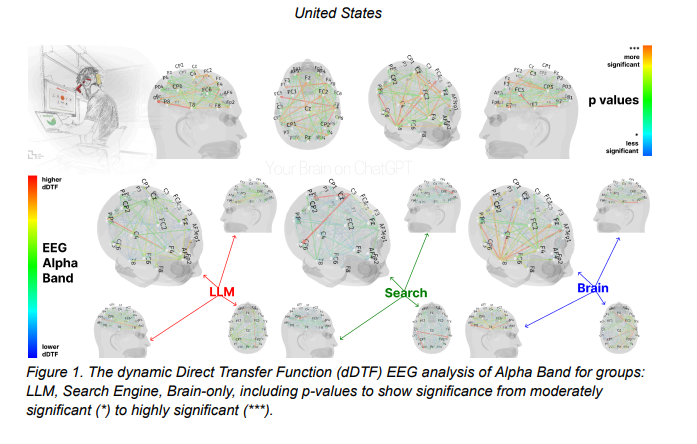
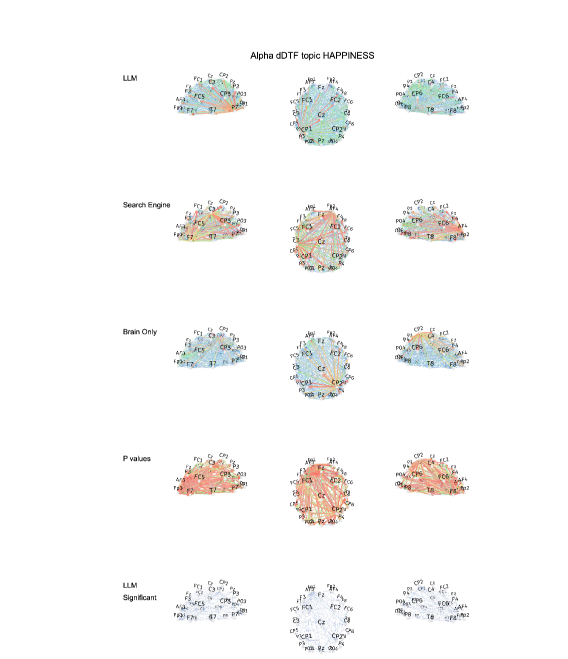
The study revealed striking differences in brain connectivity patterns:

  • Strongest connectivity appeared in the pure mental effort group
  • Moderate connectivity occurred in search engine users
  • Weakest overall coupling was found among LLM users

Participants transitioning from AI assistance to unaided work showed particularly concerning results:

  • Reduced alpha wave activity (linked to creativity and semantic processing)
  • Diminished beta wave patterns (associated with focused attention)
  • Impaired episodic memory consolidation

"These findings suggest AI reliance may create passive learning methods that weaken critical thinking," explains Kosmyna. "We're seeing what we term 'cognitive debt' - short-term efficiency gains at the expense of long-term cognitive development."

Educational Implications and Recommendations

The research highlights several concerns for academic environments:

  1. Memory encoding: LLM users showed difficulty recalling their own written content
  2. Ownership perception: AI-assisted writers felt less connection to their work
  3. Cognitive agency: Traditional methods fostered deeper engagement with material The team recommends balanced approaches:
    • Implementing "tool-free" learning phases before introducing AI assistance
    • Using AI selectively after establishing foundational neural networks
    • Developing methods to distinguish human-authored from AI-generated content

The study concludes that while LLMs offer undeniable productivity benefits, educators must carefully consider their integration to preserve critical thinking skills and knowledge retention.

Key Points:

  • Brain scans show weaker connectivity in frequent AI users
  • Memory encoding suffers when relying on LLMs for writing tasks
  • Cognitive debt accumulates through repeated AI dependency
  • Balanced educational approaches may mitigate negative effects
  • Ownership perception declines with increased AI assistance

Enjoyed this article?

Subscribe to our newsletter for the latest AI news, product reviews, and project recommendations delivered to your inbox weekly.

Weekly digestFree foreverUnsubscribe anytime

Related Articles

News

MIT Uncovers Brain's Tiny Language Hub - Smaller Than a Strawberry

MIT neuroscientists have mapped the brain's compact language center - a region smaller than a strawberry that handles all speech functions while remaining separate from thinking processes. Their 15-year study reveals how we process words independently from cognition, with implications for treating speech disorders and improving AI language models.

December 8, 2025
neurosciencelanguage processingbrain mapping
News

Google Classroom's New Podcast Tool Turns Lessons Into Engaging Audio

Google Classroom introduces an innovative podcast tool powered by Gemini AI, allowing teachers to transform lessons into engaging audio content with just a click. Designed with Gen Z learners in mind, this feature converts text materials into professional-quality podcasts complete with dialogue formats and sound effects. Early tests show dramatic improvements in student engagement, with one Renaissance art history lesson achieving a 92% completion rate compared to 45% for traditional reading materials.

January 8, 2026
education technologyAI in classroomspodcast learning
AI Takes the Test: China Trials Smart Grading in Schools
News

AI Takes the Test: China Trials Smart Grading in Schools

China's education system is embracing AI in a big way. The Ministry of Education just announced plans to pilot artificial intelligence across the entire exam process - from setting questions to grading papers. This move could revolutionize how teachers assess students while reducing their workload. The technology will roll out through the National Smart Education Platform, blending online and offline training for educators nationwide.

December 17, 2025
education technologyAI in schoolsChina education reform
AI's Scientific Breakthrough: How FrontierScience Tests the Next Generation of Research Assistants
News

AI's Scientific Breakthrough: How FrontierScience Tests the Next Generation of Research Assistants

Artificial intelligence is making waves in scientific research, but how do we measure its true reasoning capabilities? The new FrontierScience benchmark puts AI models through rigorous testing in physics, chemistry, and biology. Early results show GPT-5.2 leading the pack, though human scientists still outperform when it comes to open-ended problem solving. This development could reshape how research gets done in labs worldwide.

December 17, 2025
AI researchscientific computingmachine learning benchmarks
AI2's Molmo 2 Brings Open-Source Video Intelligence to Your Fingertips
News

AI2's Molmo 2 Brings Open-Source Video Intelligence to Your Fingertips

The Allen Institute for AI has just unveiled Molmo 2, a game-changing open-source video language model that puts powerful visual understanding tools directly in developers' hands. With versions ranging from 4B to 8B parameters, these lightweight yet capable models can analyze videos, track objects, and even explain what's happening on screen. What makes this release special? Complete transparency - you get full access to both the models and their training data, a rare find in today's proprietary AI landscape.

December 17, 2025
AI researchcomputer visionopen source AI
Alibaba's New AI Training Method Promises More Stable, Powerful Language Models
News

Alibaba's New AI Training Method Promises More Stable, Powerful Language Models

Alibaba's Tongyi Qwen team has unveiled an innovative reinforcement learning technique called SAPO that tackles stability issues in large language model training. Unlike traditional methods that risk losing valuable learning signals, SAPO uses a smarter approach to preserve important gradients while maintaining stability. Early tests show significant improvements across various AI tasks, from coding to complex reasoning.

December 10, 2025
AI researchmachine learningAlibaba