
Alibaba's New AI Training Method Promises More Stable, Powerful Language Models

Alibaba Breakthrough Makes AI Training More Reliable

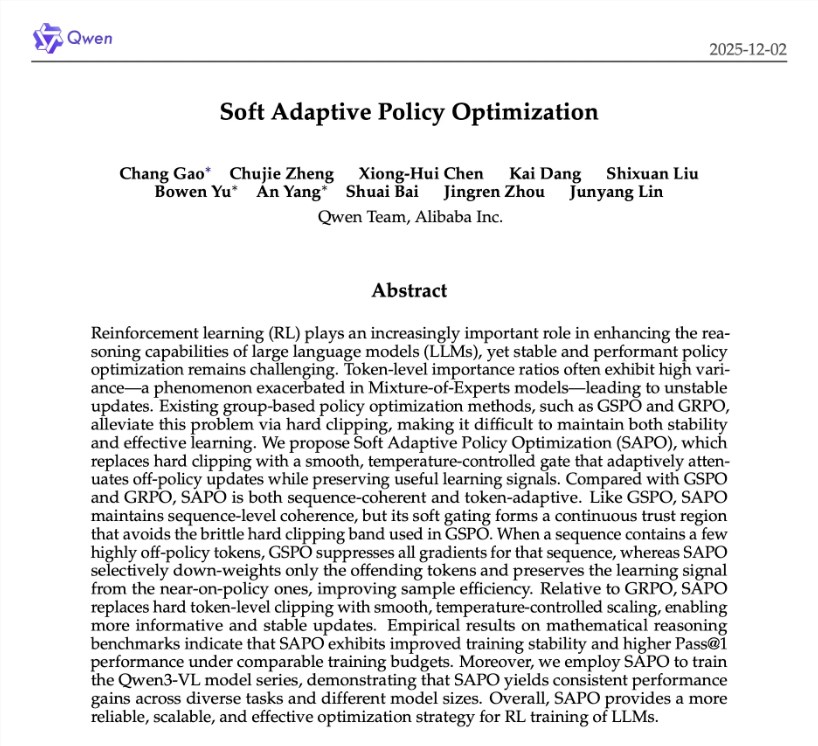
In the fast-moving world of artificial intelligence, Alibaba's Tongyi Qwen research team has developed a potentially game-changing approach to training large language models. Their new Soft Adaptive Policy Optimization (SAPO) method addresses one of the field's persistent headaches: keeping these complex systems stable during the crucial learning phase.
Image

The Problem With Current Methods

Traditional approaches like GRPO and GSPO rely on what experts call "hard clipping" - essentially putting strict limits on how much the AI can adjust its learning parameters at once. While this prevents disastrous mistakes, it comes with significant drawbacks. Imagine trying to learn piano while wearing thick gloves; you won't break anything, but you'll miss subtle nuances in your playing.

"The existing methods often throw out valuable learning opportunities," explains Dr. Li Wei, lead researcher on the project. "If one part of a sequence performs poorly, current systems might discard the entire thing - like rejecting a whole essay because of one awkward sentence."

How SAPO Works Differently

The Qwen team's solution replaces these blunt-force restrictions with something more sophisticated. SAPO uses:

  • Smart filtering: Instead of hard cutoffs, it employs smooth, adjustable thresholds that preserve more useful information
  • Asymmetric handling: It treats positive and negative learning signals differently for better efficiency
  • Context awareness: The system makes decisions at both the sequence and individual token levels

This approach maintains stability while allowing models to learn from more of their experiences. Early testing shows particular promise for mixture-of-experts models - the complex architectures powering today's most advanced AI systems.

Real-World Performance Gains

The proof came in rigorous testing across multiple domains:

  • Math problems: SAPO-powered models solved 15% more complex equations correctly
  • Coding tasks: Generated code showed fewer errors and better structure
  • Logical reasoning: Demonstrated more consistent performance on tricky word problems
  • Multimodal challenges: Combined text and visual information more effectively

"What excites us most is how broadly applicable these improvements are," notes Dr. Li. "From technical applications to creative tasks, we're seeing better results across the board."

The team has published their findings in detail (paper link: https://arxiv.org/abs/2511.20347), inviting peer review and collaboration from the global AI community.

Key Points:

  • Alibaba's SAPO method offers a smarter way to train large language models
  • Replaces crude "hard clipping" with nuanced, adaptive controls
  • Preserves valuable learning signals while maintaining stability
  • Shows measurable improvements across diverse AI applications
  • Particularly effective for complex mixture-of-experts architectures

Enjoyed this article?

Subscribe to our newsletter for the latest AI news, product reviews, and project recommendations delivered to your inbox weekly.

Weekly digestFree foreverUnsubscribe anytime

Related Articles

Alibaba's Qwen AI App Hits 100 Million Users in Record Time
News

Alibaba's Qwen AI App Hits 100 Million Users in Record Time

Alibaba's new AI assistant Qwen has taken the consumer market by storm, reportedly surpassing 100 million monthly active users just two months after launch. The app, positioned as a 'personal AI assistant that can chat and handle tasks,' has found particular popularity among students and professionals. While Alibaba hasn't officially confirmed these numbers, the rapid adoption suggests strong consumer appetite for practical AI tools in daily life.

January 14, 2026
AlibabaAI AssistantsConsumer Tech
Chinese Researchers Teach AI to Spot Its Own Mistakes in Image Creation
News

Chinese Researchers Teach AI to Spot Its Own Mistakes in Image Creation

A breakthrough from Chinese universities tackles AI's 'visual dyslexia' - where image systems understand concepts but struggle to correctly portray them. Their UniCorn framework acts like an internal quality control team, catching and fixing errors mid-creation. Early tests show promising improvements in spatial accuracy and detail handling.

January 12, 2026
AI innovationcomputer visionmachine learning
Fine-Tuning AI Models Without the Coding Headache
News

Fine-Tuning AI Models Without the Coding Headache

As AI models become ubiquitous, businesses face a challenge: generic models often miss the mark for specialized needs. Traditional fine-tuning requires coding expertise and expensive resources, but LLaMA-Factory Online changes the game. This visual platform lets anyone customize models through a simple interface, cutting costs and technical barriers. One team built a smart home assistant in just 10 hours - proving specialized AI doesn't have to be complicated or costly.

January 6, 2026
AI customizationno-code AImachine learning
Falcon H1R7B: The Compact AI Model Outperforming Larger Rivals
News

Falcon H1R7B: The Compact AI Model Outperforming Larger Rivals

The Abu Dhabi Innovation Institute has unveiled Falcon H1R7B, a surprisingly powerful 7-billion-parameter open-source language model that's rewriting the rules of AI performance. By combining innovative training techniques with hybrid architecture, this nimble contender delivers reasoning capabilities that rival models twice its size. Available now on Hugging Face, it could be a game-changer for developers needing efficient AI solutions.

January 6, 2026
AI innovationlanguage modelsmachine learning
Tencent's New Translation Tech Fits in Your Pocket
News

Tencent's New Translation Tech Fits in Your Pocket

Tencent has unveiled HY-MT1.5, a breakthrough translation system that brings powerful AI capabilities to mobile devices. The lightweight 1.8B version delivers near-instant translations while using minimal memory, perfect for smartphones. Meanwhile, the more robust 7B model excels at complex translations for enterprise use. What makes these models special? They combine massive training with human feedback to handle everything from technical jargon to cultural nuances - all while preserving document formatting.

January 5, 2026
machine translationAI modelsmobile technology
AutoNavi's Bold Leap: From Digital Maps to Intelligent Robots
News

AutoNavi's Bold Leap: From Digital Maps to Intelligent Robots

AutoNavi, Alibaba's mapping subsidiary, is making waves with its ambitious pivot from digital navigation to embodied intelligence. After topping Stanford's spatial AI benchmarks, the company has quietly formed a new division focused on bringing its world model technology into physical form—potentially through robots. This move signals AutoNavi's transformation from a simple map app into what could become the 'brain' for next-generation intelligent machines.

January 5, 2026
AutoNaviEmbodiedAIRobotics