
NVIDIA's NitroGen learns to game like humans by watching YouTube

NVIDIA Teaches AI to Master Games Just By Watching

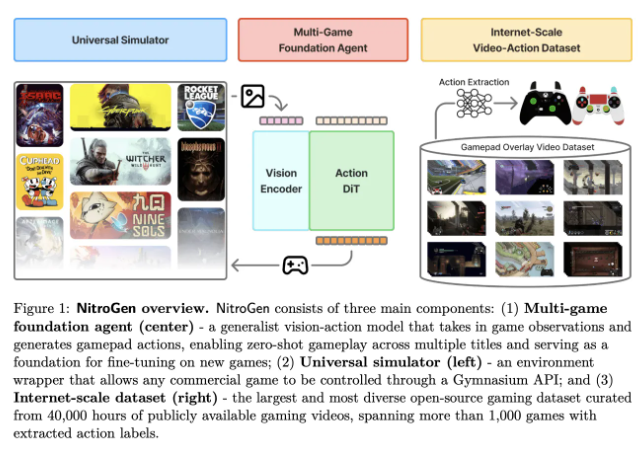
Imagine learning to play Dark Souls or Street Fighter just by watching Twitch streams. That's essentially what NVIDIA's new NitroGen AI model can do. This groundbreaking system analyzes gameplay videos complete with controller inputs displayed on-screen, then teaches itself how to play.
Image

Learning From the Gaming Community

The research team fed NitroGen a massive diet of gaming content - initially collecting 71,000 hours of raw footage before refining it down to 40,000 high-quality hours. These videos came from 818 different creators and covered an impressive variety:

  • Action RPGs (35% of total footage)
  • Platformers (18%)
  • Action-adventure games (9%)
  • Sports, racing and roguelike titles rounding out the collection

The final dataset represents gameplay from 846 distinct titles - essentially giving NitroGen what amounts to a comprehensive gaming education.

How It Works Behind the Scenes

The magic happens in three stages:

  1. Controller Detection: The system scans frames using templates for common controller layouts
  2. Input Interpretation: A specialized segmentation model deciphers exactly what buttons are being pressed
  3. Action Refinement: Coordinates get fine-tuned for precision movement controls

This meticulous approach allows NitroGen to effectively "watch and learn" like human players do when studying advanced techniques.

Practical Applications

The implications extend beyond just impressive tech demos:

  • Game Testing: Developers could automate quality assurance processes
  • Accessibility Tools: Could help create adaptive controllers for players with disabilities
  • Training Bots: Esports teams might use similar tech for practice opponents
  • Content Creation: Streamers could generate highlight reels automatically

The system even includes a general simulator that lets it interface with commercial Windows games without modifying their code - meaning it could theoretically learn any PC title.

Performance That Speaks Volumes

The numbers tell an impressive story:

  • Achieves 45-60% success rates on unfamiliar games immediately (zero-shot evaluation)
  • Shows up to 52% better performance compared to training from scratch when adapting to new titles
  • Processes game visuals at 256×256 resolution, balancing detail with computational efficiency

The model uses Diffusion Transformer architecture - cutting-edge tech that helps maintain this balance between visual understanding and responsive controls.

Key Points:

  • 🎮 Learns game mechanics purely from video observation like human players do
  • 📊 Trained on massive dataset: 40k hours across 1k+ game titles
  • ⚡ Shows remarkable adaptability - up to 52% improvement versus fresh training

Enjoyed this article?

Subscribe to our newsletter for the latest AI news, product reviews, and project recommendations delivered to your inbox weekly.

Weekly digestFree foreverUnsubscribe anytime

Related Articles

News

South Korea secures priority access to NVIDIA's cutting-edge AI chips

At CES 2026, South Korean officials announced NVIDIA's commitment to prioritize delivery of next-generation Vera Rubin GPUs to the country. This strategic move comes as part of a broader partnership that includes supplying up to 260,000 GPUs for South Korea's AI infrastructure development. Officials emphasized how securing advanced chip technology early could give Korean tech firms a crucial edge in global AI competition.

January 13, 2026
NVIDIAArtificial IntelligenceTech Partnerships
DeepSeek-V4 Set to Revolutionize Code Generation This February
News

DeepSeek-V4 Set to Revolutionize Code Generation This February

DeepSeek is gearing up to launch its powerful new AI model, DeepSeek-V4, around Chinese New Year. The update promises major leaps in code generation and handling complex programming tasks, potentially outperforming competitors like Claude and GPT series. Developers can expect more organized responses and better reasoning capabilities from this innovative tool.

January 12, 2026
AI DevelopmentProgramming ToolsMachine Learning
News

Universal Music and NVIDIA Join Forces to Revolutionize Music Discovery with AI

In a groundbreaking partnership, Universal Music Group and NVIDIA are leveraging AI to transform how we find and create music. Their new 'Music Flamingo' model understands songs like humans do - recognizing emotions, structures, and cultural nuances. This isn't just smarter search technology; it's reshaping the entire music experience while protecting artists' rights. The collaboration also includes an artist incubator focused on human-AI collaboration rather than replacement.

January 7, 2026
AI in musicMusic technologyUniversal Music
NVIDIA Takes the Wheel: Open-Source AI Model Accelerates Self-Driving Future
News

NVIDIA Takes the Wheel: Open-Source AI Model Accelerates Self-Driving Future

At CES 2026, NVIDIA's CEO Jensen Huang unveiled Alpamayo, the company's groundbreaking open-source AI model for autonomous vehicles. This move could democratize self-driving technology while challenging Chinese automakers' dominance. The release includes simulation tools and extensive driving data, signaling NVIDIA's push to reclaim leadership in automotive AI.

January 6, 2026
Autonomous VehiclesAI InnovationNVIDIA
NVIDIA's Huang Declares Robotics' ChatGPT Moment at CES 2026
News

NVIDIA's Huang Declares Robotics' ChatGPT Moment at CES 2026

NVIDIA CEO Jensen Huang made waves at CES 2026 by announcing robotics' 'ChatGPT moment,' signaling AI's leap from digital to physical realms. The company unveiled groundbreaking open-source models that enable machines to understand real-world physics and spatial relationships, backed by powerful new hardware that quadruples performance.

January 6, 2026
AI RoboticsNVIDIAPhysical Computing
NVIDIA's Alpamayo Platform Brings Human-Like Thinking to Self-Driving Cars
News

NVIDIA's Alpamayo Platform Brings Human-Like Thinking to Self-Driving Cars

At CES 2026, NVIDIA unveiled its groundbreaking Alpamayo platform, designed to give autonomous vehicles human-like reasoning capabilities. The open-source AI system can navigate complex scenarios like malfunctioning traffic lights without prior training. With its release of datasets and simulation tools, NVIDIA aims to accelerate the development of smarter self-driving technology that can explain its decisions to human passengers.

January 6, 2026
autonomous vehiclesAI innovationNVIDIA