
NVIDIA's New AI Brain Makes Smarter Tool Choices

NVIDIA's Game-Changing Approach to AI Efficiency
Image

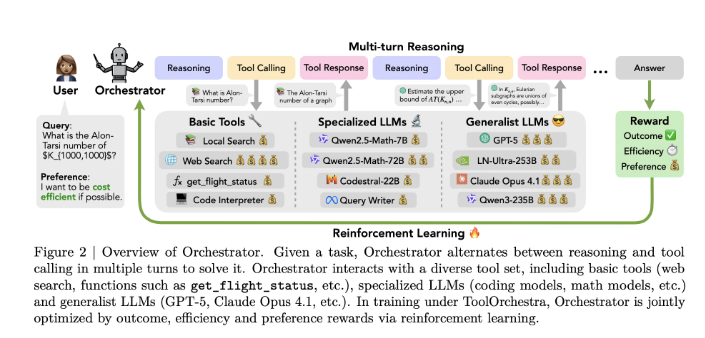
In a move that challenges conventional wisdom about artificial intelligence, NVIDIA has developed Orchestrator-8B, a surprisingly small yet powerful controller that could change how AI systems work together. While most developers reach for massive language models like GPT-5 when building AI agents, NVIDIA's team took a different path - creating specialized software that makes smarter decisions about which tools to use.

The Problem With Oversized AI

The current standard approach has an unexpected flaw. "When you give one large model complete control," explains the research paper, "it tends to favor its own capabilities even when better tools exist." This creates inefficiencies - like using a sledgehammer to crack walnuts - wasting both time and computing resources.

How Orchestrator-8B Works Differently

Built from the Qwen3-8B foundation with just 800 million parameters (tiny by today's standards), this specialized controller follows three key steps:

  1. It interprets user requests along with any preferences about speed or privacy
  2. Creates a step-by-step action plan
  3. Selects the perfect tool for each job from available options

The system communicates through simple JSON commands and keeps working until the task finishes or hits a 50-step limit.

Learning What Really Matters

The secret sauce? A sophisticated reward system that trains Orchestrator-8B through reinforcement learning. It earns points for:

  • Simply completing tasks successfully
  • Doing them quickly and affordably
  • Respecting user preferences like avoiding web searches when privacy matters most

Real-World Performance That Surprises

The numbers tell an impressive story:

  • 37.1% accuracy on complex "Human Last Exam" questions (beating GPT-5's 35.1%)
  • $0.092 average cost per task versus GPT-5's $0.302
  • 8.2 minute completion time compared to nearly 20 minutes for alternatives

The implications are significant - teams focused on efficiency now have what amounts to an AI project manager that optimizes both quality and cost.

Key Points:

  • 🧠 Specialized beats general: Orchestrator-8B proves smaller models can outperform giants when designed for specific tasks
  • Efficiency champion: Cuts costs by nearly 70% while improving accuracy
  • 🔄 Adaptive learning: Continuously improves tool selection through reinforcement rewards
  • 🤖 Future-proof design: Could manage increasingly complex ecosystems of AI tools

Enjoyed this article?

Subscribe to our newsletter for the latest AI news, product reviews, and project recommendations delivered to your inbox weekly.

Weekly digestFree foreverUnsubscribe anytime

Related Articles

News

South Korea secures priority access to NVIDIA's cutting-edge AI chips

At CES 2026, South Korean officials announced NVIDIA's commitment to prioritize delivery of next-generation Vera Rubin GPUs to the country. This strategic move comes as part of a broader partnership that includes supplying up to 260,000 GPUs for South Korea's AI infrastructure development. Officials emphasized how securing advanced chip technology early could give Korean tech firms a crucial edge in global AI competition.

January 13, 2026
NVIDIAArtificial IntelligenceTech Partnerships
News

Universal Music and NVIDIA Join Forces to Revolutionize Music Discovery with AI

In a groundbreaking partnership, Universal Music Group and NVIDIA are leveraging AI to transform how we find and create music. Their new 'Music Flamingo' model understands songs like humans do - recognizing emotions, structures, and cultural nuances. This isn't just smarter search technology; it's reshaping the entire music experience while protecting artists' rights. The collaboration also includes an artist incubator focused on human-AI collaboration rather than replacement.

January 7, 2026
AI in musicMusic technologyUniversal Music
NVIDIA Takes the Wheel: Open-Source AI Model Accelerates Self-Driving Future
News

NVIDIA Takes the Wheel: Open-Source AI Model Accelerates Self-Driving Future

At CES 2026, NVIDIA's CEO Jensen Huang unveiled Alpamayo, the company's groundbreaking open-source AI model for autonomous vehicles. This move could democratize self-driving technology while challenging Chinese automakers' dominance. The release includes simulation tools and extensive driving data, signaling NVIDIA's push to reclaim leadership in automotive AI.

January 6, 2026
Autonomous VehiclesAI InnovationNVIDIA
NVIDIA's Huang Declares Robotics' ChatGPT Moment at CES 2026
News

NVIDIA's Huang Declares Robotics' ChatGPT Moment at CES 2026

NVIDIA CEO Jensen Huang made waves at CES 2026 by announcing robotics' 'ChatGPT moment,' signaling AI's leap from digital to physical realms. The company unveiled groundbreaking open-source models that enable machines to understand real-world physics and spatial relationships, backed by powerful new hardware that quadruples performance.

January 6, 2026
AI RoboticsNVIDIAPhysical Computing
NVIDIA's Alpamayo Platform Brings Human-Like Thinking to Self-Driving Cars
News

NVIDIA's Alpamayo Platform Brings Human-Like Thinking to Self-Driving Cars

At CES 2026, NVIDIA unveiled its groundbreaking Alpamayo platform, designed to give autonomous vehicles human-like reasoning capabilities. The open-source AI system can navigate complex scenarios like malfunctioning traffic lights without prior training. With its release of datasets and simulation tools, NVIDIA aims to accelerate the development of smarter self-driving technology that can explain its decisions to human passengers.

January 6, 2026
autonomous vehiclesAI innovationNVIDIA
NVIDIA CEO Hails Open-Source AI Breakthroughs at CES 2026
News

NVIDIA CEO Hails Open-Source AI Breakthroughs at CES 2026

At CES 2026, NVIDIA's Jensen Huang made waves by championing open-source AI development, singling out DeepSeek-R1 as a standout success. The tech leader revealed NVIDIA's plans to open-source training data while showcasing their new Vera Rubin chip. Huang outlined four key areas where AI is transforming industries, predicting these changes will define future technological paradigms.

January 6, 2026
AIOpen SourceNVIDIA