
MIT and Harvard Unveil Lyra: A Breakthrough in Biological Sequence Modeling

In a significant advancement for computational biology, researchers from MIT, Harvard University, and Carnegie Mellon University have introduced Lyra, a groundbreaking method for biological sequence modeling. This innovation addresses the long-standing challenges of high computational costs and large dataset dependencies in deep learning applications for biology.
Image

A Leap in Efficiency

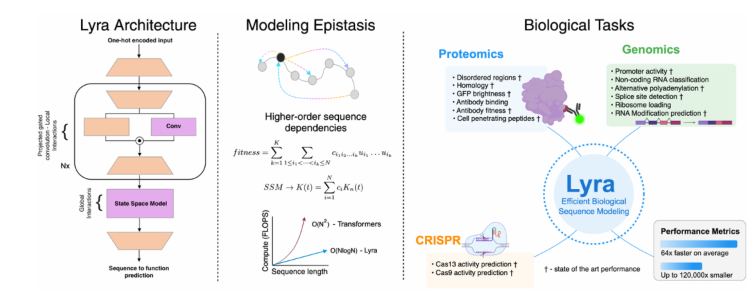
Lyra represents a paradigm shift in biological sequence analysis, requiring just 1/120,000th of the parameters used in traditional models. Remarkably, the system can be fully trained in two hours using only two GPUs, making advanced biological research accessible to labs with limited resources.

The model's design draws inspiration from epistasis – the interaction between mutations within a sequence. By employing a sub-quadratic architecture, Lyra effectively deciphers the complex relationship between biological sequences and their functions.
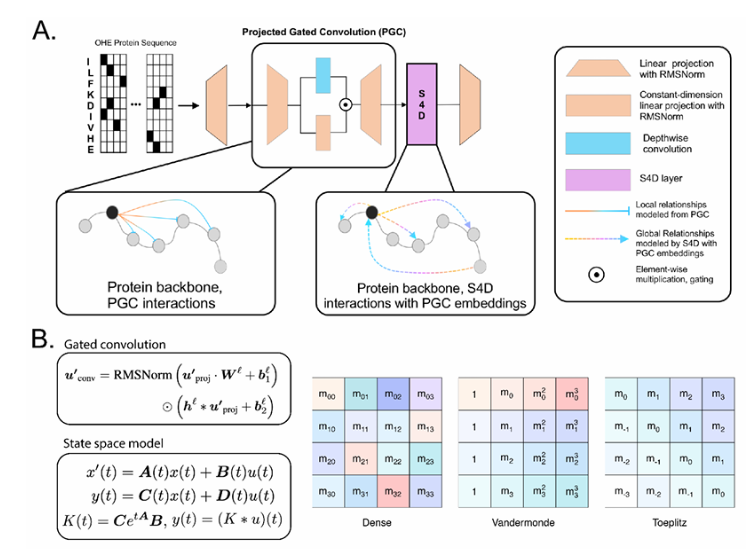
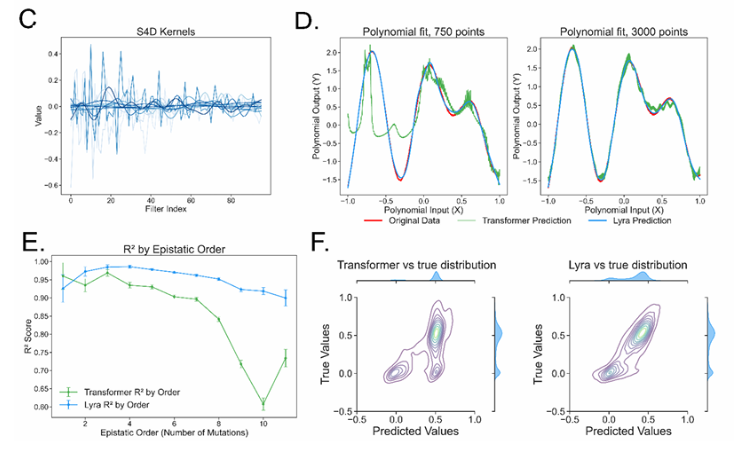
Image Image

Superior Performance Across Multiple Applications

Testing across over 100 biological tasks, Lyra has demonstrated exceptional results in:

  • Protein fitness prediction
  • RNA function analysis
  • CRISPR design

The system has achieved state-of-the-art (SOTA) performance in several key applications, outperforming conventional methods while using significantly fewer computational resources.

Technical Innovation

The research team developed a novel hybrid architecture that combines:

  1. State-space models (SSM) for global relationship modeling using Fast Fourier Transform (FFT)
  2. Projected gated convolution (PGC) for local feature extraction

This innovative approach results in inference speeds 64.18 times faster than traditional Convolutional Neural Networks (CNNs) and Transformer models.

Broad Implications for Biological Research

The implications of Lyra's efficiency extend across multiple domains:

  • Accelerated therapeutic development
  • Enhanced pathogen monitoring capabilities
  • Improved biomanufacturing processes

The research team hopes their breakthrough will democratize access to advanced biological sequence modeling, enabling more scientists to contribute to cutting-edge discoveries without requiring massive computational infrastructure.

Key Points

  1. Lyra reduces model parameters by 1/120,000th compared to traditional approaches
  2. Achieves full training in just two hours using two GPUs
  3. Demonstrates state-of-the-art performance across 100+ biological tasks
  4. Features a hybrid SSM-PGC architecture for optimal efficiency
  5. Runs inferences 64.18× faster than conventional CNNs and Transformers

Enjoyed this article?

Subscribe to our newsletter for the latest AI news, product reviews, and project recommendations delivered to your inbox weekly.

Weekly digestFree foreverUnsubscribe anytime

Related Articles

HKU's CLI-Anything Turns Any Software into AI-Friendly Tools with One Command
News

HKU's CLI-Anything Turns Any Software into AI-Friendly Tools with One Command

The University of Hong Kong's Data Intelligence Lab has released CLI-Anything, an open-source tool that transforms any software into an AI agent-friendly command-line interface. This breakthrough eliminates the frustrations of unreliable UI automation, offering developers a robust way to integrate professional tools like GIMP, Blender, and LibreOffice with AI systems. The project has already gained significant traction, surpassing 17,000 GitHub stars shortly after launch.

March 17, 2026
AI developmentsoftware automationopen source
News

Mistral AI's Small4: A Triple-Threat Open Source Model Arrives

Mistral AI has unveiled its latest open-source marvel - the Small4 model. This isn't just another incremental update; it combines three powerful capabilities into one package: logical reasoning, multimodal processing, and coding assistance. With its efficient 128-expert architecture and configurable performance modes, developers now have a versatile tool that adapts to different needs while cutting computational costs.

March 17, 2026
AI modelsopen sourceMistral AI
NVIDIA's Nemotron 3 Series: AI Gets a Fivefold Speed Boost
News

NVIDIA's Nemotron 3 Series: AI Gets a Fivefold Speed Boost

At the 2026 GTC conference, NVIDIA unveiled its Nemotron 3 series of open-source AI models, with the flagship Ultra version delivering five times faster processing. The release also includes innovative multimodal tools for audio-visual integration and real-time conversation, plus breakthroughs in robotics and medical research. Major industry players are already adopting these cutting-edge technologies.

March 17, 2026
AI innovationNVIDIAmachine learning
News

Google's AI Turns News Reports into Flood Warnings for Vulnerable Regions

Google has developed an innovative flood prediction system by analyzing millions of news articles with its Gemini AI. The technology transforms qualitative reports into quantitative data, creating early warnings for areas lacking traditional weather monitoring. Already implemented in 150 countries, this approach marks a breakthrough in using language models for disaster prevention while addressing global inequality in weather forecasting capabilities.

March 13, 2026
AI innovationdisaster preventionclimate technology
Tencent's WorldCompass Helps AI Models Navigate Complex Commands
News

Tencent's WorldCompass Helps AI Models Navigate Complex Commands

Tencent has open-sourced WorldCompass, a reinforcement learning framework that dramatically improves how AI world models understand and execute complex instructions. This breakthrough solves persistent accuracy issues, boosting performance by over 35% in challenging scenarios. The technology marks a shift from pure pre-training to sophisticated fine-tuning approaches.

March 11, 2026
AI developmentTencentmachine learning
News

Peking University and OceanBase Break New Ground in Long Video Search Technology

Researchers from Peking University and OceanBase have developed LoVR, a groundbreaking benchmark for long video retrieval that tackles key industry challenges. Accepted by WWW 2026, this innovation enables precise searches across entire videos or specific segments through advanced semantic analysis. The system features over 40,000 finely annotated clips and addresses real-world problems like semantic drift in lengthy content.

March 2, 2026
video retrievalAI researchmultimodal technology