
Meet Kosmos: The AI Scientist That Does Six Months of Research in Half a Day

AI Research Gets Turbocharged with Kosmos

Imagine completing six months of intensive scientific research before lunchtime. That's exactly what FutureHouse's new AI system Kosmos can do, and it's already making waves across multiple scientific disciplines.

How This Digital Scientist Works

At its core, Kosmos operates like the most disciplined researcher you've ever met - one who never needs coffee breaks or sleep. Image The system can plow through:
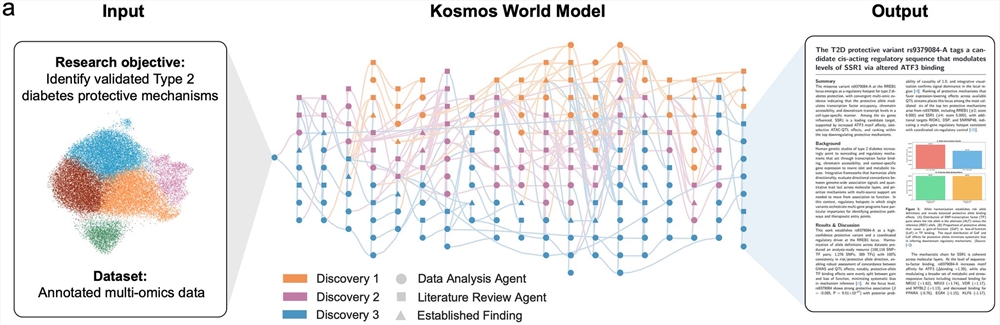
  • 1,500 academic papers in a single session
  • Generate 42,000 lines of analysis code
  • Produce fully traceable reports with citations

The secret sauce? A "structured world model" that maintains logical coherence across massive datasets - think of it as an ultra-organized digital brain capable of holding over 10 million tokens worth of context.

Real-World Breakthroughs Already Happening

The proof is in the discoveries. Kosmos has already:

  1. Confirmed nucleotide metabolism as crucial for low-temperature brain processing
  2. Identified absolute humidity thresholds affecting perovskite solar cells (over 60g/m³ causes failure)
  3. Independently replicated three unpublished studies
  4. Made four completely novel findings in neuroscience and materials science

"What excites us most isn't just the speed," explains a FutureHouse researcher who asked not to be named ahead of publication, "but how it connects dots across disciplines that humans might miss."

Affordable Science Acceleration

The best part? This research turbocharger comes at bargain basement prices:

  • $200 per run for commercial users
  • Free credits available for academics
  • Optimized for datasets under 5GB (though larger projects are possible)

The system isn't perfect yet - cross-domain reasoning accuracy hovers around 58%. But considering it costs less than many researchers' monthly coffee budget, those limitations seem minor.

What's Next?

The FutureHouse team isn't resting on their laurels. They're already working on integrating lab automation equipment to create a complete "hypothesis-experiment-analysis" loop. Soon, Kosmos might not just analyze data but design and run experiments too.

Key Points:

  • Speed: Completes half a year's human research work in just 12 hours
  • Capacity: Processes thousands of papers while maintaining logical coherence
  • Affordability: $200 per run makes advanced research accessible
  • Limitations: Best with sub-5GB datasets; cross-domain accuracy needs improvement
  • Future Plans: Full integration with lab equipment for end-to-end experimentation

Enjoyed this article?

Subscribe to our newsletter for the latest AI news, product reviews, and project recommendations delivered to your inbox weekly.

Weekly digestFree foreverUnsubscribe anytime

Related Articles

AI Expert Revises Doomsday Timeline: Humanity Gets a Few More Years
News

AI Expert Revises Doomsday Timeline: Humanity Gets a Few More Years

Former OpenAI researcher Daniel Kokotajlo has pushed back his controversial prediction about artificial intelligence destroying humanity. While he previously warned AI could achieve autonomous programming by 2027, new observations suggest the timeline may extend into the early 2030s. The expert acknowledges current AI still struggles with real-world complexity, even as tech companies like OpenAI race toward creating automated researchers by 2028.

January 6, 2026
AI safetyAGIfuture technology
AI's Scientific Breakthrough: How FrontierScience Tests the Next Generation of Research Assistants
News

AI's Scientific Breakthrough: How FrontierScience Tests the Next Generation of Research Assistants

Artificial intelligence is making waves in scientific research, but how do we measure its true reasoning capabilities? The new FrontierScience benchmark puts AI models through rigorous testing in physics, chemistry, and biology. Early results show GPT-5.2 leading the pack, though human scientists still outperform when it comes to open-ended problem solving. This development could reshape how research gets done in labs worldwide.

December 17, 2025
AI researchscientific computingmachine learning benchmarks
AI2's Molmo 2 Brings Open-Source Video Intelligence to Your Fingertips
News

AI2's Molmo 2 Brings Open-Source Video Intelligence to Your Fingertips

The Allen Institute for AI has just unveiled Molmo 2, a game-changing open-source video language model that puts powerful visual understanding tools directly in developers' hands. With versions ranging from 4B to 8B parameters, these lightweight yet capable models can analyze videos, track objects, and even explain what's happening on screen. What makes this release special? Complete transparency - you get full access to both the models and their training data, a rare find in today's proprietary AI landscape.

December 17, 2025
AI researchcomputer visionopen source AI
Alibaba's New AI Training Method Promises More Stable, Powerful Language Models
News

Alibaba's New AI Training Method Promises More Stable, Powerful Language Models

Alibaba's Tongyi Qwen team has unveiled an innovative reinforcement learning technique called SAPO that tackles stability issues in large language model training. Unlike traditional methods that risk losing valuable learning signals, SAPO uses a smarter approach to preserve important gradients while maintaining stability. Early tests show significant improvements across various AI tasks, from coding to complex reasoning.

December 10, 2025
AI researchmachine learningAlibaba
Tsinghua Researchers Flip AI Thinking: Smart Models Beat Big Models
News

Tsinghua Researchers Flip AI Thinking: Smart Models Beat Big Models

Tsinghua University scientists have turned conventional AI wisdom on its head. Their groundbreaking study reveals that what really matters isn't how big an AI model is, but how smart each part of it works - a concept they call 'capability density.' Forget massive, energy-hungry systems - the future may belong to leaner, meaner AI brains that pack more punch per parameter.

November 24, 2025
AI researchMachine learningTsinghua University
Google cracks AI's memory problem with onion-inspired learning
News

Google cracks AI's memory problem with onion-inspired learning

Google researchers have developed a breakthrough technique called Nested Learning that helps AI systems retain knowledge like humans do. Inspired by how our brains form memories at different time scales, this 'memory onion' approach allows AI to learn new skills without forgetting old ones. Early tests show forgetting rates dropping to near zero, potentially revolutionizing everything from chatbots to medical diagnosis systems.

November 10, 2025
AI researchmachine learningGoogle DeepMind