
ManimML: AI Animation Tool Simplifies Transformer Visualization

ManimML: Bridging the Gap in AI Visualization

With artificial intelligence advancing rapidly, explaining complex models like the Transformer architecture has become a critical challenge. ManimML, an open-source animation library built on Python, is addressing this issue by turning abstract machine learning concepts into dynamic visualizations.

A New Standard for Technical Communication

Developed as an extension of the Manim community edition, ManimML specializes in creating animations for neural network architectures. Its capabilities extend beyond static diagrams—it produces interactive teaching materials that show algorithms in action. This approach has proven particularly valuable for illustrating:

  • Transformer models
  • Convolutional Neural Networks (CNNs)
  • Forward/backward propagation processes
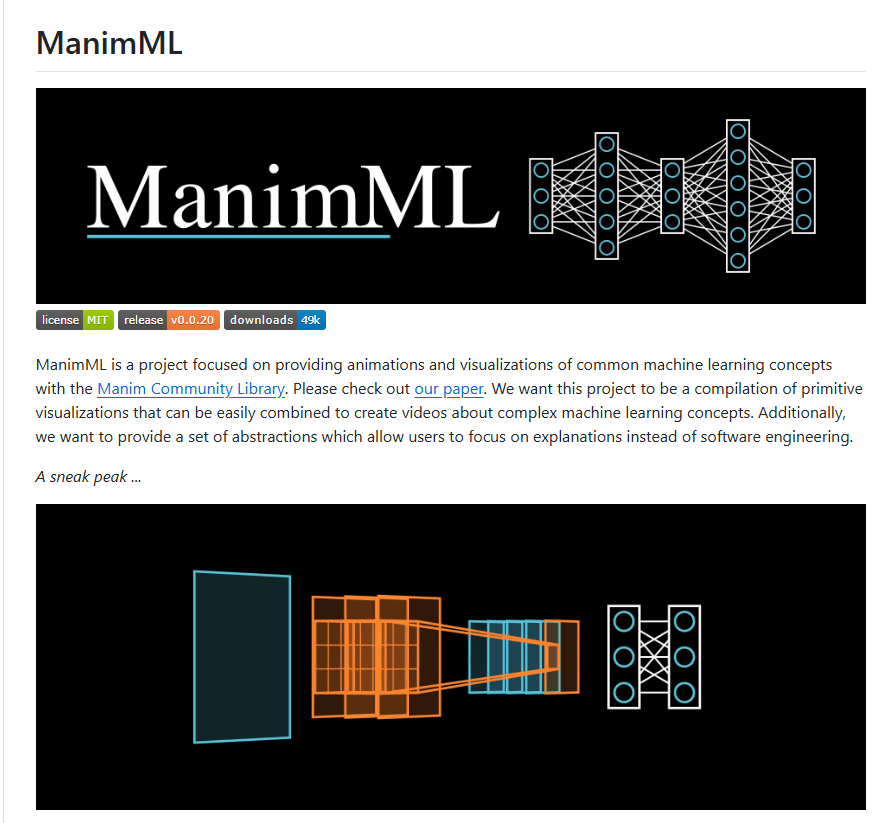
Image

Intuitive Design for Maximum Impact

The library's breakthrough lies in its user-friendly interface modeled after popular deep learning frameworks like PyTorch. Developers can generate professional animations with just a few lines of code: ```python

Sample ManimML code for Transformer visualization

transformer = NeuralNetwork([ InputLayer(), AttentionLayer(), OutputLayer() ]) transformer.animate_forward_pass() ``` Remarkably, users can even generate custom animations by simply providing a GitHub repository link and natural language descriptions to the AI-powered system.

Industry Adoption and Recognition

Since its launch, ManimML has achieved significant milestones:

  • 1,300+ GitHub stars
  • 23,000+ PyPi downloads
  • Hundreds of thousands of social media views for demo videos The tool received the Best Poster Award at IEEE VIS2023, cementing its reputation in the visualization community. Academics increasingly incorporate ManimML-generated content into research papers and conference presentations.

Transforming AI Education

The implications for education are profound:

  1. University lecturers use it to demonstrate algorithms dynamically
  2. Online course creators enhance engagement with animated examples
  3. Technical writers simplify complex concepts for broader audiences As the open-source community continues to expand ManimML's capabilities, it's poised to become an essential tool in democratizing AI understanding.

Key Points:

  • Visualization breakthrough: Makes complex AI architectures accessible through animation
  • Low barrier to entry: Python syntax familiar to ML practitioners reduces learning curve
  • Proven adoption: Strong traction in both academic and developer communities
  • Educational potential: Set to revolutionize how AI concepts are taught at all levels

Enjoyed this article?

Subscribe to our newsletter for the latest AI news, product reviews, and project recommendations delivered to your inbox weekly.

Weekly digestFree foreverUnsubscribe anytime

Related Articles

India's Alpie AI Model Makes Waves - But Is It Truly Homegrown?
News

India's Alpie AI Model Makes Waves - But Is It Truly Homegrown?

A new AI contender from India called Alpie is turning heads with performance that rivals giants like GPT-4o and Claude3.5 in math and coding tests. However, technical analysis reveals it's actually built on a Chinese open-source model, raising questions about innovation versus optimization. What makes Alpie special is its ability to run efficiently on consumer hardware, potentially democratizing AI access for smaller developers.

January 15, 2026
AIMachine LearningIndia Tech
DeepSeek-V4 Set to Revolutionize Code Generation This February
News

DeepSeek-V4 Set to Revolutionize Code Generation This February

DeepSeek is gearing up to launch its powerful new AI model, DeepSeek-V4, around Chinese New Year. The update promises major leaps in code generation and handling complex programming tasks, potentially outperforming competitors like Claude and GPT series. Developers can expect more organized responses and better reasoning capabilities from this innovative tool.

January 12, 2026
AI DevelopmentProgramming ToolsMachine Learning
Teachers Can Now Transform Textbooks Into Podcasts With Google's New AI Tool
News

Teachers Can Now Transform Textbooks Into Podcasts With Google's New AI Tool

Google Classroom is getting a major upgrade in early 2026 with Gemini-powered technology that lets educators convert textbooks into engaging podcast-style lessons with just one click. Teachers can customize audio content by grade level, learning objectives, and even choose different narrative formats like interviews or casual conversations. While the tool aims to boost engagement among Gen Z learners who love podcasts, Google emphasizes teachers should review AI-generated content for accuracy.

January 8, 2026
EdTechAIinEducationDigitalLearning
Amap's New Flying Street View Lets You Virtually Tour Stores From Above
News

Amap's New Flying Street View Lets You Virtually Tour Stores From Above

Alibaba's Amap has launched an innovative 'Flying Street View' feature powered by AI world modeling technology. This breakthrough transforms traditional static street views into dynamic aerial tours, allowing users to explore store interiors and signage details before visiting. The technology promises to revolutionize both consumer decision-making and digital marketing for businesses.

January 7, 2026
digital mappingAI visualizationretail technology
Youdao's AI Pen Now Explains Math Problems Like a Human Tutor
News

Youdao's AI Pen Now Explains Math Problems Like a Human Tutor

NetEase Youdao has upgraded its AI Q&A Pen with China's first video explanation feature. Instead of static answers, it generates personalized whiteboard-style tutorials that adapt to students' needs - even responding to requests like 'make it funnier.' The pen combines two AI models to create dynamic lessons, marking a shift from text-based learning to interactive video tutoring.

January 6, 2026
EdTechGenerativeAISmartLearning
News

DeepSeek Finds Smarter AI Doesn't Need Bigger Brains

DeepSeek's latest research reveals a breakthrough in AI development - optimizing neural network architecture can boost reasoning abilities more effectively than simply scaling up model size. Their innovative 'Manifold-Constrained Hyper-Connections' approach improved complex reasoning accuracy by over 7% while adding minimal training costs, challenging the industry's obsession with ever-larger models.

January 4, 2026
AI ResearchMachine LearningNeural Networks