
Inception Labs shakes up AI with Mercury2 - a diffusion model that thinks like an editor

A New Approach to AI Language Models

Artificial intelligence startup Inception Labs has taken a bold step away from industry norms with its newly released Mercury2 model. What makes this system special isn't just its performance - it's how fundamentally different its underlying technology works compared to most language models we use today.

Image

Thinking Differently About Text Generation

While nearly all major language models rely on Transformer architecture (the technology behind ChatGPT and similar systems), Mercury2 takes inspiration from diffusion models - the same approach that powers many image generation tools. This isn't just swapping one technical solution for another; it changes how the AI processes information.

Imagine traditional AI writing like someone typing letter by letter on a keyboard. Mercury2 works more like an experienced editor reviewing an entire manuscript at once. Instead of generating text sequentially, it can evaluate and optimize multiple sections simultaneously.

"This parallel processing gives Mercury2 significant advantages," explains Dr. Elena Torres, Chief Scientist at Inception Labs. "When handling complex reasoning tasks or long documents, our model maintains context across the entire text rather than getting stuck in linear progression."
Image

Speed That Turns Heads

The performance numbers tell an impressive story:

  • Generates 1,009 tokens per second on NVIDIA Blackwell GPUs
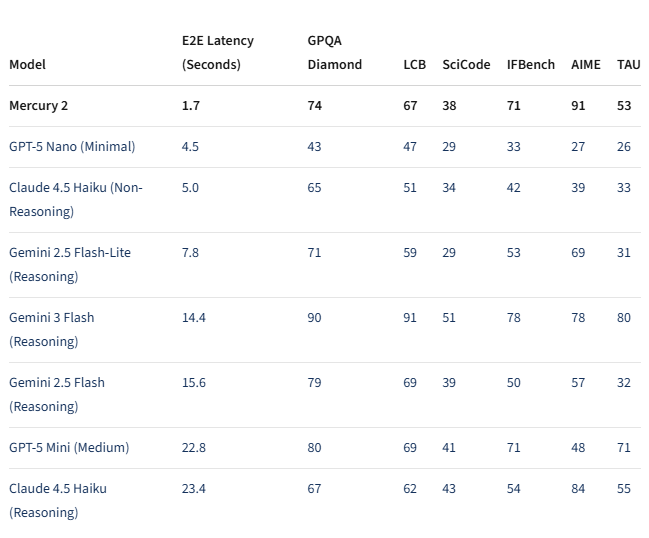
  • Responds in just 1.7 seconds end-to-end latency
  • Outpaces competitors like Google's Gemini3Flash (8x faster) and Anthropic's Claude Haiku4.5

The speed doesn't come at the cost of quality either. In benchmark tests including GPQA Diamond and AIME (standard measures for reasoning ability), Mercury2 holds its own against today's top lightweight models.

Built For Business Needs

Inception Labs clearly designed Mercury2 with practical applications in mind:

  • Cost-effective: Pricing comes in at about 25% of comparable services
  • Enterprise-ready: Supports 128,000 token contexts and tool calling functions
  • Specialized: Particularly suited for voice assistants, search systems, and coding tools where response time is critical

The API is already available for developers to test drive these capabilities firsthand.

Key Points:

  • 🌀 Architecture revolution: Swaps Transformers for diffusion models enabling parallel text optimization
  • Blazing speed: Processes over 1K tokens/second with sub-2-second response times
  • 💰 Budget-friendly: Disruptive pricing at quarter the cost of competitors

Enjoyed this article?

Subscribe to our newsletter for the latest AI news, product reviews, and project recommendations delivered to your inbox weekly.

Weekly digestFree foreverUnsubscribe anytime

Related Articles

Microsoft's New AI Model Thinks Like Humans - Decides When to Go Deep
News

Microsoft's New AI Model Thinks Like Humans - Decides When to Go Deep

Microsoft just unveiled Phi-4-reasoning-vision-15B, an open-source AI model that mimics human decision-making by choosing when to think deeply. Unlike typical models that require manual mode switching, this 15-billion-parameter wonder automatically adjusts its reasoning depth based on task complexity. Excelling in image analysis and math problems while using surprisingly little training data, it could revolutionize how we deploy lightweight AI systems.

March 5, 2026
AI innovationMicrosoft Researchlightweight models
News

Lenovo's Visionary Concepts Steal the Show at MWC 2026

Lenovo turned heads at MWC 2026 with six groundbreaking concept devices that redefine how we interact with technology. From desktop robots that blink to foldable gaming handhelds, these innovations showcase practical applications of AI in work and play. The modular PC design solves the portability-power dilemma, while creative professionals get powerful new tools for 3D modeling.

March 3, 2026
future techAI innovationmodular computing
News

DeepSeek V4 Arrives: A Multimodal AI Powerhouse

DeepSeek is gearing up to launch its V4 model, a significant upgrade featuring image, video, and text generation capabilities. The new version promises better compatibility with domestic chips and introduces a 'lite' variant with a massive 1 million token context window. With potential parameter counts reaching into the trillions, this release could redefine what's possible in multimodal AI applications.

March 2, 2026
AI innovationmultimodal technologydeep learning
News

Zhihuo AI Launches Innovation Tool to Streamline Business R&D

Beijing Zhihuo Intelligent Technology has introduced 'Zhihuo AI Innovation Master,' a new platform designed to accelerate corporate innovation cycles. The tool leverages natural language processing to transform ideas into actionable solutions while assessing patent viability. Already adopted across 30+ industries, it promises to lower R&D costs and boost efficiency for businesses of all sizes.

March 2, 2026
AI innovationR&D technologybusiness automation
Alibaba's New Voice Tech Lets You Command Sounds Like Magic
News

Alibaba's New Voice Tech Lets You Command Sounds Like Magic

Alibaba's Tongyi Lab has unveiled two groundbreaking voice models that respond to natural language commands. Forget complex settings - just tell Fun-CosyVoice3.5 to 'speak more confidently' or instruct Fun-AudioGen-VD to create a battlefield scene with echoing gunfire. These tools promise to revolutionize audio creation for podcasts, games, and films by making professional sound design accessible to everyone.

March 2, 2026
voice technologyAI innovationaudio production
News

DeepSeek V4 Brings Multimodal AI Power to Content Creation

DeepSeek is set to launch its groundbreaking V4 model next week, marking a significant leap in AI capabilities. This multimodal powerhouse will generate text, images, and videos simultaneously, opening new creative possibilities. With optimizations for domestic chips and partnerships with Huawei and Cambricon, V4 promises to boost China's AI ecosystem while giving creators powerful new tools.

February 28, 2026
AI innovationmultimodal modelscontent creation