
Gemini Leads Global AI Vision Race While Chinese Models Gain Ground

The Battle for AI Vision Supremacy Heats Up

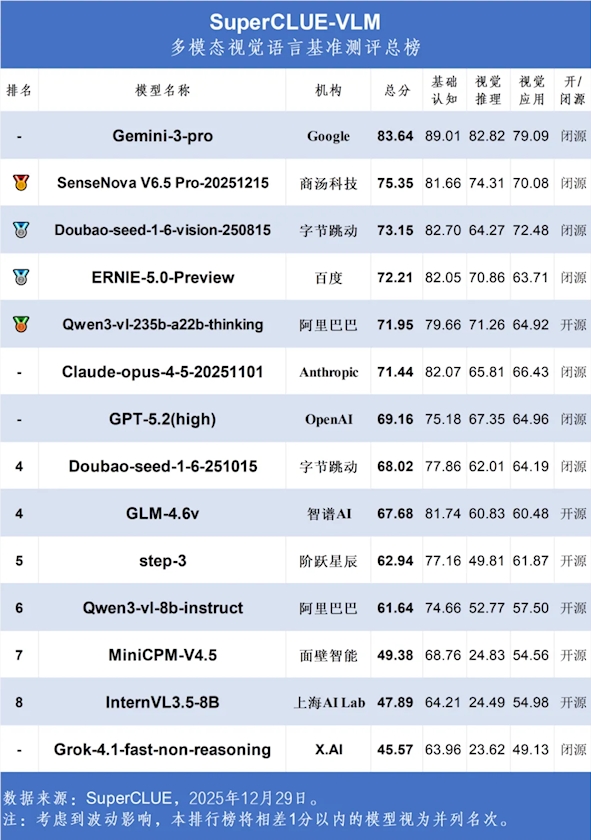
The latest SuperCLUE-VLM12 benchmark paints a fascinating picture of today's multimodal AI landscape. Google's Gemini-3-pro isn't just leading the pack - it's rewriting expectations with a commanding 83.64-point performance across all evaluation categories.
Image

Domestic Challengers Rise

What makes this competition particularly intriguing is the strong showing from Chinese models. SenseTime's SenseNova V6.5Pro claimed second place (75.35 points), demonstrating particular strength in visual reasoning tasks. Meanwhile, ByteDance's Douyin visual version edged into third (73.15 points), even outperforming several international rivals in basic cognition tests.

"These results confirm China's growing capability in computer vision technologies," notes Dr. Li Wei, an AI researcher at Tsinghua University. "Three years ago, we wouldn't have seen domestic models competing at this level."

Surprises and Breakthroughs

The benchmark delivered several notable developments:

  • Open-source milestone: Alibaba's Qwen3-vl became the first open-source model to crack the 70-point barrier (70.89 points), offering powerful visual analysis capabilities to the broader developer community.
  • Established players stumble: Anthropic's Claude-opus-4-5 managed just 71.44 points, while OpenAI's GPT-5.2 (high) surprisingly fell short at 69.16 points - well below industry expectations.
  • Baidu holds steady: ERNIE-5.0-Preview maintained China's strong representation by securing fifth place overall.

What This Means for AI Development

The results suggest we're entering a new phase where: 1) Visual understanding capabilities are becoming crucial differentiators between models 2) The gap between proprietary and open-source solutions is narrowing 3) Traditional power rankings in AI don't necessarily translate to vision capabilities

"We're seeing specialization emerge," explains MIT Professor Alan Chen. "Some models optimized for text struggle with visual tasks, while others like Gemini clearly prioritized multimodal training."

Key Points:

  • Global leader: Gemini-3-pro dominates with top scores across basic cognition (84.2), visual reasoning (83.1), and application (83.6)
  • Chinese advances: Two domestic models now rank among global top three in vision benchmarks
  • Open-source progress: Qwen3-vl breaks new ground for community-developed vision models
  • Shifting landscape: Established leaders like GPT show unexpected weaknesses in visual tasks

Enjoyed this article?

Subscribe to our newsletter for the latest AI news, product reviews, and project recommendations delivered to your inbox weekly.

Weekly digestFree foreverUnsubscribe anytime

Related Articles

MIT's Automated 'Motion Factory' Teaches AI Physical Intuition
News

MIT's Automated 'Motion Factory' Teaches AI Physical Intuition

Researchers from MIT, NVIDIA, and UC Berkeley have cracked a major challenge in video analysis - teaching AI to understand physical motion. Their automated 'FoundationMotion' system generates high-quality training data without human input, helping AI systems grasp concepts like trajectory and timing with surprising accuracy. Early tests show it outperforms much larger models, marking progress toward machines that truly understand how objects move.

January 12, 2026
computer visionAI trainingmotion analysis
Chinese Researchers Teach AI to Spot Its Own Mistakes in Image Creation
News

Chinese Researchers Teach AI to Spot Its Own Mistakes in Image Creation

A breakthrough from Chinese universities tackles AI's 'visual dyslexia' - where image systems understand concepts but struggle to correctly portray them. Their UniCorn framework acts like an internal quality control team, catching and fixing errors mid-creation. Early tests show promising improvements in spatial accuracy and detail handling.

January 12, 2026
AI innovationcomputer visionmachine learning
News

Alibaba Cloud's New Kit Brings AI Smarts to Everyday Gadgets

Alibaba Cloud has unveiled a game-changing development kit that packages its powerful AI models into ready-to-use tools for hardware makers. The kit combines speech, vision, and language capabilities to help devices like smart glasses and robots understand and interact with users naturally. With pre-built features ranging from homework help to creative tools, manufacturers can now add human-like intelligence to their products in weeks rather than months.

January 8, 2026
Alibaba CloudAI hardwaresmart devices
News

Tech Veteran Launches liko.ai to Bring Smarter Privacy-Focused Home Cameras

Ryan Li, former Meituan hardware chief, has secured funding from SenseTime and iFLYTEK affiliates for his new venture liko.ai. The startup aims to revolutionize home security cameras with edge-based AI that processes video locally rather than in the cloud - addressing growing privacy concerns while adding smarter detection capabilities. Their first products are expected mid-2026.

January 7, 2026
smart homecomputer visionedge computing
News

Smart Home Startup liko.ai Lands Funding for Edge AI Vision

AI startup liko.ai has secured its first round of funding from prominent investors including SenseTime Guoxiang Capital and Oriental Fortune Sea. The company, led by smart hardware veteran Ryan Li, aims to transform home automation with edge-based vision-language models that process data locally rather than in the cloud. Their AI Home Center promises smarter, more private smart home experiences.

January 6, 2026
edge computingsmart homecomputer vision
ByteDance's StoryMem Gives AI Videos a Memory Boost
News

ByteDance's StoryMem Gives AI Videos a Memory Boost

ByteDance and Nanyang Technological University researchers have developed StoryMem, an innovative system tackling persistent issues in AI video generation. By mimicking human memory mechanisms, it maintains character consistency across scenes - a challenge even for models like Sora and Kling. The solution cleverly stores key frames as references while keeping computational costs manageable. Early tests show significant improvements in visual continuity and user preference scores.

January 4, 2026
AI video generationByteDancecomputer vision