
DeepSeek-V4 Set to Revolutionize Code Generation This February

DeepSeek's Next-Gen AI Coder Arrives for Lunar New Year

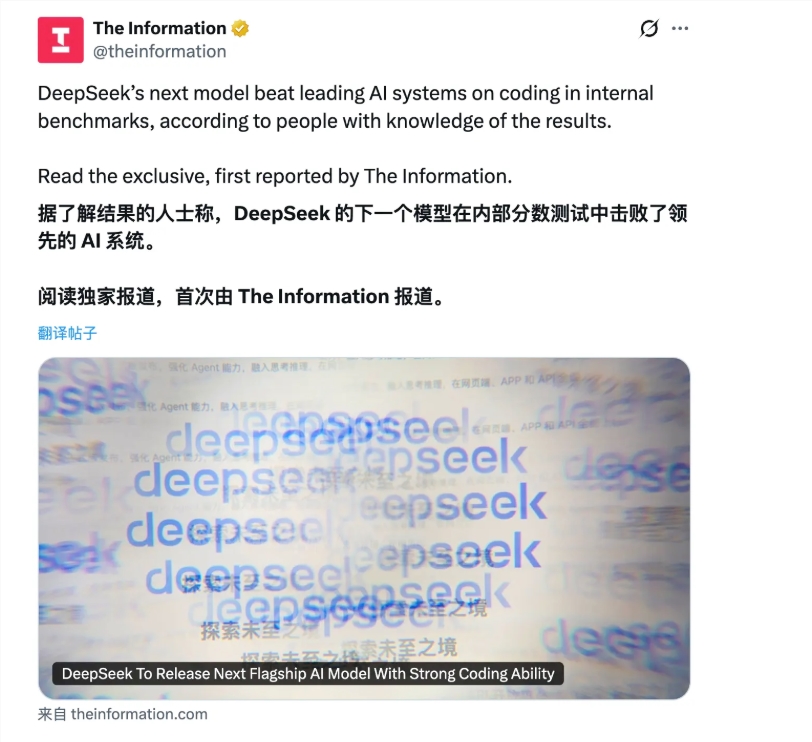
Tech circles are buzzing with anticipation as DeepSeek prepares to roll out its flagship DeepSeek-V4 model in mid-February. This isn't just another incremental update - early tests suggest it could redefine what we expect from AI-assisted coding.
Image

Why Developers Should Pay Attention

The new model builds on December's V3.2 release but packs substantially more power under the hood. Internal benchmarks show it outperforming established players like Anthropic's Claude and OpenAI's GPT series, particularly when wrestling with lengthy, complex code prompts. Imagine an AI that doesn't just complete your code snippets but truly understands the architecture of your entire project.

"Users will notice immediately how much more structured the responses are," reveals an insider familiar with the development. This isn't just about speed - it's about precision. The model's revamped architecture allows it to spot patterns in data sequences that would trip up earlier versions, all while making smarter use of computing resources.

Following in Successful Footsteps

The release strategy mirrors last year's hit R1 model, which sparked an open-source revolution among Chinese AI developers. DeepSeek has been on a roll lately, launching specialized models for everything from mathematical operations to multimodal processing. Each release seems to push boundaries further.

While company officials remain tight-lipped about specific features, the tech community is already speculating about potential applications. Could this be the tool that finally bridges the gap between conceptual design and production-ready code? Many developers think so.

What This Means for AI's Future

Beyond immediate practical applications, DeepSeek-V4 represents another leap forward in artificial intelligence capabilities. Its ability to maintain context across long code sequences suggests we're moving closer to AI that can genuinely collaborate on complex engineering challenges rather than just assisting with discrete tasks.

The launch timing - coinciding with Lunar New Year celebrations - feels symbolic. Just as the holiday marks renewal and progress in many Asian cultures, this release could signal a new chapter in how humans and machines create software together.

Key Points:

  • Launch scheduled for mid-February 2026
  • Significant improvements in code generation and long-sequence processing
  • Outperforms Claude and GPT series in internal tests
  • New architecture enables better pattern recognition
  • Follows successful R1 open-source model strategy

Enjoyed this article?

Subscribe to our newsletter for the latest AI news, product reviews, and project recommendations delivered to your inbox weekly.

Weekly digestFree foreverUnsubscribe anytime

Related Articles

Anthropic's Cowork: The AI Coding Assistant Built by AI in Just 10 Days
News

Anthropic's Cowork: The AI Coding Assistant Built by AI in Just 10 Days

Anthropic has unveiled Cowork, a groundbreaking AI programming assistant developed primarily by its own Claude model in mere days. Designed to democratize coding, Cowork lets users complete tasks through simple voice commands - though Anthropic cautions about potential risks. The tool's rapid development showcases AI's growing capability to build itself.

January 14, 2026
AI DevelopmentProgramming ToolsAnthropic
Chinese AI Model Stuns Tech World with Consumer GPU Performance
News

Chinese AI Model Stuns Tech World with Consumer GPU Performance

Jiukun Investment's new IQuest-Coder-V1 series is turning heads in the AI community. This powerful code-generation model, running on a single consumer-grade GPU, outperforms industry giants like Claude and GPT-5.2 in coding tasks. Its unique 'code flow' training approach mimics real-world development processes, offering developers unprecedented creative possibilities while keeping hardware requirements surprisingly accessible.

January 4, 2026
AI DevelopmentMachine LearningCode Generation
South Korea's AI Dream Hits Snag as Firms Rely on Chinese Code
News

South Korea's AI Dream Hits Snag as Firms Rely on Chinese Code

South Korea's ambitious plan to build a homegrown AI industry has hit turbulence after three finalists in a government-backed competition were found using Chinese open-source code. While companies defend their approach as standard practice, the revelations have sparked debate about what truly constitutes 'self-reliant' AI development in today's interconnected tech landscape.

January 14, 2026
AI DevelopmentSouth Korea TechOpen Source Controversy
Claude Code Goes Desktop: A Developer's New Best Friend
News

Claude Code Goes Desktop: A Developer's New Best Friend

Anthropic has launched a desktop preview of Claude Code, bringing AI-assisted programming to developers' fingertips with a sleek graphical interface. The standout feature? Multi-session workflows powered by Git Worktree technology let developers juggle tasks without messy code conflicts. It's like having multiple coding assistants working simultaneously in isolated branches. The desktop version plays nice with cloud tools and automatically syncs your development environment - no more npm headaches. Currently available for macOS and Windows (excluding ARM), this release transforms Claude from chatbot to full-fledged coding companion.

January 7, 2026
AI DevelopmentCoding ToolsProductivity Tech
News

DeepSeek Finds Smarter AI Doesn't Need Bigger Brains

DeepSeek's latest research reveals a breakthrough in AI development - optimizing neural network architecture can boost reasoning abilities more effectively than simply scaling up model size. Their innovative 'Manifold-Constrained Hyper-Connections' approach improved complex reasoning accuracy by over 7% while adding minimal training costs, challenging the industry's obsession with ever-larger models.

January 4, 2026
AI ResearchMachine LearningNeural Networks
MiniMax Unveils M2.1 Model with Developer-Friendly Pricing
News

MiniMax Unveils M2.1 Model with Developer-Friendly Pricing

MiniMax shakes up the AI development landscape with its newly open-sourced M2.1 programming model, now accessible across major platforms. The release comes packed with developer perks - from instant vLLM support to budget-friendly subscription plans starting at just 9.9 RMB. Early adopters can also benefit from referral discounts through February 2026.

December 31, 2025
AI DevelopmentProgramming ModelsMiniMax