
Baidu's AI Chip Arm Kunlun Takes Leap Toward Hong Kong IPO

Baidu's Chip Unit Charges Toward Hong Kong IPO

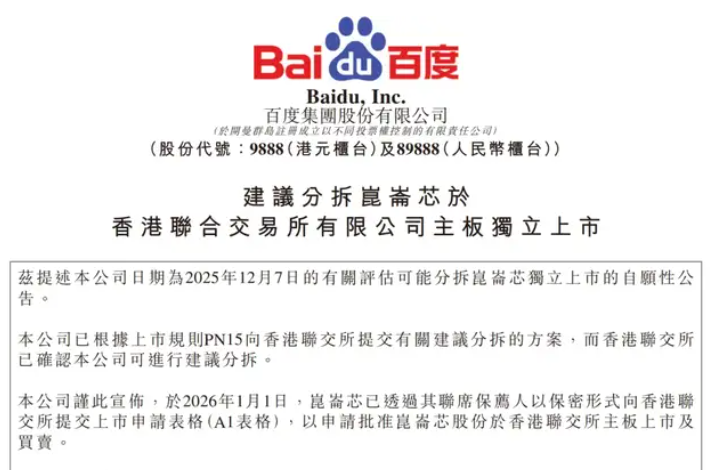
In a move that sent Baidu's shares climbing, the tech giant's semiconductor subsidiary Kunlun Xing Technology has officially filed for listing on the Hong Kong Stock Exchange. The announcement comes as China's AI chip sector shows no signs of slowing down.
Image

From Internal Project to Industry Contender

The story of Kunlun Xing reads like a Silicon Valley startup tale - albeit with Beijing characteristics. What began in 2011 as Baidu's internal FPGA accelerator project aimed at cutting costs has evolved into China's second-largest AI chip shipper by volume. The company took its first major leap in 2018 with the debut of "Kunlun 1," built on Baidu's proprietary XPU architecture.

"This isn't just about financial engineering," observes tech analyst Li Wei. "Baidu's spinning out Kunlun at precisely the moment when global investors are hungry for pure-play AI hardware stories."

Strategic Play With Multiple Payoffs

The listing serves dual purposes for Baidu:

  • Valuation clarity: Allowing markets to price Kunlun separately from its parent company
  • Funding flexibility: Creating direct access to capital markets for R&D and expansion

Notably, the offering won't include preferential rights for existing Baidu shareholders - a structure that suggests confidence in broader investor appetite.

Management Incentives Align With Growth

Insiders highlight another critical benefit: the IPO ties Kunlun leadership compensation directly to performance metrics. "When you're competing against NVIDIA and other giants, you need every motivational edge," comments semiconductor consultant Zhang Tao.

The timing appears strategic. With global demand for high-performance computing chips surging across industries from cloud computing to autonomous vehicles, Kunlun aims to position itself as China's answer to specialized AI processors.

Key Points:

  • Market position: Second-largest AI chip shipper in China since 2021 independence
  • Technical heritage: Roots trace back to Baidu's 2011 FPGA accelerator program
  • Strategic rationale: Separate valuation, direct funding access, management incentives
  • Industry context: Comes amid booming global demand for specialized AI processors

Enjoyed this article?

Subscribe to our newsletter for the latest AI news, product reviews, and project recommendations delivered to your inbox weekly.

Weekly digestFree foreverUnsubscribe anytime

Related Articles

Apple's AI Chip Production Nears Launch, Powering Future Data Centers
News

Apple's AI Chip Production Nears Launch, Powering Future Data Centers

Apple is gearing up to mass-produce its own AI server chips by late 2026, with plans to deploy them in specialized data centers starting in 2027. The tech giant's $50 billion manufacturing push includes a Texas factory already shipping servers for its Apple Intelligence platform. This move signals Apple's bet on explosive growth in AI-powered devices and services.

January 14, 2026
AppleAI HardwareData Centers
OpenAI's 'Sweetpea': Jony Ive-Designed AI Audio Device Targets Mass Market
News

OpenAI's 'Sweetpea': Jony Ive-Designed AI Audio Device Targets Mass Market

OpenAI is secretly developing an AI-powered audio device codenamed 'Sweetpea', designed by Apple's former design chief Jony Ive. The sleek oval-shaped gadget features cutting-edge 2nm AI chips and innovative silent command technology. With Foxconn handling manufacturing, OpenAI aims to ship 40-50 million units in its first year, marking its bold move into consumer hardware.

January 14, 2026
AI HardwareJony IveWearable Tech
News

South Korea secures priority access to NVIDIA's cutting-edge AI chips

At CES 2026, South Korean officials announced NVIDIA's commitment to prioritize delivery of next-generation Vera Rubin GPUs to the country. This strategic move comes as part of a broader partnership that includes supplying up to 260,000 GPUs for South Korea's AI infrastructure development. Officials emphasized how securing advanced chip technology early could give Korean tech firms a crucial edge in global AI competition.

January 13, 2026
NVIDIAArtificial IntelligenceTech Partnerships
News

Dell's GB10 Brings Supercomputer Power to Your Desk

Dell's new Pro Max with GB10 system packs serious AI muscle into a desktop-sized package. With 128GB unified memory and NVIDIA's Blackwell architecture, developers can now fine-tune models up to 20 billion parameters locally - no cloud required. The compact powerhouse weighs just 1.2kg but delivers performance that could reshape how AI teams prototype and iterate.

January 9, 2026
AI HardwareLocal ComputingNVIDIA Blackwell
News

Nvidia's Rubin AI Chips Promise Quantum Leap in Computing Power

Nvidia has unveiled its groundbreaking Rubin chip architecture at CES, marking a significant leap forward in AI computing capabilities. The new system, already in production, delivers 3.5x faster training and 5x quicker inference than its predecessor. Major tech players like OpenAI and AWS are already on board, with supercomputer projects lining up to harness Rubin's power. This innovation comes as the AI infrastructure race heats up, with Nvidia predicting hundreds of billions in sector investments.

January 6, 2026
AI HardwareChip TechnologyNvidia
Looki Secures $20M Boost Ahead of CES Showcase
News

Looki Secures $20M Boost Ahead of CES Showcase

AI hardware innovator Looki has closed a $20 million Series A round led by Ant Group, with Meituan Longzhu and others joining. The fresh capital will fuel development of their 'Life Viewer' camera that transforms daily moments into creative content. As CES2026 approaches, Looki prepares to unveil groundbreaking 'Proactive AI' features that anticipate user needs rather than waiting for commands.

January 6, 2026
AI HardwareConsumer TechSmart Devices