
Apple's AI Paper Hits Snag: Benchmark Errors Trigger Late-Night Debugging Frenzy

Apple's Visual Reasoning Paper Requires Emergency Fix After Benchmark Errors Surface
Image

The AI research community buzzed with controversy this week as flaws emerged in an Apple paper submitted to ICLR 2025. The study, which boldly claimed smaller models could surpass GPT-5's visual reasoning capabilities, now faces serious questions about its methodology.

The Discovery That Shook the Team

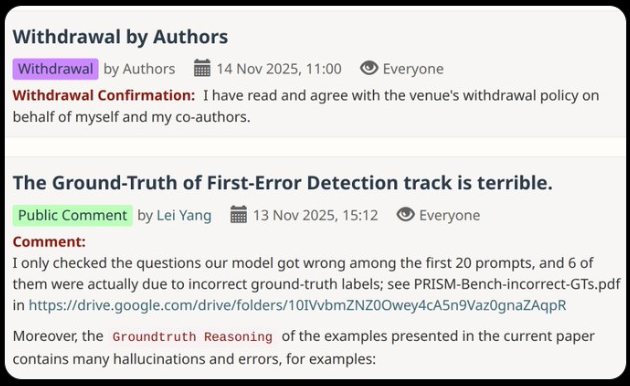
Lei Yang, a researcher at Jiechu Star, stumbled upon troubling inconsistencies while attempting to replicate the study's results. "At first I thought I must be doing something wrong," Yang admitted. "Then I realized the official code completely omitted crucial image inputs."

The problems didn't stop there. When Yang examined a sample of 20 test questions, he found six contained incorrect ground truth labels—an error rate suggesting nearly one-third of the benchmark data might be flawed.

Swift Response But Lingering Questions

Yang's GitHub issue initially received scant attention before being abruptly closed. Undeterred, he published a detailed critique that quickly went viral across academic circles. Within 24 hours, Apple's research team acknowledged "defects in the data generation process" and rushed out corrected benchmarks.

The incident highlights growing pains in AI research methodology:

  • Automated dataset generation without proper validation checks
  • Pressure to demonstrate breakthroughs against larger models
  • The human cost when errors slip through—countless hours wasted replicating flawed work

"Before you burn midnight oil on replication," Yang advises fellow researchers, "run a quick diagnostic check first."

The episode serves as a cautionary tale about maintaining rigorous standards even amid fierce competition to push boundaries in artificial intelligence.

Key Points:

  • Apple paper claimed small models beat GPT-5 at visual reasoning tasks
  • Independent researcher found missing code components and labeling errors affecting ~30% of benchmark data
  • Findings prompted urgent corrections from original authors
  • Incident sparks debate about quality control in AI research methodologies

Enjoyed this article?

Subscribe to our newsletter for the latest AI news, product reviews, and project recommendations delivered to your inbox weekly.

Weekly digestFree foreverUnsubscribe anytime

Related Articles

News

DeepSeek Finds Smarter AI Doesn't Need Bigger Brains

DeepSeek's latest research reveals a breakthrough in AI development - optimizing neural network architecture can boost reasoning abilities more effectively than simply scaling up model size. Their innovative 'Manifold-Constrained Hyper-Connections' approach improved complex reasoning accuracy by over 7% while adding minimal training costs, challenging the industry's obsession with ever-larger models.

January 4, 2026
AI ResearchMachine LearningNeural Networks
DeepSeek-V4 Set to Revolutionize Code Generation This February
News

DeepSeek-V4 Set to Revolutionize Code Generation This February

DeepSeek is gearing up to launch its powerful new AI model, DeepSeek-V4, around Chinese New Year. The update promises major leaps in code generation and handling complex programming tasks, potentially outperforming competitors like Claude and GPT series. Developers can expect more organized responses and better reasoning capabilities from this innovative tool.

January 12, 2026
AI DevelopmentProgramming ToolsMachine Learning
NYU Professor's 42-Cent AI Oral Exams Expose Cheating Gap
News

NYU Professor's 42-Cent AI Oral Exams Expose Cheating Gap

An NYU professor found students acing written assignments often couldn't explain basic concepts when quizzed verbally. His solution? AI-powered oral exams costing just 42 cents per student. While stressful for some, 70% agreed these tests better measured real understanding than traditional methods. The experiment reveals both cheating vulnerabilities and AI's potential to transform academic assessment.

January 5, 2026
AI in EducationAcademic IntegrityNYU Innovation
Chinese AI Model Stuns Tech World with Consumer GPU Performance
News

Chinese AI Model Stuns Tech World with Consumer GPU Performance

Jiukun Investment's new IQuest-Coder-V1 series is turning heads in the AI community. This powerful code-generation model, running on a single consumer-grade GPU, outperforms industry giants like Claude and GPT-5.2 in coding tasks. Its unique 'code flow' training approach mimics real-world development processes, offering developers unprecedented creative possibilities while keeping hardware requirements surprisingly accessible.

January 4, 2026
AI DevelopmentMachine LearningCode Generation
News

Meta's AI Shakeup: LeCun Questions New Leader's Credentials

AI pioneer Yann LeCun didn't mince words about Meta's new AI chief Alexandr Wang, calling him inexperienced in research leadership. The criticism comes as Zuckerberg reshuffles Meta's AI team following disappointing performance. LeCun reveals deep divisions over Meta's AI direction while launching his own venture focused on alternative approaches.

January 4, 2026
MetaArtificial IntelligenceTech Leadership
NVIDIA's NitroGen learns to game like humans by watching YouTube
News

NVIDIA's NitroGen learns to game like humans by watching YouTube

NVIDIA has unveiled NitroGen, an AI model that learns to play video games simply by watching gameplay videos. Trained on 40,000 hours of footage spanning over 1,000 titles, this breakthrough can understand controller inputs from screen recordings alone. The system shows remarkable adaptability, improving performance by up to 52% when transferring skills to new games.

December 29, 2025
AI GamingNVIDIAMachine Learning