
Ant Group and Renmin University Unveil First Native MoE Diffusion Language Model

Ant Group and Renmin University Unveil Groundbreaking LLaDA-MoE Model

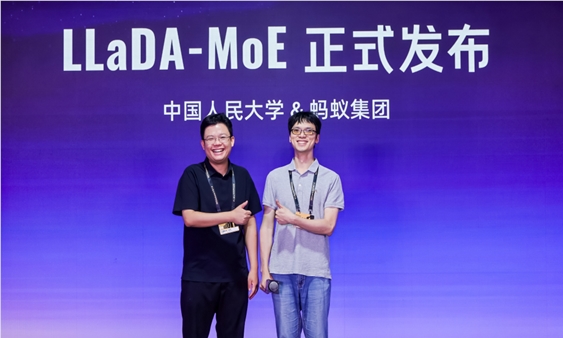
At the 2025 Inclusion·Bund Conference, Ant Group and Renmin University jointly introduced LLaDA-MoE, the industry's first native Mixture of Experts (MoE) architecture diffusion language model (dLLM). This breakthrough challenges the conventional belief that language models must be autoregressive.

Key Innovations

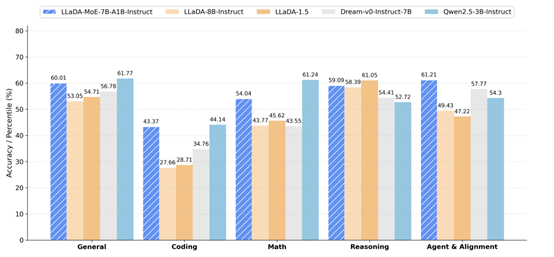
The LLaDA-MoE model was trained from scratch on approximately 20 terabytes of data, demonstrating remarkable scalability and stability in industrial-scale training. It outperforms previous dense diffusion language models like LLaDA1.0/1.5 and Dream-7B, while matching the performance of equivalent autoregressive models like Qwen2.5-3B-Instruct. Notably, it achieves this by activating only 1.4 billion parameters out of a total 7 billion.
Image

Caption: Renmin University and Ant Group jointly launched the first MoE architecture diffusion model LLaDA-MoE.

Performance Highlights

Under Ant's unified evaluation framework, LLaDA-MoE showed an average improvement of 8.4% across 17 benchmarks, including HumanEval, MBPP, and GSM8K. It leads LLaDA-1.5 by 13.2% and ties with Qwen2.5-3B-Instruct, validating the "MoE amplifier" effect in the dLLM field.
Image

Caption: Performance metrics of LLaDA-MoE compared to other models.

Technical Breakthroughs

Lan Zhenzhong, Director of Ant Group's General AI Research Center, emphasized that this model represents a significant step toward scaling dLLMs to larger sizes. The team rewrote training code based on LLaDA-1.0 and utilized Ant's distributed framework ATorch for parallel acceleration.

Assistant Professor Li Chongxuan from Renmin University highlighted that traditional autoregressive models struggle with bidirectional token dependencies, a limitation addressed by LLaDA-MoE's parallel decoding approach.

Open-Source Commitment

Ant Group plans to open-source not only the model weights but also a custom inference engine optimized for dLLM parallelism, which reportedly outperforms NVIDIA's fast-dLLM solution. Technical reports and code will be released on GitHub and Hugging Face.

Key Points:

  • First native MoE architecture diffusion language model (dLLM)
  • Trained on 20T data with 7B total parameters (1.4B activated)
  • Outperforms dense diffusion models; matches autoregressive counterparts
  • Open-sourcing model weights and inference framework soon

Enjoyed this article?

Subscribe to our newsletter for the latest AI news, product reviews, and project recommendations delivered to your inbox weekly.

Weekly digestFree foreverUnsubscribe anytime

Related Articles

News

MiniMax Surpasses Baidu: China's AI Landscape Gets a Shake-Up

In a stunning market reversal, AI unicorn MiniMax has overtaken tech giant Baidu with a HK$382.6 billion valuation. The company's stock surged 22% amid strong financials showing 158.9% revenue growth, with 70% coming from international markets. This milestone signals shifting priorities in China's AI sector - from technical benchmarks to real-world profitability and global competitiveness.

March 11, 2026
AITechStocksMarketTrends
Xie Saining's Team Unveils Solaris: A Breakthrough in Multi-User Video AI
News

Xie Saining's Team Unveils Solaris: A Breakthrough in Multi-User Video AI

Xie Saining's research team has launched Solaris, the world's first multi-user video world model, powered by Kunlun Wanzhi's Matrix-Game2.0. This innovative technology enhances player interaction in environments like Minecraft, outperforming previous solutions. The release coincides with a major funding milestone for Xie's AI company, AMI, highlighting the growing importance of world models in advancing artificial general intelligence.

March 11, 2026
AIMachine LearningVirtual Worlds
Ant Group's AI Hiring Spree: Tech Roles Dominate 2026 Campus Recruitment
News

Ant Group's AI Hiring Spree: Tech Roles Dominate 2026 Campus Recruitment

Ant Group kicks off its 2026 spring campus hiring with a strong focus on AI talent. A whopping 85% of openings are technical roles, with over 70% directly tied to artificial intelligence fields like large model algorithms and AI security. The recruitment spans global locations including Hangzhou, San Francisco, and London. This marks Ant's sixth consecutive year maintaining tech positions above 80%, signaling its aggressive push into AGI development while nurturing future tech leaders through specialized programs.

March 10, 2026
AntGroupAI RecruitmentTech Talent
ChatGPT Now Recognizes Songs Like Shazam - Here's How It Works
News

ChatGPT Now Recognizes Songs Like Shazam - Here's How It Works

OpenAI has teamed up with Shazam to bring music recognition directly into ChatGPT. No more switching apps when you hear that catchy tune - just ask ChatGPT what's playing and get instant results. The integration lets users identify songs through simple voice or text commands, complete with artist info and preview clips. It's like having a music-savvy friend in your chat.

March 10, 2026
OpenAIChatGPTShazam
GPT-5.4 Arrives With Mind-Reading AI and Million-Token Memory
News

GPT-5.4 Arrives With Mind-Reading AI and Million-Token Memory

OpenAI's latest model, GPT-5.4, introduces revolutionary features that bring us closer to truly intelligent digital assistants. The new Thinking mode lets users peer into the AI's reasoning process, while million-token memory enables handling massive documents. Perhaps most impressive are its native computer operation abilities - this AI doesn't just talk, it can actually work across your applications.

March 6, 2026
AIOpenAIGPT
AI Agents Get Smarter on the Fly with New Training Framework
News

AI Agents Get Smarter on the Fly with New Training Framework

Ant Group and Tsinghua University have unveiled AReaL v1.0, a breakthrough reinforcement learning framework that lets AI agents improve themselves during actual use. Unlike traditional systems that require extensive coding, this innovative solution allows existing agents to connect seamlessly - imagine your digital assistant getting better at its job every time you use it. The system's secret weapon? An AI-powered development assistant that helped build its complex architecture in record time.

March 4, 2026
AIMachineLearningTechInnovation