
Xiaohongshu's New AI Tool Lets You Compose Images Like a Pro

Xiaohongshu and Fudan Break New Ground in AI Image Generation
Image

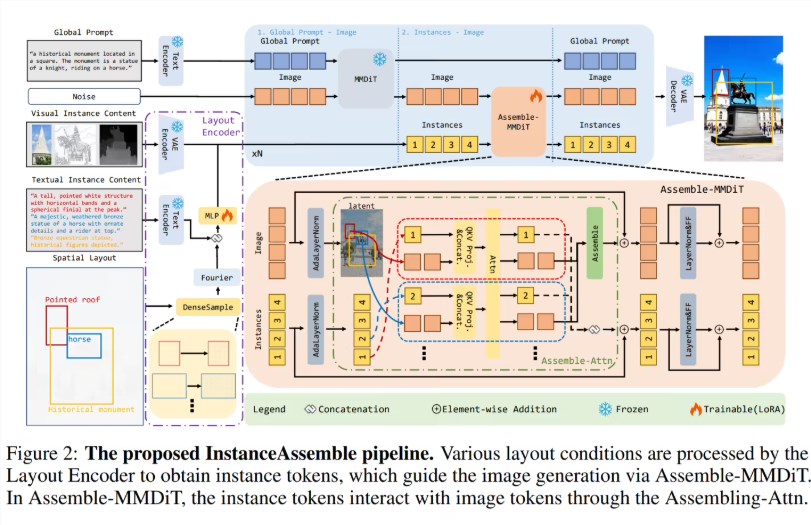
The collaboration between social media platform Xiaohongshu and Fudan University has yielded InstanceAssemble, a breakthrough technology that finally gives users real control over where objects appear in AI-generated images. Accepted by the prestigious NeurIPS 2025 conference, this innovation addresses what creators have long complained about - AI's tendency to misplace or misunderstand spatial relationships between elements.

Solving the Placement Puzzle

While current text-to-image systems can produce stunning visuals, they often stumble when asked to position objects precisely. Want a cat sitting on a specific chair? The AI might put it beside the chair instead - or worse, turn it into some feline-chair hybrid. InstanceAssemble changes this through its "instance assembly attention" mechanism.

"It's like giving the AI spatial awareness," explains Dr. Li Wen from Fudan's Computer Science department. "Users simply define bounding boxes and descriptions for each element, and the system generates content exactly where it should be."

Lightweight Yet Powerful

The technology impresses with its efficiency. Rather than requiring complete model retraining, InstanceAssemble adds just:

  • 3.46% parameters for Stable Diffusion3-Medium
  • A mere 0.84% for Flux.1 models

This lightweight approach makes adoption practical for developers working with existing systems.

Benchmarking Progress

The team didn't stop at the core technology. They've also released Denselayout - a benchmark dataset containing 90,000 instances - along with new evaluation metrics to standardize performance measurement across the industry.

With all code and pretrained models available on GitHub, InstanceAssemble could revolutionize fields from graphic design to advertising by finally giving creators pixel-perfect control over AI-generated compositions.

Key Points:

  • 🎯 Pinpoint placement through innovative "instance assembly attention"
  • Minimal overhead adds less than 4% parameters to existing models
  • 🔓 Fully open-source including pretrained models and benchmarking tools

Enjoyed this article?

Subscribe to our newsletter for the latest AI news, product reviews, and project recommendations delivered to your inbox weekly.

Weekly digestFree foreverUnsubscribe anytime

Related Articles

MIT's Automated 'Motion Factory' Teaches AI Physical Intuition
News

MIT's Automated 'Motion Factory' Teaches AI Physical Intuition

Researchers from MIT, NVIDIA, and UC Berkeley have cracked a major challenge in video analysis - teaching AI to understand physical motion. Their automated 'FoundationMotion' system generates high-quality training data without human input, helping AI systems grasp concepts like trajectory and timing with surprising accuracy. Early tests show it outperforms much larger models, marking progress toward machines that truly understand how objects move.

January 12, 2026
computer visionAI trainingmotion analysis
Chinese Researchers Teach AI to Spot Its Own Mistakes in Image Creation
News

Chinese Researchers Teach AI to Spot Its Own Mistakes in Image Creation

A breakthrough from Chinese universities tackles AI's 'visual dyslexia' - where image systems understand concepts but struggle to correctly portray them. Their UniCorn framework acts like an internal quality control team, catching and fixing errors mid-creation. Early tests show promising improvements in spatial accuracy and detail handling.

January 12, 2026
AI innovationcomputer visionmachine learning
News

Tech Veteran Launches liko.ai to Bring Smarter Privacy-Focused Home Cameras

Ryan Li, former Meituan hardware chief, has secured funding from SenseTime and iFLYTEK affiliates for his new venture liko.ai. The startup aims to revolutionize home security cameras with edge-based AI that processes video locally rather than in the cloud - addressing growing privacy concerns while adding smarter detection capabilities. Their first products are expected mid-2026.

January 7, 2026
smart homecomputer visionedge computing
News

Smart Home Startup liko.ai Lands Funding for Edge AI Vision

AI startup liko.ai has secured its first round of funding from prominent investors including SenseTime Guoxiang Capital and Oriental Fortune Sea. The company, led by smart hardware veteran Ryan Li, aims to transform home automation with edge-based vision-language models that process data locally rather than in the cloud. Their AI Home Center promises smarter, more private smart home experiences.

January 6, 2026
edge computingsmart homecomputer vision
ByteDance's StoryMem Gives AI Videos a Memory Boost
News

ByteDance's StoryMem Gives AI Videos a Memory Boost

ByteDance and Nanyang Technological University researchers have developed StoryMem, an innovative system tackling persistent issues in AI video generation. By mimicking human memory mechanisms, it maintains character consistency across scenes - a challenge even for models like Sora and Kling. The solution cleverly stores key frames as references while keeping computational costs manageable. Early tests show significant improvements in visual continuity and user preference scores.

January 4, 2026
AI video generationByteDancecomputer vision
ByteDance's StoryMem Brings Consistency to AI-Generated Videos
News

ByteDance's StoryMem Brings Consistency to AI-Generated Videos

ByteDance and Nanyang Technological University researchers have developed StoryMem, a breakthrough system tackling character consistency issues in AI video generation. By intelligently storing and referencing key frames, the technology maintains visual continuity across scenes - achieving 28.7% better consistency than existing models. While promising for storytelling applications, the system still faces challenges with complex multi-character scenes.

January 4, 2026
AI video generationByteDancecomputer vision