
Unsloth Studio Puts AI Fine-Tuning in Your Hands

Unsloth Studio Democratizes AI Model Fine-Tuning
Image

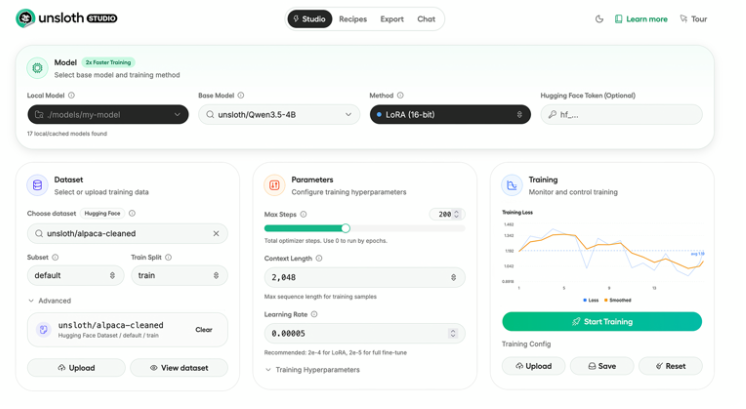
In a move that could reshape how developers work with large language models, Unsloth AI has launched Unsloth Studio - a local visual interface that brings professional-grade model fine-tuning capabilities to everyday computers. This isn't just another incremental improvement; it's a fundamental shift in accessibility for AI development.

Breaking Down the Technical Barriers

What sets Unsloth Studio apart is its remarkable efficiency. Using custom Triton-language backpropagation kernels, the platform achieves what seemed impossible until now:

  • Lightning-fast training at twice the speed of conventional methods
  • Dramatically reduced memory needs, cutting VRAM requirements by 70%
  • Consumer hardware compatibility, letting RTX4090/5090 GPUs handle models previously requiring server clusters

"We're seeing developers fine-tune 70B parameter models on single GPUs," explains the Unsloth team. "That's the kind of capability that used to require expensive cloud setups or specialized hardware."

The All-in-One Workflow Solution

The studio isn't just about raw performance - it's designed for real-world usability:

Visual Data Preparation

Gone are the days of wrestling with messy datasets. The node-based workflow automatically processes PDFs, JSONL files, and other formats, transforming them into structured training data through NVIDIA DataDesigner integration.

Built-In Advanced Training

Unsloth comes ready with GRPO (Group-wise Relative Policy Optimization) from DeepSeek-R1, enabling complex reasoning training without additional infrastructure. This means your local setup can now achieve results comparable to cloud-based alternatives.

Deployment Made Simple

The platform closes the loop with one-click exports to GGUF, vLLM, and Ollama formats. No more struggling to move trained models into production - it's all handled seamlessly within the same environment.

Why This Matters Now

As AI development becomes increasingly democratized, tools like Unsloth Studio represent a crucial step forward. It shifts power from expensive cloud services back to individual developers and organizations who value privacy and cost-efficiency. With native support for popular model families like Llama4 and Qwen, it's positioned to become an essential tool in every AI developer's arsenal.

The implications are significant: smaller teams can now compete with larger organizations in creating specialized models, academic researchers can experiment without budget constraints, and businesses can maintain full control over their proprietary AI developments.

Key Points:

  • Open-source visual interface eliminates complex setup processes
  • 2x faster training with 70% less VRAM usage than standard methods
  • Enables large model fine-tuning on consumer GPUs (RTX4090/5090)
  • Comprehensive workflow from data prep to deployment in one package
  • Supports latest model architectures including Llama4 and Qwen series

Enjoyed this article?

Subscribe to our newsletter for the latest AI news, product reviews, and project recommendations delivered to your inbox weekly.

Weekly digestFree foreverUnsubscribe anytime

Related Articles

Mistral AI's Small4: A Versatile Powerhouse for Developers
News

Mistral AI's Small4: A Versatile Powerhouse for Developers

European AI lab Mistral has unveiled its latest innovation - the Small4 model. This open-source marvel combines reasoning, multimodal understanding, and programming capabilities in one package. With a 256k context window and efficient MoE architecture, it promises significant performance gains over its predecessor. Developers now have a powerful all-in-one solution that doesn't force them to choose between specialized models.

March 20, 2026
AI DevelopmentOpen SourceMachine Learning
Alibaba's Qwen3.5-Max Shakes Up Global AI Rankings
News

Alibaba's Qwen3.5-Max Shakes Up Global AI Rankings

Alibaba's latest AI model, Qwen3.5-Max-Preview, has stunned the tech world by topping LMArena's blind tests with a record 1464 score. The Chinese model outperformed global rivals like GPT5.4 and Claude4.5, signaling China's growing dominance in AI. Half of the top ten spots now belong to Chinese companies, marking a seismic shift in the global AI landscape.

March 20, 2026
Artificial IntelligenceAlibabaMachine Learning
Anthropic's Claude Code Goes Mobile: Control AI Development from Your Phone
News

Anthropic's Claude Code Goes Mobile: Control AI Development from Your Phone

Anthropic has quietly rolled out a game-changing feature for developers - Claude Code Channels. Now you can manage your local AI coding sessions remotely via Telegram or Discord, receiving updates and sending commands from anywhere. The feature transforms Claude Code into a truly asynchronous development assistant, letting you step away from your desk while it keeps working. Early adopters are already comparing it to collaborating with a human engineer.

March 20, 2026
AI DevelopmentAnthropicRemote Coding
OpenAI Bolsters Codex with Astral Acquisition in Strategic Play
News

OpenAI Bolsters Codex with Astral Acquisition in Strategic Play

OpenAI has made another strategic move by acquiring developer tool startup Astral, known for its popular Python tools Ruff and uv. The acquisition aims to strengthen Codex, OpenAI's programming assistant that's seen user numbers triple this year. This comes as part of OpenAI's broader expansion strategy that's included several high-profile acquisitions across different tech sectors.

March 20, 2026
OpenAIAI DevelopmentTech Acquisitions
News

Anthropic's New AI Model Faces Backlash Amid OpenClaw Controversy

Anthropic has launched Claude 3.6 Sonnet, its latest enterprise-focused AI model with enhanced programming capabilities and massive context windows. But the release comes at a difficult time - the company is embroiled in a public relations crisis over its handling of the open-source OpenClaw project. While the technical upgrades are impressive, analysts say Anthropic's heavy-handed trademark enforcement may have damaged its reputation with developers at a crucial moment.

March 19, 2026
AI DevelopmentEnterprise TechnologyOpen Source Controversy
Google's Gemini API Gets Smarter with New Multi-Tool Features
News

Google's Gemini API Gets Smarter with New Multi-Tool Features

Google DeepMind has supercharged its Gemini API with two game-changing features that make AI development smoother. The new multi-tool chaining lets developers combine Google services like Search and Maps with custom functions in one go, while the context circulation feature automatically passes data between tools. These upgrades tackle common frustrations like clunky workflows and slow responses, giving developers more power to build sophisticated AI applications.

March 19, 2026
AI DevelopmentGoogle DeepMindAPI Updates