

San Francisco Blackout Freezes Waymo's Robotaxi Fleet, Revealing Tech Vulnerabilities
Power Outage Exposes Cracks in Autonomous Vehicle Infrastructure
San Francisco's streets turned into an unintended parking lot for Waymo's robotaxis last night when a widespread power outage left the company's entire fleet frozen in place. The blackout, triggered by a fire at a Pacific Gas & Electric substation, didn't just darken homes - it revealed surprising vulnerabilities in what many consider the world's most advanced autonomous driving system.
Grid Down, Cars Stopped
Social media erupted with videos showing the surreal scene: pristine white Jaguar I-Paces with their distinctive spinning lidars sat motionless at intersections and mid-block, forcing human drivers to navigate around them like obstacles in some real-world video game. The paralysis wasn't limited to Waymo - failed traffic signals and halted Muni buses brought much of the city's transportation network to a standstill.
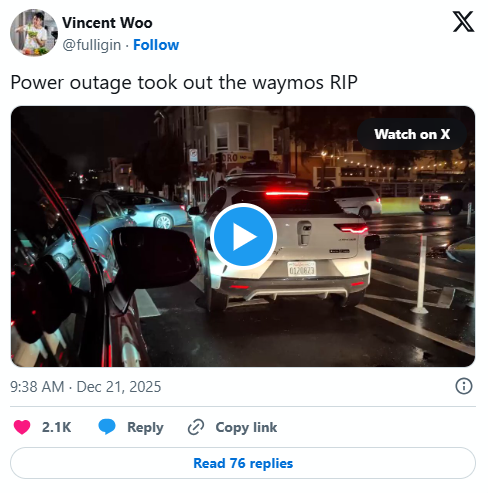
"We've temporarily suspended all ride-hailing services in the Bay Area," confirmed Waymo spokesperson Suzanne Philion in a carefully worded statement. While the company pledged cooperation with city officials on recovery efforts, they notably avoided explaining why their vehicles couldn't handle what amounted to an urban-scale version of losing Wi-Fi.
The Ghosts in the Machine
Industry experts quickly identified three likely failure points:
- Traffic light dependence: Waymo's vehicles rely heavily on digital signals from smart traffic lights that went dark during the outage. Without these electronic cues, the cars' safety protocols may have triggered automatic shutdowns.
- Network blackout: Autonomous systems constantly communicate with remote servers for real-time updates and monitoring. When cellular networks faltered during the power failure, the vehicles might have entered a protective "safe mode."
- No backup plan: Unlike human drivers who can cautiously proceed through dark intersections, the AI appears to lack contingency protocols for complete infrastructure failure scenarios.
The timing couldn't be worse for Waymo. Internal documents recently leaked to Tiger Global show the service handling nearly half a million weekly rides - double its spring volume. This rapid expansion makes last night's system-wide failure particularly embarrassing for Alphabet's self-driving division.
A Wake-Up Call for Smart Cities
The incident raises uncomfortable questions about how "smart" our transportation future really is. If a single point of failure can paralyze an entire fleet of autonomous vehicles, what does that mean for cities betting big on driverless technology?
"This shows we can't just focus on making cars smarter," cautioned MIT urban tech researcher Dr. Elena Petrov. "The supporting infrastructure needs equal attention - and redundancy." Her team has long warned about over-reliance on centralized systems vulnerable to both technical failures and potential cyberattacks.
As PG&E crews worked through the night restoring power, many San Franciscans found themselves doing something unexpected: missing human taxi drivers who could at least improvise when things went wrong.
Key Points:
- Systemic vulnerability: A power outage completely disabled Waymo's robotaxi operations in San Francisco
- Safety protocols backfire: The very mechanisms designed to keep autonomous vehicles safe may have caused their paralysis
- Infrastructure dependence: The incident highlights how self-driving tech relies on functioning urban digital systems
- Growth vs reliability: Waymo's rapid expansion meets real-world stress test with mixed results
- Industry implications: Raises questions about smart city planning and autonomous vehicle readiness
