
Robots Gain 3D Vision with New GeoVLA Framework

Robots Finally See the World Like We Do
Image

Imagine trying to navigate your kitchen blindfolded - that's essentially how today's robots experience the world. While artificial intelligence has made tremendous strides, most robotic vision systems still struggle with basic spatial awareness. Current vision-language-action (VLA) models like OpenVLA and RT-2 rely on flat, two-dimensional images, leaving them literally blind to depth and positioning.

This limitation becomes painfully obvious in unstructured environments where depth perception matters. Picture a robot arm trying to grab a cup on a crowded table - without understanding which objects are closer or farther away, simple tasks become frustrating exercises in trial and error.

A Three-Dimensional Breakthrough

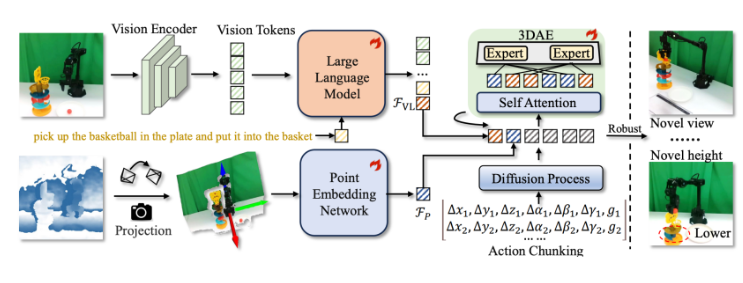
The research team at Yueli Lingji has developed what might be the glasses robots desperately need. Their GeoVLA framework introduces true 3D perception by combining two innovative components:

  1. Point Cloud Embedding Network (PEN): Processes spatial data much like our brain interprets depth cues
  2. Spatial-Aware Action Expert (3DAE): Translates that spatial understanding into precise movements

"We've essentially given robots their missing dimension," explains Dr. Lin Sun, lead researcher on the project. "Where current systems see flat pictures, GeoVLA builds mental models of space - understanding not just what objects are, but where they actually exist in three dimensions."
Image

Putting Depth Perception to the Test

The results speak volumes about this new approach:

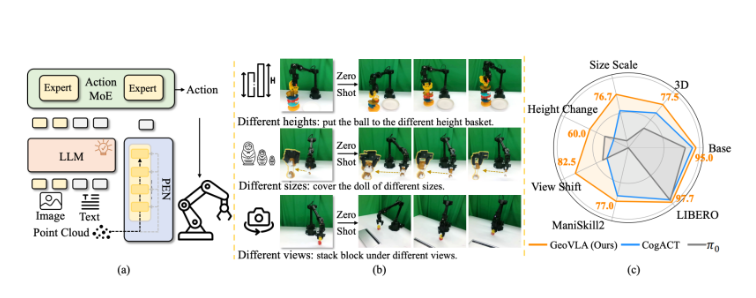
  • 97.7% success rate on LIBERO benchmark tests (outperforming previous models)
  • Exceptional handling of complex objects in ManiSkill2 simulations
  • Remarkable adaptability to unexpected scenarios and perspective changes

The secret lies in GeoVLA's task separation approach: traditional visual-language models handle object identification while specialized components manage spatial reasoning and movement planning.

What This Means for Robotics

The implications extend far beyond laboratory demonstrations:

  • More reliable manufacturing robots that can handle irregular parts
  • Household assistants capable of navigating cluttered spaces safely
  • Search-and-rescue bots that better understand collapsed structures

The team has made their work publicly available, inviting further development from the robotics community.

Key Points:

  • Problem: Current robot vision lacks depth perception
  • Solution: GeoVLA adds true 3D understanding through dual-stream architecture
  • Components: PEN for spatial mapping + 3DAE for movement planning
  • Results: Near-perfect performance in controlled tests with strong real-world potential
  • Availability: Framework accessible via project website

Enjoyed this article?

Subscribe to our newsletter for the latest AI news, product reviews, and project recommendations delivered to your inbox weekly.

Weekly digestFree foreverUnsubscribe anytime

Related Articles

PixVerse R1 Brings Virtual Worlds to Life with Real-Time AI Magic
News

PixVerse R1 Brings Virtual Worlds to Life with Real-Time AI Magic

Aishikeji's groundbreaking PixVerse R1 shatters boundaries between virtual and real worlds. This revolutionary model blends three cutting-edge technologies to create interactive digital environments that respond instantly to user input. From gaming worlds that breathe to movies you can influence, PixVerse opens doors for creators everywhere.

January 14, 2026
AI innovationvirtual realityinteractive media
Robots That Learn Like Humans: 1X Unveils Breakthrough AI Model
News

Robots That Learn Like Humans: 1X Unveils Breakthrough AI Model

Robotics startup 1X has introduced its groundbreaking 'World Model' AI system, designed to teach humanoid robots new skills through video observation. Unlike traditional programming, this approach enables robots to continuously evolve their capabilities by analyzing real-world physics and actions. The Neo robot, set for commercial release in 2025, could soon be learning tasks much like humans do - by watching and practicing.

January 14, 2026
roboticsAIlearninghumanoidrobots
How AI is Transforming Live Streaming with Virtual Reality
News

How AI is Transforming Live Streaming with Virtual Reality

OTO Electronics' subsidiary Chuanxiang Shuwei is revolutionizing live streaming by blending AI with XR technology. Their MetaBox solutions help brands create immersive virtual experiences, breaking content monotony while boosting engagement. With over 100 major clients and record-breaking results, they're proving this tech's commercial potential extends far beyond traditional broadcasting.

January 14, 2026
AI innovationvirtual productionlive streaming
News

Shanghai's Maifushi Climbs to Top Five in National AI Rankings

Shanghai-based Maifushi has secured fourth place in China's prestigious 'Top 100 AI Agents of 2025' list with its innovative Smart Body Mid-Platform 3.0. The Jing'an district company stands out among tech giants by solving industry pain points through no-code AI solutions that empower businesses across retail, manufacturing and supply chains. Their achievement signals a shift toward practical AI applications that drive real-world efficiency.

January 14, 2026
AI innovationShanghai techenterprise automation
Qiongche's Pocket-Sized Revolution: How Your Phone Could Help Train Future Robots
News

Qiongche's Pocket-Sized Revolution: How Your Phone Could Help Train Future Robots

Tech innovator Qiongche Intelligence has unveiled 'RoboPocket,' a game-changing device that turns everyday smartphone users into data collectors for AI training. This pocket-sized solution breaks down traditional lab barriers, allowing high-quality real-world data to be gathered anywhere, anytime. Experts say this marks a significant shift toward more practical, accessible robot development.

January 12, 2026
AI innovationcrowdsourced datarobotics development
MIT's Automated 'Motion Factory' Teaches AI Physical Intuition
News

MIT's Automated 'Motion Factory' Teaches AI Physical Intuition

Researchers from MIT, NVIDIA, and UC Berkeley have cracked a major challenge in video analysis - teaching AI to understand physical motion. Their automated 'FoundationMotion' system generates high-quality training data without human input, helping AI systems grasp concepts like trajectory and timing with surprising accuracy. Early tests show it outperforms much larger models, marking progress toward machines that truly understand how objects move.

January 12, 2026
computer visionAI trainingmotion analysis