
Pangram Outperforms AI Detectors in Accuracy and Cost

Pangram Leads AI Text Detection with Unmatched Accuracy

A comprehensive study by the University of Chicago has identified Pangram as the most reliable and cost-effective AI text detection tool currently available. The research compared multiple detection systems across six text categories and four major language models.

Methodology: Rigorous Testing Framework

The team assembled a dataset of 1,992 human-written texts spanning:

  • Amazon product reviews
  • Blog posts
  • News articles
  • Novel excerpts
  • Restaurant reviews
  • Resumes

These were paired with AI-generated counterparts from GPT-4.1, Claude Opus4, Claude Sonnet4, and Gemini 2.0 Flash. Performance was measured using:

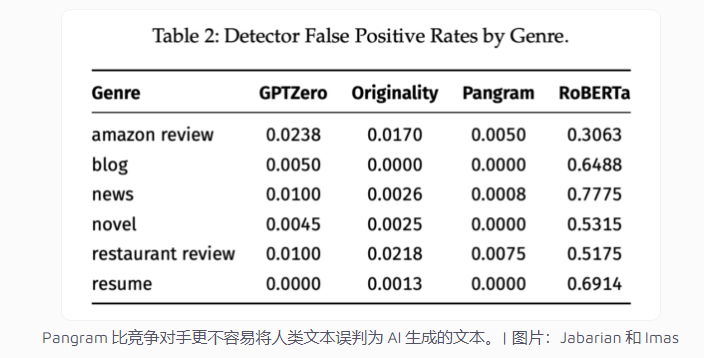
  • False Positive Rate (FPR): Human texts misclassified as AI
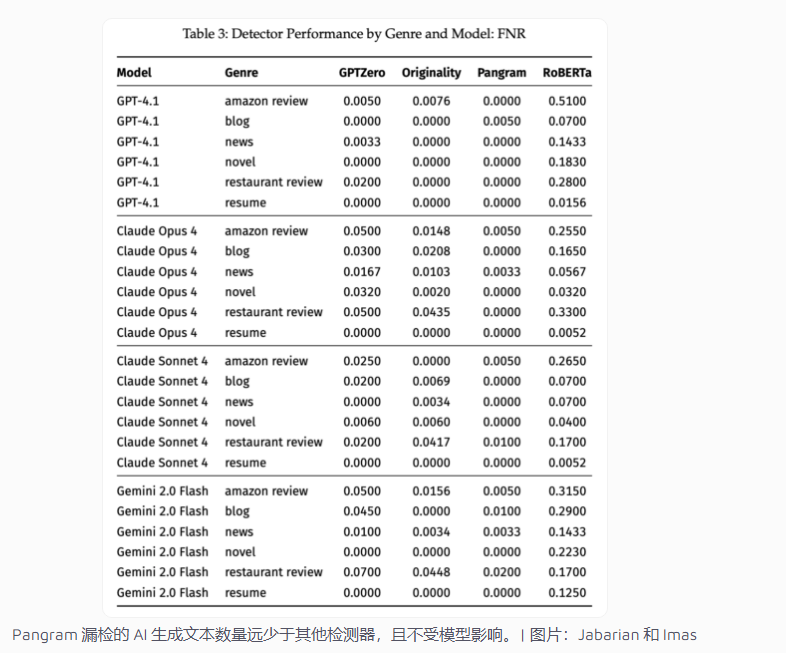
  • False Negative Rate (FNR): Undetected AI-generated content
Image

Performance Breakdown: Pangram Dominates Rankings

The findings show Pangram achieved:

  • Near-perfect detection (0% errors) for medium/long texts
  • Minimal error rates (<0.01) even in short samples
  • Consistent performance across all four AI models tested

The open-source RoBERTa-based detectors performed worst, incorrectly flagging 30%-69% of human writing as machine-generated.

Model-Specific Detection Variations

The study revealed significant differences in how detectors handle outputs from various AI systems: | Detector | Strengths | Weaknesses | |----------|-----------|------------| | Pangram | Universal accuracy (FPR <0.02) | None significant | | OriginalityAI | Effective vs Gemini | Struggles with Claude outputs | | GPTZero | Model-independent | Lower overall accuracy |

The research notes that while all detectors perform well on long-form content like novels, Pangram maintains superior accuracy even with brief restaurant reviews.

Anti-Evasion Capabilities Tested

The team evaluated systems against StealthGPT, a tool designed to bypass detection:

  • Pangram's performance remained stable (<5% variance)
  • Competitors showed 20%-40% accuracy drops Image
    Economic Advantages Emerge

The cost analysis revealed:

  • Pangram identifies AI content for just $0.0228 per sample
  • Half the cost of OriginalityAI ($0.045)
  • One-third GPTZero's expense ($0.068)

The "Policy Cap" feature allows institutions to set maximum acceptable error rates (e.g., 0.5%), with Pangram being the only system maintaining high accuracy under such constraints.

Key Points:

  1. Pangram demonstrates superior accuracy across all tested text types and lengths
  2. Open-source detectors performed poorly compared to commercial solutions
  3. Detection effectiveness varies significantly by source AI model
  4. Cost analysis shows Pangram offers best value at $0.0228 per accurate detection
  5. Researchers recommend regular "stress tests" as AI generation tools evolve

Enjoyed this article?

Subscribe to our newsletter for the latest AI news, product reviews, and project recommendations delivered to your inbox weekly.

Weekly digestFree foreverUnsubscribe anytime

Related Articles

Pangram Outperforms Rivals in AI Text Detection Study
News

Pangram Outperforms Rivals in AI Text Detection Study

A University of Chicago study found Pangram significantly outperforms competitors like OriginalityAI and GPTZero in detecting AI-generated text. The commercial tool achieved near-zero error rates for medium/long texts while maintaining lower costs. Researchers warn of an ongoing 'arms race' between detection tools and evolving AI models.

November 3, 2025
AI detectionPangramtext analysis
Google's Gemini App Now Spots AI-Generated Videos with Ease
News

Google's Gemini App Now Spots AI-Generated Videos with Ease

Google has rolled out a game-changing update to its Gemini app, giving users the power to detect AI-generated videos with a simple upload. Leveraging SynthID watermarking tech, the tool scans both visual and audio tracks, offering detailed reports on potential AI manipulation. Available globally without extra cost, this feature marks a big step in fighting deepfakes and boosting digital trust.

December 19, 2025
AI detectionGoogle Geminideepfake prevention
News

Spotting AI Writing: Wikipedia Editors Share Their Tricks

Wikipedia editors have created a handy guide to help identify AI-generated content online. The guide highlights telltale signs like overused phrases, exaggerated importance claims, and vague marketing language that often appear in machine-written texts. As AI writing becomes more sophisticated, these clues help readers distinguish human from artificial authorship.

November 21, 2025
AI detectionWikipediacontent moderation
Google Gemini Now Spots AI-Generated Images Instantly
News

Google Gemini Now Spots AI-Generated Images Instantly

Google's Gemini introduces a game-changing feature letting users detect AI-made images with a simple question. Beyond just photos, verification for videos and audio is coming soon—possibly even to Google Search. The tech leverages SynthID watermarks and will adopt the C2PA standard, making it easier to track content origins across platforms like TikTok and OpenAI's Sora.

November 21, 2025
AI detectionGoogle Geminidigital authenticity
News

Wikipedia's New Guide Spots AI Writing Like a Pro

Wikipedia editors have cracked the code on detecting AI-generated content. Their newly released guide reveals telltale signs like vague importance claims, excessive media name-dropping, and marketing-speak adjectives. These patterns stem from AI's training on internet content filled with self-promotion and SEO tactics. As public awareness grows, this knowledge could reshape how we consume online information.

November 21, 2025
AI detectionWikipediacontent authenticity
Humanify AI Review: Can It Detect and Humanize AI Text?
News

Humanify AI Review: Can It Detect and Humanize AI Text?

Humanify AI offers dual functionality for detecting AI-generated content and rewriting it into natural language. This review examines its accuracy, usability, pricing, and ideal use cases for students, professionals, and content creators.

June 17, 2025
AI detectioncontent optimizationwriting tools