
OpenAudio Launches S1-Mini: A Lightweight, Open-Source TTS Model

The AI voice technology landscape has gained a powerful new tool with the release of OpenAudio S1-Mini, an open-source text-to-speech (TTS) model developed by Fish Audio. This lightweight version of the acclaimed S1 model brings professional-grade voice synthesis capabilities to resource-constrained environments while maintaining impressive performance.
Image

Technical Breakthrough in a Compact Package

Distilled from its 4B-parameter predecessor, S1-Mini operates with just 0.5 billion parameters—a remarkable reduction that makes it suitable for edge devices and local applications. Despite its smaller size, the model doesn't compromise on quality. Trained on over 2 million hours of audio data, it supports 14 languages including Chinese, English, Japanese, and French.

What sets S1-Mini apart is its emotional range. The model generates more than 50 types of vocal expressions, from anger and happiness to laughter and crying sounds. These capabilities produce remarkably human-like speech that could easily be mistaken for real recordings.

Democratizing Voice Technology

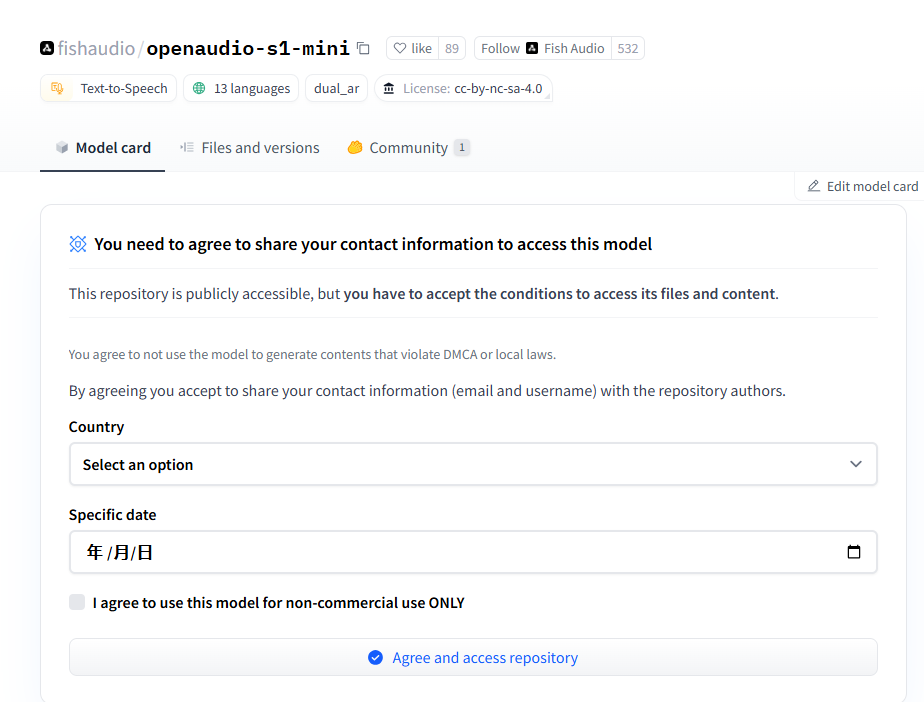
The decision to open-source S1-Mini represents a strategic move to lower barriers in AI voice development. Available for free download on Hugging Face (with non-commercial use terms), the model provides small teams and independent developers access to technology that previously required expensive subscriptions.

OpenAudio has also launched an online demo platform, allowing potential users to experience the model's capabilities firsthand. This transparency builds community trust while encouraging collaborative improvement of the technology.
Image

Competitive Performance Metrics

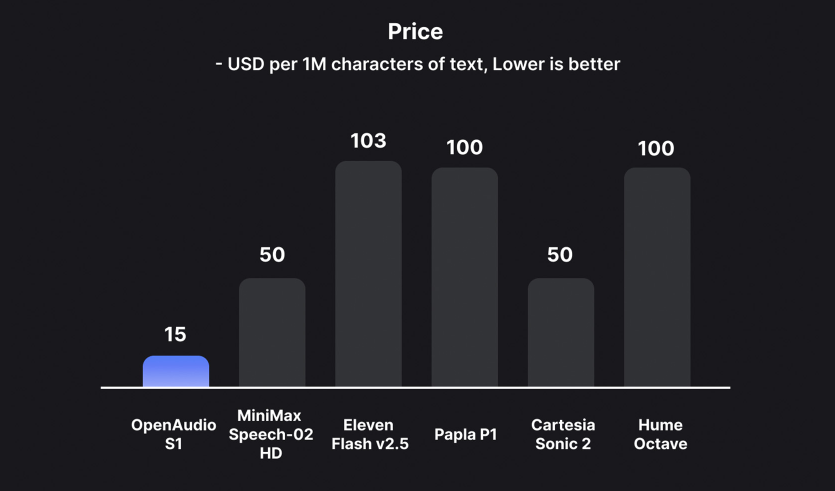
Independent testing on platforms like Hugging Face's TTS Arena reveals that S1-Mini holds its own against commercial offerings from ElevenLabs and OpenAI. The model's secret weapon is its use of Reinforcement Learning with Human Feedback (RLHF), which fine-tunes outputs for natural flow and emotional authenticity.

While currently restricted to non-commercial use, S1-Mini offers tremendous value for academic research and personal projects—particularly in multilingual applications where its performance shines.

Versatile Applications Across Industries

The education sector could leverage S1-Mini for language learning tools, while media producers might use it for audiobook narration or podcast generation. Interactive applications stand to benefit from its special effects capabilities like laughter or shouting—features that add depth to virtual characters.

Global adoption appears promising thanks to robust non-English language support. This positions S1-Mini as a potential game-changer in markets underserved by existing TTS solutions.

Future Developments

Fish Audio plans continuous improvements to S1-Mini, including expanded language support and potential real-time application versions. As the open-source community contributes to its development, the model could challenge commercial TTS monopolies and drive innovation across the industry.

The project is available at: https://huggingface.co/fishaudio/openaudio-s1-mini

Key Points

  1. OpenAudio S1-Mini offers high-quality TTS with just 0.5B parameters
  2. Supports 14 languages and over 50 emotional vocal expressions
  3. Available as free open-source software on Hugging Face (non-commercial)
  4. Outperforms some commercial models in naturalness tests
  5. Potential applications span education, entertainment, and interactive media

Enjoyed this article?

Subscribe to our newsletter for the latest AI news, product reviews, and project recommendations delivered to your inbox weekly.

Weekly digestFree foreverUnsubscribe anytime

Related Articles

DeepSeek's Memory Boost: How AI Models Are Getting Smarter
News

DeepSeek's Memory Boost: How AI Models Are Getting Smarter

DeepSeek researchers have developed Engram, a clever add-on that helps large language models remember common phrases and facts more efficiently. Acting like a mental sticky note system, Engram lets AI focus its brainpower on complex reasoning while quickly recalling basic information. Early tests show impressive results - models equipped with Engram performed better across various tasks while using the same computing resources.

January 15, 2026
AI efficiencymachine learningnatural language processing
Chinese Researchers Teach AI to Spot Its Own Mistakes in Image Creation
News

Chinese Researchers Teach AI to Spot Its Own Mistakes in Image Creation

A breakthrough from Chinese universities tackles AI's 'visual dyslexia' - where image systems understand concepts but struggle to correctly portray them. Their UniCorn framework acts like an internal quality control team, catching and fixing errors mid-creation. Early tests show promising improvements in spatial accuracy and detail handling.

January 12, 2026
AI innovationcomputer visionmachine learning
Fine-Tuning AI Models Without the Coding Headache
News

Fine-Tuning AI Models Without the Coding Headache

As AI models become ubiquitous, businesses face a challenge: generic models often miss the mark for specialized needs. Traditional fine-tuning requires coding expertise and expensive resources, but LLaMA-Factory Online changes the game. This visual platform lets anyone customize models through a simple interface, cutting costs and technical barriers. One team built a smart home assistant in just 10 hours - proving specialized AI doesn't have to be complicated or costly.

January 6, 2026
AI customizationno-code AImachine learning
Falcon H1R7B: The Compact AI Model Outperforming Larger Rivals
News

Falcon H1R7B: The Compact AI Model Outperforming Larger Rivals

The Abu Dhabi Innovation Institute has unveiled Falcon H1R7B, a surprisingly powerful 7-billion-parameter open-source language model that's rewriting the rules of AI performance. By combining innovative training techniques with hybrid architecture, this nimble contender delivers reasoning capabilities that rival models twice its size. Available now on Hugging Face, it could be a game-changer for developers needing efficient AI solutions.

January 6, 2026
AI innovationlanguage modelsmachine learning
Robots Get Personal Voices Through MiniMax-Zhiyuan Partnership
News

Robots Get Personal Voices Through MiniMax-Zhiyuan Partnership

MiniMax and Zhiyuan Robotics are teaming up to give robots truly personalized voices. Their collaboration goes beyond standard text-to-speech tech, enabling each user to create a unique vocal identity for their robotic companion. The system even understands emotional nuances, promising more natural interactions in eldercare, customer service and entertainment settings.

January 5, 2026
AI voice synthesisrobot companionsemotional AI
News

Google DeepMind Forecasts AI's Next Leap: Continuous Learning by 2026

Google DeepMind researchers predict AI will achieve continuous learning capabilities by 2026, marking a pivotal moment in artificial intelligence development. This breakthrough would allow AI systems to autonomously acquire new knowledge without human intervention, potentially revolutionizing fields from programming to scientific research. The technology builds on recent advances showcased at NeurIPS 2025 and could lead to fully automated programming by 2030 and AI-driven Nobel-level research by mid-century.

January 4, 2026
AI evolutionmachine learningfuture tech