
OpenAI's GPT-5.4 Leak Reveals Game-Changing Memory Capabilities

OpenAI's Next Leap: GPT-5.4 Details Surface in Accidental Leak

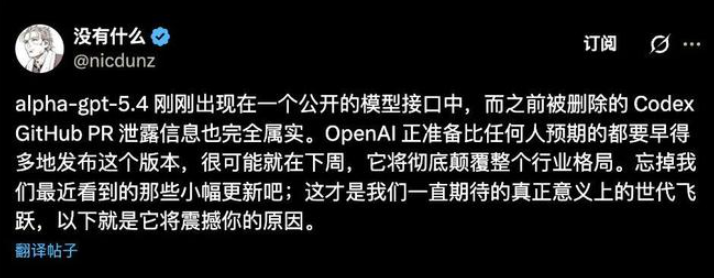
The AI development community buzzed with excitement this week when an OpenAI engineer accidentally included unreleased GPT-5.4 code in a public repository update. Though quickly removed, the slip gave us tantalizing glimpses of what might be coming next in large language model technology.
Image

Memory That Lasts

The most striking revelation? GPT-5.4 appears poised to solve one of current AI's biggest limitations - its goldfish-like memory. The leaked specs suggest:

  • Massive context windows: Up to 2 million tokens, dwarfing current models' capabilities
  • True persistence: Unlike today's session-based chats, GPT-5.4 could maintain workflow states between interactions

Imagine an AI that remembers your project details and preferences like a human colleague would - that's the promise of this "stateful AI" approach.

Seeing Clearly

The leaks also hint at major visual processing upgrades:

Pixel-perfect analysis: Instead of working with compressed images, the model would access original image bytes directly. For designers and engineers, this could mean:

  • Accurate interpretation of complex diagrams
  • No more distorted UI mockup analyses
  • True visual understanding at the pixel level

Strategic Moves in the AI Race

Why skip straight to 5.4? Industry watchers see this as OpenAI's counterpunch against competitors like Anthropic's Claude and Google's Gemini. The focus appears to be shifting from benchmark scores to practical utility:

Agent-first design: Reliability for autonomous operation seems prioritized over raw performance metrics.

Hardware hurdles: Supporting these memory features will push current computing infrastructure to its limits, particularly regarding high-bandwidth memory requirements.

The accidental reveal - though quickly "corrected" by OpenAI - gives us fascinating insight into where conversational AI might be heading next.

Key Points:

  • Memory breakthrough: Potential for 2M token context and cross-session state retention
  • Visual upgrades: Native high-resolution image processing capabilities
  • Strategic timing: Likely response to competitive pressure in the AI space
  • Implementation challenges: Will require significant hardware advancements

Enjoyed this article?

Subscribe to our newsletter for the latest AI news, product reviews, and project recommendations delivered to your inbox weekly.

Weekly digestFree foreverUnsubscribe anytime

Related Articles

OpenAI's Sora Video Tool Gets Major Upgrade
News

OpenAI's Sora Video Tool Gets Major Upgrade

OpenAI's latest update to its Sora video generation API brings five key improvements that content creators will love. The enhancements tackle common frustrations like inconsistent characters across scenes and short video lengths. Now you can maintain character appearances throughout multiple clips, generate longer 20-second videos, and get both horizontal and vertical formats simultaneously - perfect for cross-platform sharing.

March 13, 2026
OpenAIvideo generationAI tools
Grok4.20 Beta Debuts with Record-Breaking Accuracy
News

Grok4.20 Beta Debuts with Record-Breaking Accuracy

xAI's latest language model, Grok4.20 Beta, sets a new industry standard with its impressive 78% non-hallucination rate while keeping costs competitive. Though trailing slightly behind rivals Gemini3.1Pro and GPT-5.4 in benchmark tests, Grok4.20 shines in factual reliability—a crucial advancement for AI applications demanding precision.

March 13, 2026
AI developmentlanguage modelstech innovation
News

NVIDIA's Nemotron 3 Super shakes up AI with open-source power rivaling top models

NVIDIA has unleashed Nemotron 3 Super, a groundbreaking open-source AI model that's turning heads with performance nearly matching premium closed-source alternatives like GPT-5.4. This 120-billion-parameter powerhouse combines innovative architecture with practical efficiency, delivering triple the reasoning speed while maintaining impressive accuracy. Already adopted by major tech players, it could democratize access to high-performance AI tools.

March 12, 2026
AI developmentOpen-source technologyNVIDIA
Tencent's WorldCompass Helps AI Models Navigate Complex Commands
News

Tencent's WorldCompass Helps AI Models Navigate Complex Commands

Tencent has open-sourced WorldCompass, a reinforcement learning framework that dramatically improves how AI world models understand and execute complex instructions. This breakthrough solves persistent accuracy issues, boosting performance by over 35% in challenging scenarios. The technology marks a shift from pure pre-training to sophisticated fine-tuning approaches.

March 11, 2026
AI developmentTencentmachine learning
OpenAI Bolsters AI Safety with Strategic Promptfoo Acquisition
News

OpenAI Bolsters AI Safety with Strategic Promptfoo Acquisition

OpenAI has acquired AI safety startup Promptfoo in a move to strengthen its smart agent security framework. The small but mighty 23-person team behind Promptfoo developed an open-source evaluation tool now used by over 350,000 developers and 25% of Fortune 500 companies. This acquisition signals OpenAI's commitment to making AI systems safer as they become increasingly integrated into business workflows.

March 11, 2026
AI SafetyOpenAITech Acquisitions
News

ChatGPT Gets a Video Upgrade: OpenAI Merges Sora to Boost Creativity

OpenAI is shaking things up by bringing its Sora video generator directly into ChatGPT. This bold move aims to supercharge the platform's creative tools while helping OpenAI reach its ambitious goal of 1 billion weekly users. But merging these powerful AI technologies won't come cheap - the company expects astronomical computing costs exceeding $225 billion through 2030.

March 11, 2026
OpenAIChatGPTAI video