
New AI Turns Photos Into Ready-to-Simulate 3D Objects

From Flat Photos to Functional 3D Models

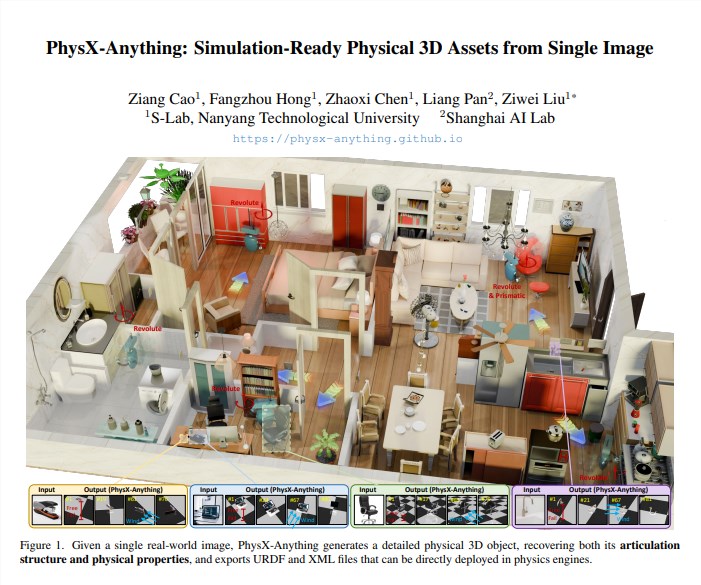
Imagine snapping a picture of a chair and instantly getting a digital version that behaves just like the real thing - complete with proper weight distribution, moving parts, and realistic physics. That's exactly what PhysX-Anything delivers. Developed jointly by Nanyang Technological University and Shanghai Artificial Intelligence Lab, this breakthrough technology bridges the gap between computer vision and physical simulation.
Image

How It Works

The system uses a clever two-step approach. First, it analyzes the overall physical properties of objects - things like mass distribution and surface friction. Then it zooms in to refine individual components and their movement ranges. This prevents the common pitfall where visually accurate models behave strangely in simulations.

What really sets PhysX-Anything apart is its efficient encoding method. It packs all the necessary information - shape, joints, physics - into compact digital packages that reconstruct quickly during use. This makes the process about twice as fast as current state-of-the-art methods.

Real-World Performance

Tests show impressive results:

  • Geometry accuracy improved by 18%
  • Physics errors reduced by 27%
  • Scale accurate within 2 centimeters
  • Joint movements precise to within 5 degrees

The practical benefits are even more striking. When used for robot training simulations:

  • Grasping success rates jumped by 12%
  • Required training time dropped by nearly a third

The team validated these improvements using everyday objects from IKEA furniture to kitchen utensils.

Open Access Future

The researchers have made everything publicly available - code, trained models, datasets - hoping to accelerate development in this space. They're already working on version 2.0, which will accept video input to capture how objects move over time.

For roboticists and game developers alike, this technology could dramatically simplify creating digital twins of real-world objects. Instead of painstakingly modeling every physical property manually, they might soon just snap pictures and get working simulations.

The implications extend beyond robotics too - imagine architects testing furniture arrangements or product designers prototyping new ideas using photos of existing items as starting points.

Key Points:

  • Converts single images into simulation-ready 3D assets
  • Preserves both visual appearance and physical behavior
  • Open-source framework available now on GitHub
  • Version supporting video input coming early next year

Enjoyed this article?

Subscribe to our newsletter for the latest AI news, product reviews, and project recommendations delivered to your inbox weekly.

Weekly digestFree foreverUnsubscribe anytime

Related Articles

Robots That Learn Like Humans: 1X Unveils Breakthrough AI Model
News

Robots That Learn Like Humans: 1X Unveils Breakthrough AI Model

Robotics startup 1X has introduced its groundbreaking 'World Model' AI system, designed to teach humanoid robots new skills through video observation. Unlike traditional programming, this approach enables robots to continuously evolve their capabilities by analyzing real-world physics and actions. The Neo robot, set for commercial release in 2025, could soon be learning tasks much like humans do - by watching and practicing.

January 14, 2026
roboticsAIlearninghumanoidrobots
MIT's Automated 'Motion Factory' Teaches AI Physical Intuition
News

MIT's Automated 'Motion Factory' Teaches AI Physical Intuition

Researchers from MIT, NVIDIA, and UC Berkeley have cracked a major challenge in video analysis - teaching AI to understand physical motion. Their automated 'FoundationMotion' system generates high-quality training data without human input, helping AI systems grasp concepts like trajectory and timing with surprising accuracy. Early tests show it outperforms much larger models, marking progress toward machines that truly understand how objects move.

January 12, 2026
computer visionAI trainingmotion analysis
Chinese Researchers Teach AI to Spot Its Own Mistakes in Image Creation
News

Chinese Researchers Teach AI to Spot Its Own Mistakes in Image Creation

A breakthrough from Chinese universities tackles AI's 'visual dyslexia' - where image systems understand concepts but struggle to correctly portray them. Their UniCorn framework acts like an internal quality control team, catching and fixing errors mid-creation. Early tests show promising improvements in spatial accuracy and detail handling.

January 12, 2026
AI innovationcomputer visionmachine learning
Tencent's New AI Tool Brings 3D Characters to Life
News

Tencent's New AI Tool Brings 3D Characters to Life

Tencent Hunyuan has unveiled HY-Motion 1.0, a groundbreaking open-source model that transforms text into lifelike 3D animations. This ten-billion parameter system tackles the animation industry's biggest headaches—high costs and lengthy production times—by generating smooth, natural movements from simple descriptions. Game developers and animators can now create complex character actions in minutes rather than days, with support for major platforms like Unity and Unreal Engine.

January 8, 2026
AI animation3D modelinggame development
News

Tech Veteran Launches liko.ai to Bring Smarter Privacy-Focused Home Cameras

Ryan Li, former Meituan hardware chief, has secured funding from SenseTime and iFLYTEK affiliates for his new venture liko.ai. The startup aims to revolutionize home security cameras with edge-based AI that processes video locally rather than in the cloud - addressing growing privacy concerns while adding smarter detection capabilities. Their first products are expected mid-2026.

January 7, 2026
smart homecomputer visionedge computing
News

Boston Dynamics and Google DeepMind Team Up to Power Next-Gen Atlas Robots

In a groundbreaking move, Boston Dynamics is partnering with Google DeepMind to integrate the Gemini Robotics AI model into its next-generation Atlas humanoid robot. This collaboration combines Boston Dynamics' unmatched robotic mobility with Google's advanced AI reasoning capabilities, potentially transforming Atlas from an acrobatic marvel into a truly autonomous helper capable of understanding complex instructions and adapting to new environments.

January 6, 2026
roboticsartificial intelligencetech innovation