Mofa Launches World's First 3D Digital Human Open Platform

Mofa Technology Pioneers Embodied AI with Star Cloud Platform

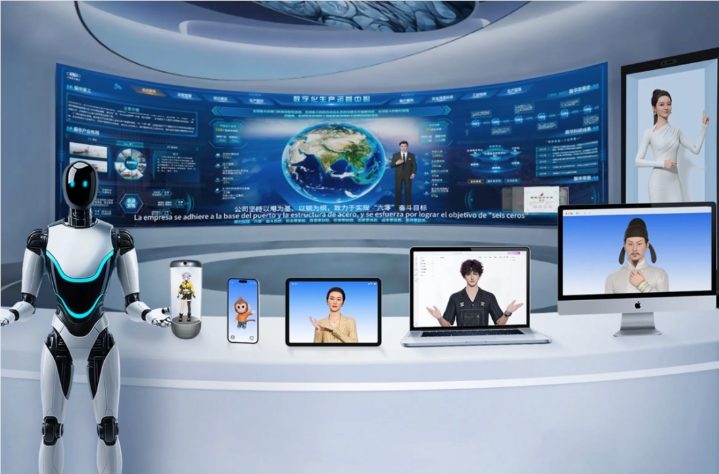
On May 30th, Mofa Technology made a significant leap in artificial intelligence by launching "Mofa Star Cloud," the world's first open platform enabling developers to create fully expressive 3D digital humans. This innovation moves AI interactions beyond text-based exchanges into the realm of embodied communication.

How It Works: From Text to Lifelike Animation

The platform's core is a 3D multimodal real-time generation engine that transforms text input into synchronized outputs:

  • Speech generation
  • Micro-expressions
  • Full-body movements

Image

The system achieves remarkable performance metrics:

  • 30+ fps refresh rate
  • <100ms latency
  • Compatibility with mobile devices, tablets, car systems, and TVs

CTO Li Yu explains their breakthrough "cloud-end split architecture" separates computationally intensive modeling from lightweight rendering. Terminals receive compressed action bitstreams requiring just 1/10th the bandwidth of conventional video streams.

Real-World Applications Beyond Demos

The platform has already moved past prototype stage with several implementations:

  1. Smart Hotel Concierge: Shanghai Center integrated Star Cloud into front desk tablets for real-time guest services
  2. Accessibility Solutions: A provincial government hall created sign language avatars for hearing-impaired visitors
  3. HR Tech Innovation: Partnering with HR SaaS providers to develop AI interviewers that replicate human interaction rhythms

Business Model and Adoption

The company offers tiered pricing:

  • Free access to basic models
  • Usage-based fees for advanced emotion controls and industry-specific knowledge packages
  • Enterprise private deployment options

The launch attracted over 2,000 developer applications, spanning education, healthcare, retail, and IoT sectors.

Future Roadmap

CEO Chai Jinxiang outlined upcoming initiatives:

  • Open-sourcing select motion-driven interfaces
  • Launching "Star Cloud Ready" certification with chip manufacturers
  • Targeting deployment on 1 billion mid-range devices within one year

The goal? To make embodied intelligence a default interaction method rather than a high-end showcase.

Key Points:

  • First open platform enabling realistic 3D digital humans
  • Cloud-end architecture enables local processing on affordable hardware
  • Already deployed in customer service, accessibility, and HR applications
  • Tiered pricing model accommodates diverse developer needs
  • Plans for massive scaling through chip partnerships

Enjoyed this article?

Subscribe to our newsletter for the latest AI news, product reviews, and project recommendations delivered to your inbox weekly.

Weekly digestFree foreverUnsubscribe anytime

Related Articles

News

MiniMax and Tencent Cloud Revolutionize AI Training with Million-Agent Sandbox

In a groundbreaking collaboration, AI innovator MiniMax and tech giant Tencent Cloud have successfully deployed a massive reinforcement learning sandbox capable of handling millions of AI agents simultaneously. This infrastructure breakthrough dramatically reduces training costs while improving efficiency, potentially accelerating the development of smarter AI systems. The partnership marks a significant step toward making large-scale agent training more accessible and cost-effective for the industry.

March 18, 2026
Artificial IntelligenceMachine LearningCloud Computing
News

Yang Zhilin Reveals Kimi's Secret Sauce: Efficiency, Memory and Digital Teams

At NVIDIA's GTC2026 conference, Moonshot AI founder Yang Zhilin unveiled the three pillars powering their Kimi K2.5 model - token efficiency, long context memory, and agent clusters. This marks a shift from brute-force computing to smarter architecture design. The approach could redefine how we measure AI intelligence beyond just parameter counts.

March 18, 2026
AI InnovationMoonshot AINVIDIA GTC
News

Tencent's AI Push Fuels Record B2B Growth in 2025

Tencent's latest financial results reveal strong momentum in its enterprise services division, with B2B revenue hitting 229.4 billion yuan - a new high for the tech giant. The company credits its AI investments and cloud computing improvements for driving this growth, while also announcing upcoming upgrades to its HY AI models. With products like WorkBuddy gaining traction, Tencent appears well-positioned in the competitive AI services market.

March 18, 2026
TencentAI BusinessCloud Computing
News

Tencent Games Surge 22% in 2025 as AI and Global Push Pay Off

Tencent's gaming division hit new heights in 2025, with revenue jumping 22% to 241.6 billion yuan. International markets proved particularly lucrative, surpassing $10 billion for the first time thanks to hits like PUBG Mobile. The company's AI investments are transforming gameplay, with over 110 million players engaging with intelligent NPCs. Domestic favorites like Honor of Kings continue to thrive while new titles like Delta Force show promising growth.

March 18, 2026
TencentGaming IndustryArtificial Intelligence
News

Microsoft Warns OpenAI: Cloud Deal with Amazon May Spark Legal Battle

Microsoft is threatening legal action against OpenAI over its $50 billion cloud partnership with Amazon, alleging it violates their exclusive agreement. The dispute centers on OpenAI's new enterprise product Frontier and technical workarounds designed to bypass Microsoft's terms. This conflict comes at a delicate time for OpenAI, already facing legal challenges from Elon Musk while preparing for a potential 2026 IPO.

March 18, 2026
MicrosoftOpenAIAmazon
News

Robots' ChatGPT Moment Still Years Away, Says Tech Founder

Wang Xingxing, founder of Autonomous Intelligent Technology, predicts embodied AI won't reach its breakthrough moment for another 2-3 years. While progress continues, robots still struggle with complex real-world tasks. The industry awaits that pivotal threshold when machines can handle unfamiliar scenarios as smoothly as ChatGPT processes text.

March 18, 2026
Artificial IntelligenceRoboticsEmerging Technology