
MIT's AI Restores 15th-Century Painting in Record Time

Researchers at the Massachusetts Institute of Technology (MIT) have revolutionized art restoration with an artificial intelligence system that completed work on a 15th-century masterpiece in just three and a half hours - a task that would normally require months of painstaking manual labor.
Image

The breakthrough came from mechanical engineering graduate Alex Kachkine, who combined his passion for traditional art restoration with cutting-edge technology. Frustrated by seeing valuable artworks languish in galleries due to the prohibitive costs and time requirements of conventional restoration, Kachkine developed a solution that preserves historical pieces while making the process exponentially faster.

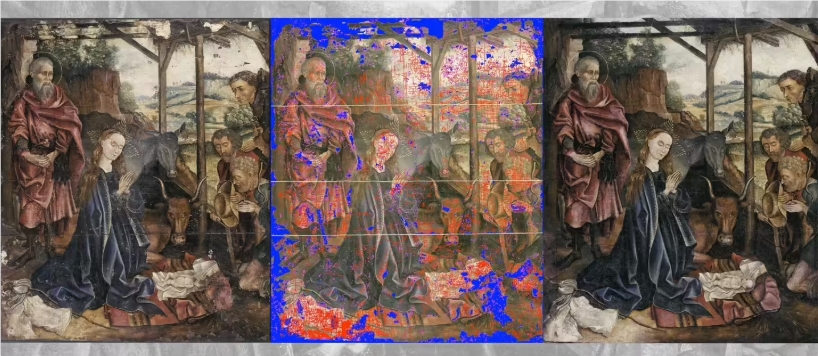
How the Technology Works Kachkine's team selected a severely damaged Renaissance-era oil painting as their test subject. After carefully removing previous restoration attempts, they created high-resolution scans of the artwork. Advanced AI algorithms then analyzed these images to reconstruct what the original likely looked like, generating both a digital model and a detailed "damage map" pinpointing areas needing repair.

The system identifies every crack, flake, and faded pigment with remarkable precision. For the experimental restoration, the team addressed 5,612 individual damages using 57,314 distinct colors - an impossible feat for human restorers working at similar speed.

Reversible Protection Perhaps most importantly for art conservationists, the method is completely reversible. The team prints their color corrections on an ultra-thin polymer film mask consisting of two layers: one providing precise coloring and another white base layer for proper saturation. This mask attaches to the painting with temporary varnish that can be safely removed later.

"We're not touching the original artwork at all," Kachkine emphasizes. "The digital record we create serves both as our restoration guide today and as a permanent reference for future conservators."

The implications extend far beyond this single painting. Museums worldwide house thousands of works too fragile or expensive to restore using traditional methods. Could this technology bring masterpieces back to public view that have been hidden in storage for decades?

Key Points

  1. MIT's AI system restored a damaged Renaissance painting in just 3.5 hours versus months for manual methods
  2. The reversible process uses detachable polymer masks and temporary varnish to protect original artworks
  3. High-resolution scanning creates permanent digital records for future conservation efforts
  4. The technique addressed over 5,600 individual damages with precise color matching
  5. This approach could make art restoration accessible for thousands of neglected works worldwide

Enjoyed this article?

Subscribe to our newsletter for the latest AI news, product reviews, and project recommendations delivered to your inbox weekly.

Weekly digestFree foreverUnsubscribe anytime

Related Articles

News

Smart Vacuums Take Over Homes as AI Cleaning Tech Surges

Robot vacuums have evolved from clumsy gadgets to intelligent home assistants, with global shipments jumping nearly 19% in 2025. Today's models can navigate around shoes and pet messes, respond to voice commands, and even learn cleaning preferences. Market data shows consumers increasingly value these smart features over raw suction power.

January 12, 2026
smart homeAI technologyconsumer electronics
Mistral AI's Voxtral Models Now Available on Amazon SageMaker
News

Mistral AI's Voxtral Models Now Available on Amazon SageMaker

Mistral AI has introduced its innovative Voxtral models, combining text and audio processing in powerful new ways. The smaller Voxtral-Mini handles quick transcriptions, while the robust Voxtral-Small tackles complex multilingual tasks. Amazon SageMaker now supports these models through flexible container deployment, opening doors for businesses to implement advanced audio-text intelligence solutions.

December 23, 2025
AI technologyVoice recognitionCloud computing
MIT's Smart Hack Makes AI Models Work Smarter, Not Harder
News

MIT's Smart Hack Makes AI Models Work Smarter, Not Harder

MIT researchers have cracked the code on making large language models more efficient. Their new 'instance-adaptive scaling' method dynamically adjusts computing power based on question complexity - saving energy while maintaining accuracy. Think of it like giving AI the ability to choose between sprinting and marathon pacing depending on the task.

December 9, 2025
AI efficiencyMIT researchadaptive computing
News

MIT Uncovers Brain's Tiny Language Hub - Smaller Than a Strawberry

MIT neuroscientists have mapped the brain's compact language center - a region smaller than a strawberry that handles all speech functions while remaining separate from thinking processes. Their 15-year study reveals how we process words independently from cognition, with implications for treating speech disorders and improving AI language models.

December 8, 2025
neurosciencelanguage processingbrain mapping
Soul App Hits 11 Million Daily Users as It Files for Hong Kong IPO
News

Soul App Hits 11 Million Daily Users as It Files for Hong Kong IPO

China's Soul App, an AI-powered social platform where users interact through avatars, has filed for a Hong Kong IPO after reaching 11 million daily active users. With Tencent as its largest shareholder, the platform boasts strong financials including 83% gross margins and rapid revenue growth. Nearly 80% of its users belong to Gen Z, spending over 50 minutes daily in its immersive virtual environment.

November 28, 2025
social mediaAI technologyHong Kong IPO
Anker Unveils Coin-Sized AI Voice Recorder with Advanced Features
News

Anker Unveils Coin-Sized AI Voice Recorder with Advanced Features

Anker has launched the Soundcore Work, a compact AI voice recorder measuring just 0.91 inches. Priced at $99.99, it offers transcription, summarization, and supports over 100 languages. With an eight-hour battery life (extendable to 32 hours) and local GPT-4o processing, it prioritizes privacy while being ideal for meetings and important communications.

September 4, 2025
AI technologywearable techvoice recognition