
IBM's Granite 4.0 Speech Model: Smaller Size, Bigger Performance

IBM Raises the Bar With Compact Granite Speech Model
Image

In a move that could reshape voice technology deployment, IBM has introduced Granite 4.0 1B Speech, a leaner but more capable version of its multilingual speech recognition system. Designed specifically for edge computing environments where resources are limited, this model packs surprising power into its streamlined framework.

Efficiency Meets Performance

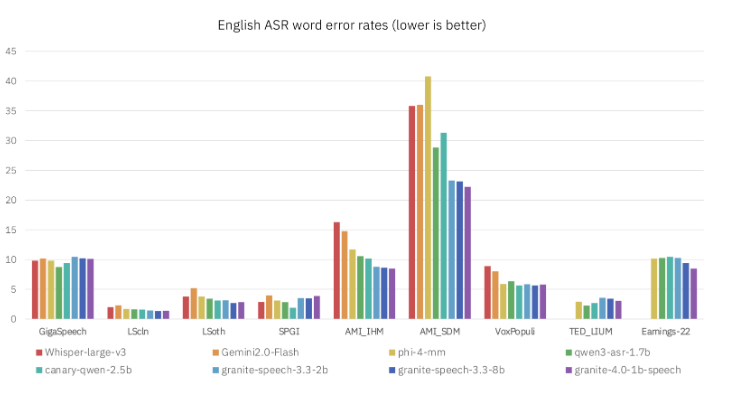
The numbers tell an impressive story: while sporting half the parameters of previous versions, Granite 4.0 actually delivers better results across multiple metrics. Imagine shrinking your smartphone while doubling its battery life - that's the kind of engineering achievement IBM has accomplished here.

Key improvements include:

  • New support for Japanese automatic speech recognition (ASR)
  • Enhanced keyword bias detection
  • Significant accuracy boosts in English transcription

The secret sauce? A relentless focus on optimizing memory usage and reducing computational overhead without compromising core functionality.

How It Works: Two-Stage Innovation

The model employs a clever modular approach that separates audio processing from language understanding:

  1. First converts audio signals to text
  2. Then processes that text through IBM's specialized Granite language model

This architecture gives developers welcome flexibility - they can customize each stage independently based on specific needs.

Language Capabilities That Impress

Currently supporting six languages (English, French, German, Spanish, Portuguese and Japanese), Granite shines particularly bright in English-to-Chinese (Mandarin) translation tasks. For global businesses operating across these languages, this could mean smoother communication with fewer hiccups.

The performance metrics speak volumes - topping the OpenASR leaderboard with an average word error rate of just 5.52%, making it one of the most accurate solutions available today.

Open Source Advantage

In a win for developers everywhere, IBM has released Granite under the permissive Apache 2.0 license. This means teams can deploy it locally using popular frameworks like Transformers or vLLM - particularly valuable for mobile or edge devices where cloud connectivity might be spotty.

The implications are exciting: from smarter voice assistants in remote locations to real-time translation devices that don't need constant internet access.

Key Points:

  • 50% smaller than previous versions with improved accuracy
  • Supports six languages plus English-Chinese translation
  • Innovative two-stage architecture enables flexible deployment
  • Leads OpenASR benchmark with 5.52% word error rate
  • Available as open source under Apache 2.0 license

Enjoyed this article?

Subscribe to our newsletter for the latest AI news, product reviews, and project recommendations delivered to your inbox weekly.

Weekly digestFree foreverUnsubscribe anytime

Related Articles

Qualcomm and Arduino Unveil Ventuno Q: A Powerhouse for AI Robotics
News

Qualcomm and Arduino Unveil Ventuno Q: A Powerhouse for AI Robotics

Qualcomm makes its first major move since acquiring Arduino with the launch of Ventuno Q, a cutting-edge development board packing serious AI muscle. Designed for robotics enthusiasts and professionals alike, this hardware promises to bring cloud-level AI processing to your workbench. While pricing remains under wraps, its specs - including a dedicated NPU and industrial-grade processor - suggest Qualcomm means business in the maker market.

March 10, 2026
roboticsedge computingAI hardware
News

NetSpeed's Edge AI Gateway Simplifies Manga Production

NetSpeed Technologies has introduced an Edge AI Gateway that's transforming AI-powered manga production. The plug-and-play solution addresses key industry pain points by enabling seamless model collaboration, reducing latency, and ensuring compliance. Early adopters like Guangtongchen and Ouxi Network report significant efficiency gains and cost reductions in their animation workflows.

March 5, 2026
AI animationedge computingcreative technology
IBM Bucks Trend: Empowering Junior Staff as AI Supervisors
News

IBM Bucks Trend: Empowering Junior Staff as AI Supervisors

While tech giants slash entry-level jobs fearing AI disruption, IBM is making a bold countermove. The company plans to triple junior hires by 2026, radically redesigning roles to focus on human-AI collaboration rather than tasks vulnerable to automation. IBM's CHRO explains this strategy aims to future-proof both their workforce and leadership pipeline.

February 13, 2026
IBMFutureOfWorkAIStrategy
News

DEEPX Brings Energy-Efficient AI Chips to China Through Strategic Partnership

South Korean AI chipmaker DEEPX has partnered with China Resources Digital to enter the competitive Chinese semiconductor market. Their focus? Bridging the gap between power-hungry GPUs and basic SoCs with ultra-efficient chips designed specifically for edge AI applications. The collaboration builds on DEEPX's successful work optimizing Baidu's OCR technology, promising industrial solutions that balance performance with energy savings.

February 10, 2026
semiconductorsedge computingindustrial AI
Stepfun's New AI Model Packs Speed and Smarts for Digital Assistants
News

Stepfun's New AI Model Packs Speed and Smarts for Digital Assistants

Stepfun has unveiled Step3.5Flash, a nimble open-source AI model built specifically for powering digital assistants. This lightweight solution delivers rapid responses while matching the performance of closed-source alternatives in key areas like coding and complex calculations. Developers can now access this 'agent brain' through multiple platforms including GitHub and HuggingFace.

February 2, 2026
AI modelsOpen-source techDigital assistants
News

AI Boom Strains Hardware Supply Chain: Prices Soar as Edge Devices Take Off

The insatiable demand for AI computing power is reshaping the global hardware landscape. Chip packaging and memory prices are skyrocketing while domestic manufacturers race to fill supply gaps. Meanwhile, AI is breaking free from data centers - smart glasses and AI-powered earbuds signal the next frontier in consumer tech.

January 26, 2026
semiconductorsAI hardwaresupply chain