
Gemini-3-Pro Leads Multimodal AI Race as Chinese Models Gain Ground

Multimodal AI Showdown: Who's Winning the Vision-Language Race?

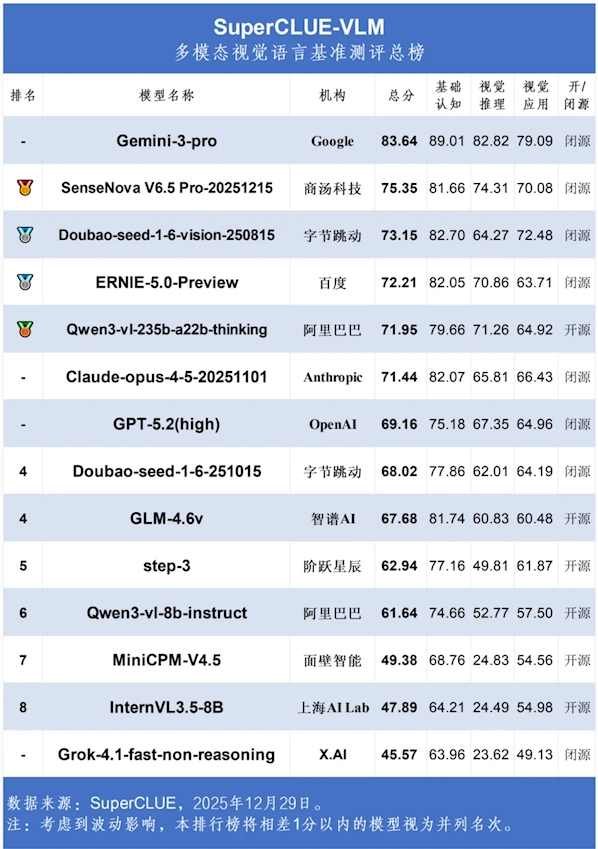
The battle for supremacy in multimodal artificial intelligence has taken an interesting turn with December 2025's SuperCLUE-VLM rankings. These evaluations measure how well AI systems understand and reason about visual information - a crucial capability as machines increasingly interact with our image-rich digital world.

The Clear Frontrunner

Google's Gemini-3-Pro continues its dominance with an overall score of 83.64 points, leaving competitors in the dust. Its performance is particularly strong in basic image understanding (89.01 points), though even this leader shows room for improvement in visual reasoning (82.82) and application tasks (79.09).

"What makes Gemini stand out isn't just raw scores," explains Dr. Lin Zhao, an AI researcher at Tsinghua University. "It's their consistent performance across all test categories while others excel in specific areas but falter elsewhere."

China's Rising Stars

The real story might be China's rapid advancement:

  • SenseTime's SenseNova V6.5Pro claims second place (75.35 points)
  • ByteDance's Doubao impresses with third place (73.15 points)
  • Alibaba's Qwen3-VL makes history as first open-source model to cross 70 points
Image

These results suggest Chinese tech firms are prioritizing capabilities particularly useful domestically - think analyzing social media images or short video content.

Surprises and Stumbles

The rankings held some shocks:

OpenAI's much-hyped GPT-5.2 landed a disappointing 69.16 score despite its high configuration, raising questions about its multimodal development priorities.

Meanwhile, Anthropic's Claude-opus-4-5 delivered steady performance (71.44 points), maintaining its reputation for strong language understanding capabilities.

What These Scores Really Mean

The SuperCLUE-VLM tests evaluate three crucial skills:

  1. Basic Cognition: Can the AI identify objects and text?
  2. Visual Reasoning: Does it understand relationships and context?
  3. Application: Can it perform practical tasks like answering questions about images?

The results reveal where progress is happening fastest - and where challenges remain:

"We're seeing incredible advances in basic recognition," notes Dr. Zhao, "but higher-order reasoning still separates the best from the rest."

The strong showing by open-source Qwen3-VL could democratize access to powerful multimodal tools, while commercial models like Doubao demonstrate how specialized training pays off for specific use cases.

Key Points:

  • Google maintains leadership but Chinese models are closing gaps rapidly
  • Open-source options now compete with proprietary systems
  • Visual reasoning remains toughest challenge across all platforms
  • Performance varies dramatically by application - no one-size-fits-all solution yet

Enjoyed this article?

Subscribe to our newsletter for the latest AI news, product reviews, and project recommendations delivered to your inbox weekly.

Weekly digestFree foreverUnsubscribe anytime

Related Articles

Zhipu and Huawei Unveil Breakthrough AI Image Model Powered Entirely by Domestic Tech
News

Zhipu and Huawei Unveil Breakthrough AI Image Model Powered Entirely by Domestic Tech

Chinese AI firm Zhipu has partnered with Huawei to launch GLM-Image, a groundbreaking multimodal model that's entirely trained on domestic hardware. This innovative system combines text and image generation capabilities, excelling particularly at Chinese character rendering and complex visual tasks. Available now as open-source software, it promises to make advanced AI image creation more accessible.

January 14, 2026
AI InnovationDomestic TechnologyComputer Vision
NVIDIA and Stanford Unleash Open-Source Gaming AI That Masters 1,000 Titles
News

NVIDIA and Stanford Unleash Open-Source Gaming AI That Masters 1,000 Titles

In a groundbreaking collaboration, NVIDIA and Stanford University have introduced NitroGen - an AI agent capable of playing over 1,000 different games after training on 40,000 hours of gameplay data. What sets this apart? The team is open-sourcing everything: the trained model weights and their massive GameVerse-1K dataset. This isn't just about gaming; researchers see it as a stepping stone toward more general artificial intelligence that could eventually power robots and autonomous systems.

December 26, 2025
Artificial IntelligenceMachine LearningVideo Games
Zhihu's 2025 AI Rankings Show Doubao Leading the Pack
News

Zhihu's 2025 AI Rankings Show Doubao Leading the Pack

Zhihu's latest annual AI rankings reveal ByteDance's Doubao taking the top spot, with DeepSeek and Tongyi Qianwen close behind. The list highlights growing competition between domestic and international AI products, with Gemini, ChatGPT, and Claude representing strong overseas contenders. Vertical applications like Cursor and Dreamina also made impressive showings.

December 24, 2025
AI RankingsDoubaoArtificial Intelligence
Apple's UniGen 1.5 AI Blurs Lines Between Seeing and Creating Images
News

Apple's UniGen 1.5 AI Blurs Lines Between Seeing and Creating Images

Apple has unveiled UniGen 1.5, a groundbreaking AI model that combines image understanding, generation, and editing in a single system. Unlike traditional approaches, this unified framework produces higher quality results by leveraging its comprehension capabilities during creation. The model introduces innovative 'editing instruction alignment' technology and shows impressive performance in industry benchmarks, though some challenges remain in text generation within images.

December 19, 2025
AI InnovationComputer VisionApple Research
News

Twitter Spat Sparks Breakthrough: Xie's Team Unveils Game-Changing AI Tool

What began as a heated Twitter debate about self-supervised learning models has blossomed into a significant academic breakthrough. Xie Saining's team transformed online discussions into iREPA - an innovative framework that boosts generative AI performance with just three lines of code. Their research overturns conventional wisdom, showing spatial structure matters more than global semantics for image generation quality.

December 17, 2025
AI ResearchComputer VisionMachine Learning
Chinese AI Breakthrough: Emu3.5 Model Predicts Reality's Next Move
News

Chinese AI Breakthrough: Emu3.5 Model Predicts Reality's Next Move

Beijing's Zhiyuan Institute has unveiled Emu3.5, a revolutionary AI model that doesn't just generate content - it understands how the world works. Unlike conventional models that merely manipulate pixels and words, Emu3.5 predicts what happens next in any scenario, blending images, text and video into unified 'world states'. This leap forward could transform everything from robotics to autonomous vehicles.

December 4, 2025
AI ResearchMachine LearningComputer Vision