
DeepSeek's New AI Models Take on Tech Giants

DeepSeek Levels Up With Dual AI Release

The AI research community just got exciting new tools to play with. DeepSeek has launched version 3.2 of its flagship models, bringing serious competition to closed-source alternatives from big tech companies.

Two Models, Double the Impact

The company introduced two variants:

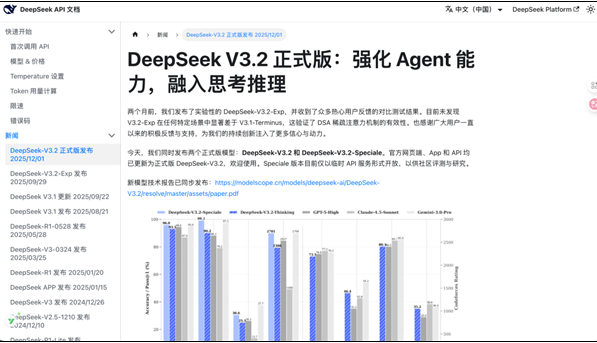
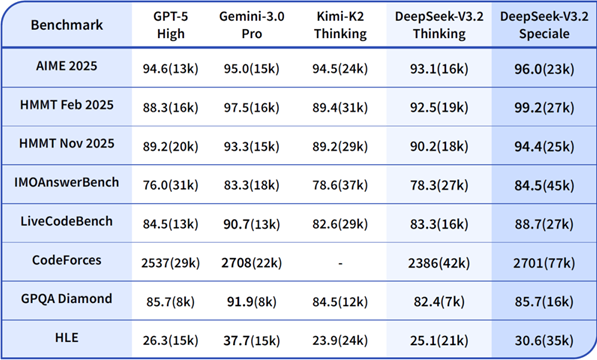
  • V3.2 Standard Edition: Performs neck-and-neck with OpenAI's GPT-5 when handling documents up to 128,000 words
  • V3.2-Speciale: Matches Google's Gemini3Pro on academic benchmarks while producing more detailed answers
Image

Technical Breakthroughs Under the Hood

The secret sauce? A clever innovation called Directory-Style Attention (DSA). Traditional AI models struggle with long documents because processing time grows exponentially with length. DSA changes this dramatically:

  • Makes processing time grow linearly instead of exponentially
  • Uses 40% less memory
  • Runs inferences 2.2 times faster

The result? These are the first open-source models capable of handling million-token documents on a single graphics card.
Image

Smarter Thinking Through Better Training

The DeepSeek team didn't cut corners on training either:

  • Dedicated over 10% of their computing power specifically to reinforcement learning
  • Used group-based reinforcement learning (GRPO) combined with majority voting
  • Removed artificial limits that discouraged lengthy reasoning chains

The payoff shows in testing - Speciale produces answers that are not only longer (32% more tokens than Gemini3Pro) but also more accurate (4.8 percentage points higher).

Open Source Commitment Continues

Both models are available now on GitHub and Hugging Face under the business-friendly Apache 2.0 license. DeepSeek promises more openness ahead: "We're planning to release our DSA kernel and RL training framework next," a company spokesperson said.

The move continues DeepSeek's strategy of turning proprietary advantages into community assets - an approach that could reshape the competitive landscape by 2026 if they maintain this pace.

Key Points:

  1. Performance Parity: Matches GPT-5/Gemini3Pro capabilities in respective domains
  2. Technical Innovation: DSA enables efficient million-token processing
  3. Training Investment: Significant computing resources devoted to RL optimization
  4. Open Philosophy: Full weights available commercially under Apache 2.0 license

Enjoyed this article?

Subscribe to our newsletter for the latest AI news, product reviews, and project recommendations delivered to your inbox weekly.

Weekly digestFree foreverUnsubscribe anytime

Related Articles

News

Tailwind CSS Crisis: How AI Boom Left Developers Divided

Tailwind CSS, the beloved utility-first framework, faces an existential paradox. While its adoption hits record highs thanks to AI coding tools, these same technologies have gutted its revenue streams - triggering massive layoffs. Founder Adam Wathan reveals documentation traffic dropped 40% as developers bypass official channels entirely. The crisis sparks urgent debates about open-source sustainability in the AI era.

January 12, 2026
TailwindCSSOpenSourceAIEthics
Mugen3D Turns Single Photos Into Stunning 3D Worlds
News

Mugen3D Turns Single Photos Into Stunning 3D Worlds

A groundbreaking AI tool called Mugen3D is transforming how we create 3D content. Using advanced 3D Gaussian Splatting technology, it can generate remarkably realistic models from just one image - capturing textures, lighting, and materials with astonishing accuracy. This innovation promises to democratize 3D creation across industries from gaming to e-commerce.

January 12, 2026
AIComputerGraphicsDigitalCreation
News

Qualcomm and Google Join Forces to Revolutionize Car Tech with AI

Qualcomm and Google are teaming up to tackle one of the automotive industry's biggest headaches: fragmented in-car systems. Their new 'Automotive AI Agent' combines Qualcomm's Snapdragon Digital Chassis with Google's Android Automotive OS, promising smoother development and smarter features like facial recognition. The partnership also introduces cloud-based development tools that could cut R&D time significantly. This collaboration marks a major step toward more unified, intelligent vehicle systems.

January 9, 2026
automotive-techAIsmart-cars
News

Tailwind's AI Paradox: Soaring Popularity, Plummeting Profits

Tailwind Labs faces a cruel irony - while its CSS framework enjoys record-breaking adoption thanks to AI tools generating Tailwind code, the company has slashed 75% of its engineering team. As AI agents bypass documentation pages, traffic dropped 40%, causing revenue to nosedive nearly 80%. Founder Adam Wathan calls this 'AI's brutal impact' on traditional open-source business models.

January 9, 2026
TailwindCSSOpenSourceAIDisruption
News

Bosch Bets Big on AI with €2.5 Billion Push Into Smart Cars

At CES 2026, automotive giant Bosch unveiled plans to invest over €2.5 billion in AI development by 2027, targeting smarter cockpits and safer autonomous driving systems. The German supplier aims to transform from hardware specialist to software leader, projecting its tech division could hit €10 billion in sales by the mid-2030s.

January 7, 2026
BoschAIautonomous vehicles
MiniMax IPO Fever: Hong Kong Investors Flock to China's AI Pioneer
News

MiniMax IPO Fever: Hong Kong Investors Flock to China's AI Pioneer

MiniMax, China's rising star in AI technology, has concluded its Hong Kong IPO with staggering investor enthusiasm. The offering saw subscriptions oversubscribed by 1,209 times, raising over HK$253 billion. Backed by heavyweight investors like Alibaba and Abu Dhabi Investment Authority, MiniMax is set to become one of the fastest-growing AI companies ever to go public when it lists on January 9.

January 6, 2026
AIIPOHongKongMarkets