
China Telecom Unveils Tianti AI Smart Glasses at 1999 Yuan

China Telecom Launches Tianti AI Smart Glasses

China Telecom has officially entered the smart glasses market with the launch of its Tianti AI Smart Glasses, priced competitively at 1999 yuan. The product combines a lightweight design with advanced AI functionalities, aiming to carve a niche in the consumer electronics sector.

Design and Ergonomics

The Tianti AI Smart Glasses feature an ultra-light semi-frame structure, weighing just 38 grams. The design includes an adjustable nose bridge and elastic temples that can expand up to 15 degrees, ensuring a comfortable fit for various face shapes. An 8-degree ergonomic forward tilt is incorporated to reduce visual fatigue during prolonged use.
Image

Core Specifications

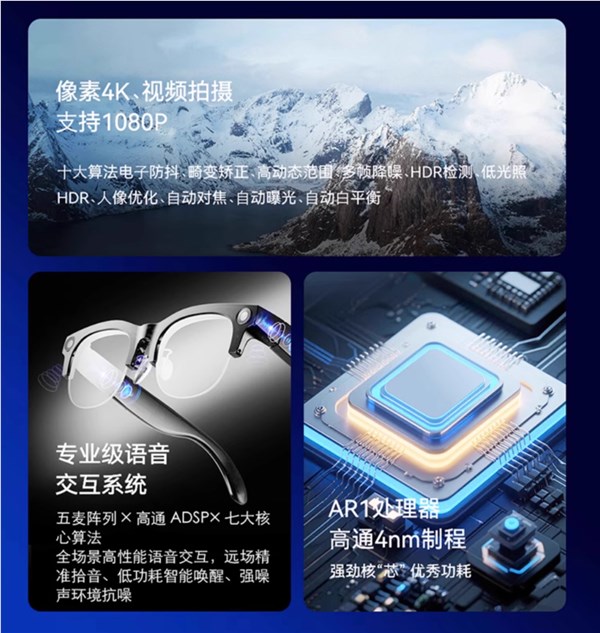
Powered by the Qualcomm Snapdragon AR1 chip, the glasses come with 2GB of memory and 32GB of storage. They boast a 12-megapixel ultra-wide-angle lens capable of recording 1440P resolution videos at 30 frames per second. Advanced imaging technologies like EIS electronic image stabilization, LDC distortion correction, and HDR image optimization enhance video quality.

The audio system utilizes an open custom acoustic chamber and intelligent tuning technology. A 5-microphone array paired with noise reduction algorithms ensures accurate voice activation even in noisy environments. The glasses also offer a private anti-leakage sound function for discreet usage.

AI and Functionality

The Tianti AI Smart Glasses are equipped with China Telecom's proprietary Tianyi Xingchen large model, enabling features like:

  • Intelligent object recognition
  • Text recognition
  • Food nutritional analysis
  • Automatic exhibition interpretation

The glasses support voice control and provide real-time bilingual translation between Chinese and English, making them versatile for both personal and professional use.

Battery Life and Charging

A single charge delivers up to 7 hours of continuous use. The included 3000mAh charging box supports up to 10 full charge cycles, with a fast-charging capability that provides significant power in just 40 minutes. According to official data:

  • Audio playback: Up to 4 hours
  • Bluetooth mode: 200 minutes of continuous use
  • Video recording: 35 minutes per session

Market Positioning

As China Telecom's first self-branded smart glasses, the Tianti AI model targets the sub-2000 yuan market by blending hardware innovation with AI services. The product is designed for diverse scenarios, including:

  • Daily office work
  • Cultural tourism
  • Health management

The integration of these features aims to deliver a seamless and intelligent user experience.

Key Points

  • Price: 1999 yuan ($275 approx.)
  • Weight: 38 grams (ultra-light)
  • Chipset: Qualcomm Snapdragon AR1
  • Camera: 12MP ultra-wide-angle lens (1440P video)
  • Battery: 7 hours per charge (3000mAh charging case)
  • AI Features: Object recognition, bilingual translation

Enjoyed this article?

Subscribe to our newsletter for the latest AI news, product reviews, and project recommendations delivered to your inbox weekly.

Weekly digestFree foreverUnsubscribe anytime

Related Articles

News

ByteDance Shuts Down Rumors About Doubao AI Glasses Launch

ByteDance has officially denied rumors about the imminent launch of Doubao AI glasses, stating there's no concrete sales plan yet. Despite speculation fueled by supply chain reports, the company maintains the product hasn't reached shipping phase. Industry experts suggest this reflects ByteDance's cautious approach to hardware launches, possibly due to technical challenges or strategic timing considerations.

January 6, 2026
ByteDanceAI WearablesSmart Glasses
Alibaba's Qwen Dominates AI Landscape With Record Downloads
News

Alibaba's Qwen Dominates AI Landscape With Record Downloads

Alibaba's Qwen large language model has surged ahead in global adoption, amassing over 700 million downloads—more than the combined totals of Meta, OpenAI and other major competitors. Its comprehensive open-source approach and versatile applications have propelled Chinese AI development to new heights on the international stage.

January 9, 2026
Artificial IntelligenceOpen SourceTech Innovation
News

Lenovo's Featherlight AI Glasses Redefine Workplace Tech at CES 2026

Lenovo stole the spotlight at CES 2026 with groundbreaking AI glasses weighing just 45 grams - lighter than most sunglasses. These innovative wearables ditch smartphone dependency to connect directly with computers, offering professionals a hands-free productivity boost. With dual Micro-OLED displays and smart features like real-time translation, Lenovo is betting big on workplace applications rather than chasing consumer entertainment trends.

January 7, 2026
AI WearablesFuture of WorkCES Innovations
NVIDIA CEO Hails Open-Source AI Breakthroughs at CES 2026
News

NVIDIA CEO Hails Open-Source AI Breakthroughs at CES 2026

At CES 2026, NVIDIA's Jensen Huang made waves by championing open-source AI development, singling out DeepSeek-R1 as a standout success. The tech leader revealed NVIDIA's plans to open-source training data while showcasing their new Vera Rubin chip. Huang outlined four key areas where AI is transforming industries, predicting these changes will define future technological paradigms.

January 6, 2026
AIOpen SourceNVIDIA
News

Nvidia's Rubin AI Chips Promise Quantum Leap in Computing Power

Nvidia has unveiled its groundbreaking Rubin chip architecture at CES, marking a significant leap forward in AI computing capabilities. The new system, already in production, delivers 3.5x faster training and 5x quicker inference than its predecessor. Major tech players like OpenAI and AWS are already on board, with supercomputer projects lining up to harness Rubin's power. This innovation comes as the AI infrastructure race heats up, with Nvidia predicting hundreds of billions in sector investments.

January 6, 2026
AI HardwareChip TechnologyNvidia
News

Moonshot AI Prepares Major Kimi Upgrade With Multimodal Boost

Moonshot AI is gearing up to launch an enhanced version of its Kimi K2 model in early 2026, promising significant improvements in handling multiple data types. The upgrade, tentatively named K2.1/K2.5, builds on the success of last year's open-source release with better visual and audio processing capabilities. Meanwhile, the company's strong financial position - boasting over 10 billion yuan in reserves - signals fierce competition brewing among China's AI leaders.

January 4, 2026
Artificial IntelligenceMultimodal ModelsMoonshot AI