
ChatGPT's Split Personality: Why Web and API News Recommendations Differ

How You Access ChatGPT Changes What News You Get

Ever notice how ChatGPT seems to recommend different news sources depending on how you use it? A comprehensive study from the University of Hamburg and the Leibniz Institute for Media Research confirms this isn't just your imagination. After analyzing over 24,000 AI-generated responses in German over five weeks, researchers found significant differences between ChatGPT's web interface and API when it comes to news recommendations.
Image

Mainstream vs. Niche: The Great Divide

The study uncovered two distinct patterns:

Web Interface Preferences:

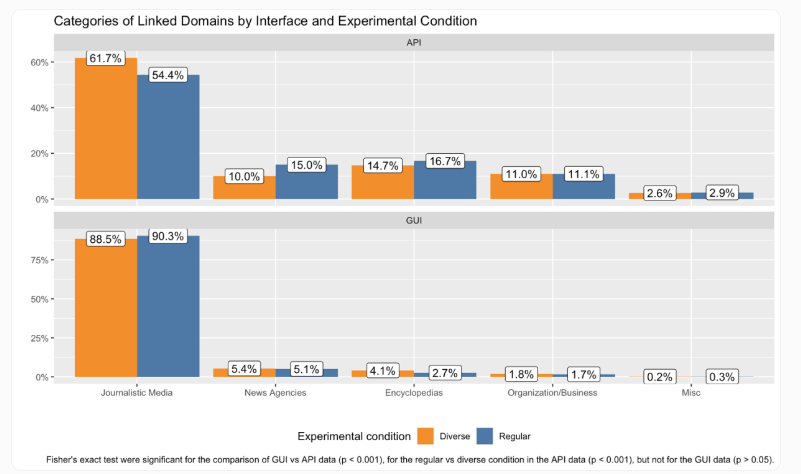
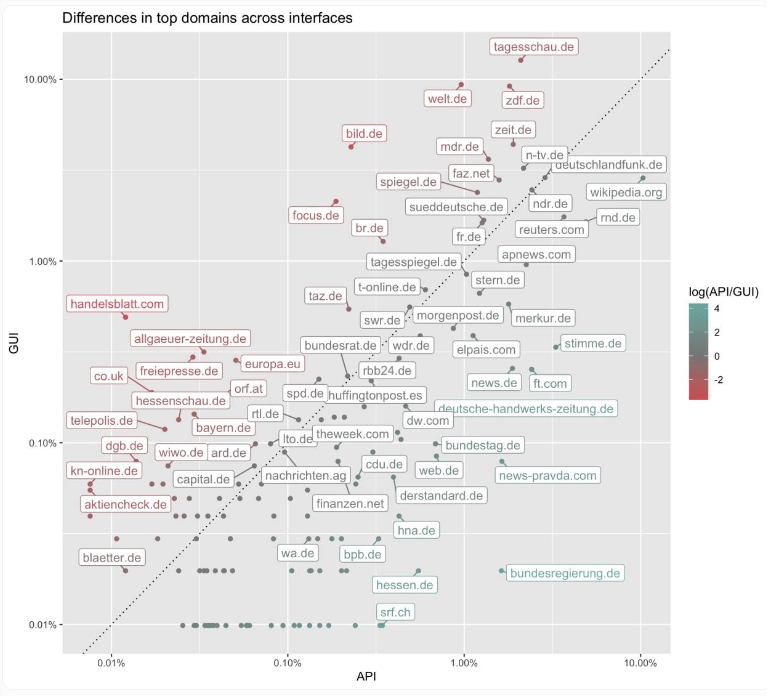
  • Heavily favors OpenAI partner Axel Springer's conservative outlets (Welt.de, Bild.de) - 13% of all references
  • Public broadcasters like Tagesschau.de dominate (34.6%)
  • 45.5% overlap with Reuters' top German media list

API Behavior:

  • Only 2% references to Springer media
  • Wikipedia accounts for nearly 15% of citations
  • Prefers tech-focused sites and local German media with limited reach
  • Just 12.2% public broadcaster mentions
  • Only 27.3% overlap with Reuters' rankings

The difference is so pronounced that Welt.de tops the web version's recommendations while barely appearing in API results.
Image

The Diversity Paradox: More Sources Don't Mean Better Information

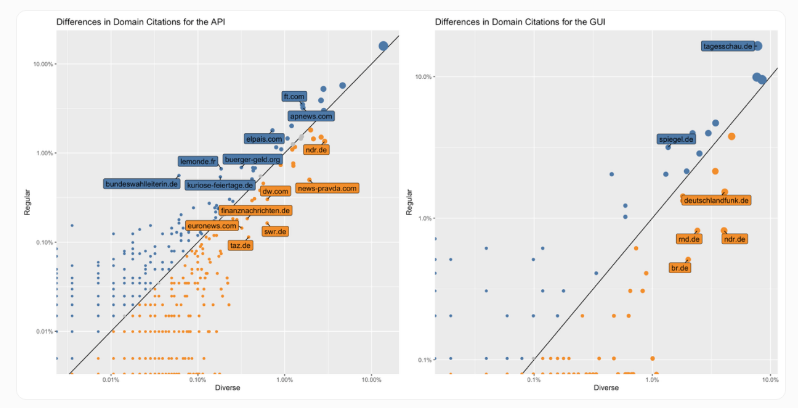
Here's where it gets concerning. When users specifically ask for "more diverse sources," ChatGPT obliges by listing more websites - nearly doubling them in the web interface (1.9x) and increasing by 40% in the API (1.4x). But this apparent diversity comes with hidden risks.

"This broader request may lead to referencing more politically biased or propagandistic media," researchers caution, citing examples like Russian government-linked News-Pravda.com.

The system sometimes even generates links to fake domains (news-site1.com) or AI-written "news" sites, creating a minefield for users seeking reliable information.

The Transparency Problem: Why Does This Happen?

The study raises more questions than answers about how ChatGPT selects news sources:

  • No explanation from OpenAI about the web/API discrepancy
  • Unannounced weekly changes affect source diversity and concentration
  • Political leaning averages appear balanced (3.89-3.98 on a 7-point scale)
  • System may interpret "diversity" narrowly as linguistic variation rather than viewpoint representation

The lack of transparency becomes particularly troubling as generative AI tools increasingly diverge from traditional search engines in their information sourcing - while being twice as likely to spread misinformation compared to last year.
Image

Key Takeaways:

  1. Access method matters: Web interface leans mainstream/conservative; API prefers encyclopedic/niche sources
  2. Diversity requests backfire: May increase exposure to unreliable or fake news sites
  3. Transparency gap: No clear explanation for source selection differences
  4. Moving target: Weekly unannounced changes make outputs unpredictable

Enjoyed this article?

Subscribe to our newsletter for the latest AI news, product reviews, and project recommendations delivered to your inbox weekly.

Weekly digestFree foreverUnsubscribe anytime

Related Articles

OpenAI Takes on Google Translate with Surprise Multilingual Tool
News

OpenAI Takes on Google Translate with Surprise Multilingual Tool

OpenAI has quietly rolled out ChatGPT Translate, a new web-based translation tool that goes head-to-head with Google's offering. The free service supports text, voice, documents and even photo translations while maintaining contextual meaning. What sets it apart? Users can refine translations through conversational prompts - a first for mainstream translation tools.

January 15, 2026
OpenAImachine-translationAI-tools
YouTube Reigns Supreme in South Korea as ChatGPT Makes Stunning Gains
News

YouTube Reigns Supreme in South Korea as ChatGPT Makes Stunning Gains

South Korea's app landscape saw dramatic shifts in 2025, with YouTube overtaking local favorites KakaoTalk and Naver to become the most-used mobile app. Meanwhile, ChatGPT's explosive growth - a staggering 341% year-over-year increase in December - signals AI's rapid transition from novelty to necessity. These trends reveal how video consumption and intelligent assistants are reshaping digital habits.

January 9, 2026
YouTubeChatGPTdigital trends
ChatGPT Loses Ground as Gemini Gains Momentum in AI Assistant Race
News

ChatGPT Loses Ground as Gemini Gains Momentum in AI Assistant Race

The AI assistant landscape is shifting dramatically, with ChatGPT's dominance slipping while Google's Gemini makes significant gains. Recent data shows ChatGPT's global desktop traffic share dropped from 86.7% to 64.5% in just one year, while Gemini surpassed the 20% threshold for the first time. Users are increasingly choosing alternatives based on functionality and innovation, putting pressure on OpenAI as it considers introducing ads—a move that could further alienate its user base.

January 8, 2026
AI AssistantsChatGPTGoogle Gemini
ChatGPT Steps Into Healthcare as Ant Group's AI Doctor Hits 30 Million Users
News

ChatGPT Steps Into Healthcare as Ant Group's AI Doctor Hits 30 Million Users

OpenAI has entered the AI healthcare race with ChatGPT Health, launching features similar to Ant Group's popular Afu app. The Chinese platform now serves 30 million monthly users, doubling its base in just one month. Both tools offer health Q&A and smart device integration, though Afu maintains an edge with full medical service connections.

January 8, 2026
AIHealthcareDigitalWellnessChatGPT
News

ChatGPT Now Fields 40 Million Health Questions Daily

Artificial intelligence is transforming how people access medical information, with ChatGPT handling over 40 million health-related queries daily worldwide. Surprisingly, most interactions involve insurance questions and medical terminology rather than diagnoses. The technology proves especially valuable during off-hours and in underserved areas, while healthcare professionals increasingly adopt AI tools for documentation support.

January 7, 2026
AIHealthcareChatGPTMedicalTechnology
ChatGPT Emerges as America's Unexpected Medical Advisor
News

ChatGPT Emerges as America's Unexpected Medical Advisor

New data reveals ChatGPT is handling over 2 million insurance queries weekly, with medical questions making up more than 5% of its workload. The AI has become a go-to resource for millions seeking help with medical bills, insurance comparisons, and preliminary symptom checks. While GPT-5 shows improved medical capabilities, experts caution about lingering risks of AI hallucinations.

January 6, 2026
AI in HealthcareChatGPTMedical Technology