Apple Unveils M5 MacBook Pro: AI-Optimized Chip with 24-Hour Battery

Apple Introduces M5-Powered MacBook Pro with AI Focus

Apple has unveiled its latest 14-inch MacBook Pro, powered by the groundbreaking M5 chip—the company's first processor specifically optimized for artificial intelligence workloads. The new device promises significant improvements in AI performance, battery life, and local computing capabilities.

Next-Generation Silicon Architecture

The M5 chip features:

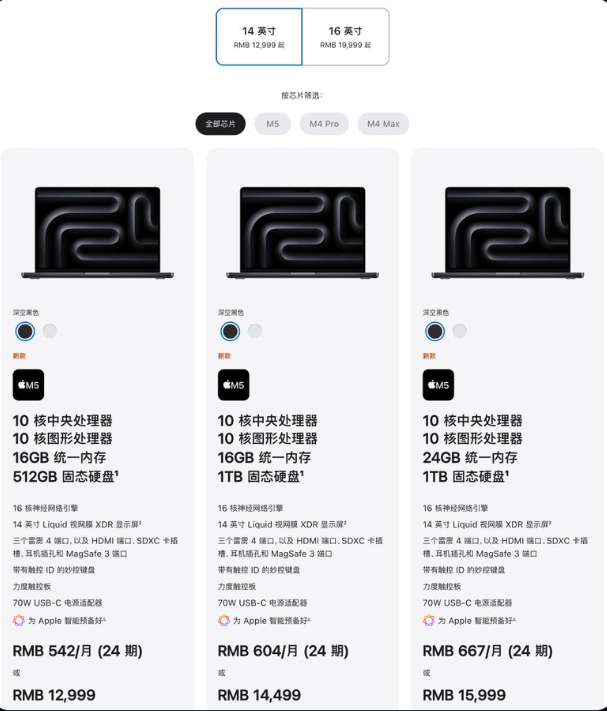
  • 10-core CPU and 10-core GPU configuration
  • Dedicated neural network acceleration units in each GPU core
  • Third-generation ray tracing engine
  • Dynamic cache technology for efficient memory allocation

According to Apple benchmarks, the M5 delivers 6x faster AI performance compared to the original M1 chip. This enables local execution of demanding tasks like:

  • Large language model processing
  • Image generation algorithms
  • Diffusion model inference

Image

Professional-Grade Hardware Specifications

The new MacBook Pro boasts:

  • Liquid Retina XDR display with 1600 nits HDR peak brightness
  • Industry-leading 24-hour battery life
  • Comprehensive port selection including Thunderbolt 4/5 and MagSafe 3 charging
  • Upgraded 12MP camera with Center Stage AI tracking

The extended battery performance positions the device as ideal for all-day:

  • AI model training sessions
  • Video rendering projects
  • Intensive computational workflows

Local AI Computing Advantages

Apple emphasizes the M5 MacBook Pro's ability to run local AI environments like LM Studio natively. This approach offers:

  • Elimination of cloud API latency
  • Enhanced data privacy by keeping sensitive information on-device
  • Reduced operational costs compared to cloud-based solutions

The company positions the device as a "platform-level" tool for AI development and creative workflows.

Availability and Considerations

While Apple hasn't announced specific pricing or release dates, they confirm availability "soon" through official channels. Potential buyers should note that:

  • Real-world thermal performance remains untested
  • Compatibility with mainstream AI frameworks needs verification
  • The premium positioning likely means higher price points

The M5 represents Apple's strategic push into dedicated AI hardware acceleration as generative tools become essential across creative and technical fields.

Key Points:

  1. First Apple silicon specifically optimized for AI workloads (6x faster than M1)
  2. Revolutionary 24-hour battery life enables all-day professional use
  3. Local processing eliminates cloud dependencies and privacy concerns
  4. Targets developers, creators working with generative AI tools

Enjoyed this article?

Subscribe to our newsletter for the latest AI news, product reviews, and project recommendations delivered to your inbox weekly.

Weekly digestFree foreverUnsubscribe anytime

Related Articles

Apple's M5 chips redefine laptop power with groundbreaking AI and battery life
News

Apple's M5 chips redefine laptop power with groundbreaking AI and battery life

Apple has unveiled its next-generation M5 Pro and M5 Max chips, delivering revolutionary AI performance and unprecedented battery efficiency. The new MacBook Pro models can run for a full day on a single charge while offering four times the AI processing power of previous generations. Alongside these powerhouse machines, Apple also introduced more affordable M5-powered MacBook Air models and upgraded Studio Displays with stunning 5K resolution.

March 5, 2026
Apple SiliconAI ComputingLaptop Technology
News

Mac Mini's Hidden Power: How Engineers Unlocked AI Training on Apple's M4 Chip

In a surprising breakthrough, engineers have cracked open Apple's Neural Engine capabilities, revealing that Mac Minis can do far more than just run apps. By reverse-engineering the M4 chip with Claude AI's help, researchers discovered these compact machines can efficiently train AI models - challenging the need for expensive GPU setups. The findings show energy efficiency up to 80 times better than professional-grade hardware, potentially democratizing AI development.

March 9, 2026
Apple SiliconAI HardwareMachine Learning
News

SpaceX's Million-Satellite Gamble: Building AI Supercomputers in Orbit

SpaceX has filed an audacious plan with the FCC to launch over a million satellites, not for internet service but to create orbiting AI data centers. The proposed space-based supercomputers would leverage the vacuum and cold of space to achieve unprecedented computing power while solving Earth-bound data centers' biggest headaches: energy use and heat dissipation. While promising revolutionary computing capabilities by 2030, the plan faces daunting technical and regulatory hurdles that could ground Elon Musk's latest sky-high ambition.

February 3, 2026
SpaceXAI ComputingOrbital Data Centers
Zhipu AI Rations Coding Plan Access Amid Computing Crunch
News

Zhipu AI Rations Coding Plan Access Amid Computing Crunch

Chinese AI firm Zhipu faces growing pains as its popular GLM-4.7 model strains computing resources. Starting January 23, daily sign-ups for its coding service will be slashed to just 20% of current capacity. The move aims to maintain quality for existing users during peak hours, though automatic renewal subscribers won't be affected.

January 21, 2026
AI ComputingZhipu AIResource Management
News

Luxshare Precision Bets Big with $2 Billion Stock Buyback Amid AI Push

Luxshare Precision announces a massive 2 billion yuan stock repurchase, signaling strong confidence in its future. The move comes as the company posts impressive growth figures and makes strategic advances in AI computing technology. With its market value now exceeding 410 billion yuan, Luxshare is transforming from an Apple supplier to an AI manufacturing leader.

January 5, 2026
Luxshare PrecisionStock BuybackAI Computing
Apple Bets Big on AI Independence with New Server Chip
News

Apple Bets Big on AI Independence with New Server Chip

Apple is making a bold move into AI infrastructure with its first self-designed server chip, codenamed Baltra. Partnering with Broadcom, the tech giant aims to reduce reliance on NVIDIA by focusing squarely on AI inference tasks. Slated for a 2027 debut, Baltra promises faster response times for services like Siri while cutting energy costs. This marks Apple's latest push toward controlling every piece of its technological puzzle.

December 16, 2025
Apple SiliconAI HardwareTech Innovation