
Alibaba's MAI-UI Outshines Rivals in Smart GUI Technology

Alibaba's MAI-UI Sets New Standard for GUI Intelligence
Image

In a significant leap for human-computer interaction, Alibaba's Tongyi Lab has introduced MAI-UI, a family of intelligent agents that are changing how we interact with graphical interfaces. Unlike traditional systems, these agents don't just follow commands—they understand context, ask clarifying questions, and continuously improve their performance.

How MAI-UI Works

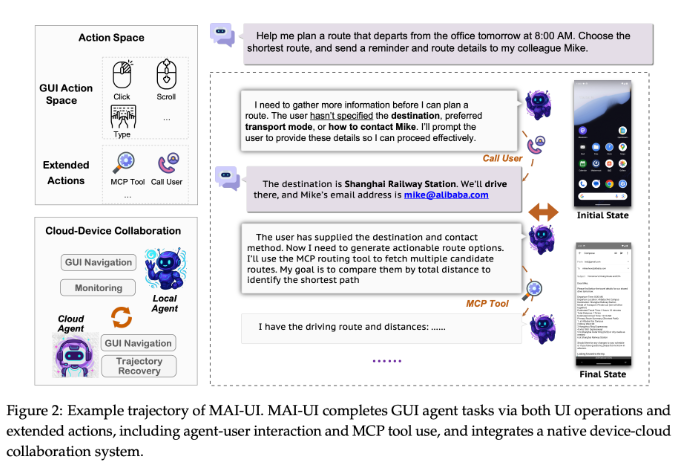
Built on the Qwen3VL framework, MAI-UI comes in four model sizes (2B to 235B parameters) capable of processing both natural language instructions and UI screenshots. Imagine telling your phone 'book me a table for two at an Italian restaurant' and watching as the agent navigates reservation apps on its own—clicking buttons, entering text, and even handling unexpected pop-ups.
Image

What sets MAI-UI apart is its MCP tool integration, allowing seamless switching between direct GUI manipulation and API-level operations. When faced with ambiguous requests like 'find me something fun to do tonight,' the agent can actually ask follow-up questions before taking action.

Learning While Doing

The system's secret weapon? A self-improving pipeline combining:

  • Seed tasks from manuals and public data
  • Human oversight from annotators
  • Online reinforcement learning

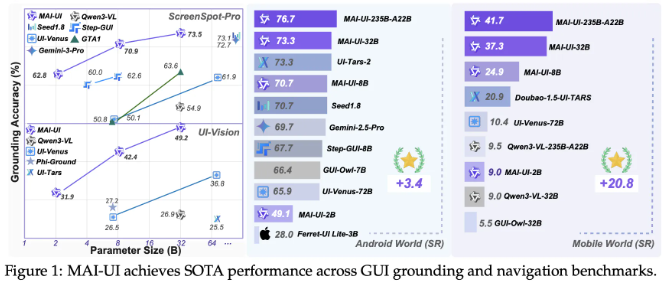
This approach helped MAI-UI achieve remarkable scores: 41.7% success rate on MobileWorld benchmarks and an impressive 76.7% on AndroidWorld tests—outperforming all comparable systems.

Why This Matters

For everyday users, this technology means:

  • More intuitive app interactions
  • Fewer frustrating dead-ends in complex workflows
  • Devices that truly understand user intent rather than just following scripts

The implications extend beyond consumer convenience—enterprise applications could see dramatic efficiency gains in areas like customer service automation and workflow management.

The team has made the project available on GitHub, inviting developers to explore its potential.

Key Points:

  • Next-gen interaction: MAI-UI blends GUI navigation with conversational AI for more natural device control
  • Android mastery: The system performs real-time operations including clicks, swipes, and text entry
  • Benchmark leader: Outperforms competitors by significant margins in standardized testing
  • Continuous learning: Reinforcement learning allows ongoing performance improvements

Enjoyed this article?

Subscribe to our newsletter for the latest AI news, product reviews, and project recommendations delivered to your inbox weekly.

Weekly digestFree foreverUnsubscribe anytime

Related Articles

Alibaba's Qwen AI App Hits 100 Million Users in Record Time
News

Alibaba's Qwen AI App Hits 100 Million Users in Record Time

Alibaba's new AI assistant Qwen has taken the consumer market by storm, reportedly surpassing 100 million monthly active users just two months after launch. The app, positioned as a 'personal AI assistant that can chat and handle tasks,' has found particular popularity among students and professionals. While Alibaba hasn't officially confirmed these numbers, the rapid adoption suggests strong consumer appetite for practical AI tools in daily life.

January 14, 2026
AlibabaAI AssistantsConsumer Tech
Mugen3D Turns Single Photos Into Stunning 3D Worlds
News

Mugen3D Turns Single Photos Into Stunning 3D Worlds

A groundbreaking AI tool called Mugen3D is transforming how we create 3D content. Using advanced 3D Gaussian Splatting technology, it can generate remarkably realistic models from just one image - capturing textures, lighting, and materials with astonishing accuracy. This innovation promises to democratize 3D creation across industries from gaming to e-commerce.

January 12, 2026
AIComputerGraphicsDigitalCreation
News

Qualcomm and Google Join Forces to Revolutionize Car Tech with AI

Qualcomm and Google are teaming up to tackle one of the automotive industry's biggest headaches: fragmented in-car systems. Their new 'Automotive AI Agent' combines Qualcomm's Snapdragon Digital Chassis with Google's Android Automotive OS, promising smoother development and smarter features like facial recognition. The partnership also introduces cloud-based development tools that could cut R&D time significantly. This collaboration marks a major step toward more unified, intelligent vehicle systems.

January 9, 2026
automotive-techAIsmart-cars
News

Bosch Bets Big on AI with €2.5 Billion Push Into Smart Cars

At CES 2026, automotive giant Bosch unveiled plans to invest over €2.5 billion in AI development by 2027, targeting smarter cockpits and safer autonomous driving systems. The German supplier aims to transform from hardware specialist to software leader, projecting its tech division could hit €10 billion in sales by the mid-2030s.

January 7, 2026
BoschAIautonomous vehicles
MiniMax IPO Fever: Hong Kong Investors Flock to China's AI Pioneer
News

MiniMax IPO Fever: Hong Kong Investors Flock to China's AI Pioneer

MiniMax, China's rising star in AI technology, has concluded its Hong Kong IPO with staggering investor enthusiasm. The offering saw subscriptions oversubscribed by 1,209 times, raising over HK$253 billion. Backed by heavyweight investors like Alibaba and Abu Dhabi Investment Authority, MiniMax is set to become one of the fastest-growing AI companies ever to go public when it lists on January 9.

January 6, 2026
AIIPOHongKongMarkets
NVIDIA CEO Hails Open-Source AI Breakthroughs at CES 2026
News

NVIDIA CEO Hails Open-Source AI Breakthroughs at CES 2026

At CES 2026, NVIDIA's Jensen Huang made waves by championing open-source AI development, singling out DeepSeek-R1 as a standout success. The tech leader revealed NVIDIA's plans to open-source training data while showcasing their new Vera Rubin chip. Huang outlined four key areas where AI is transforming industries, predicting these changes will define future technological paradigms.

January 6, 2026
AIOpen SourceNVIDIA