
AI Adoption Soars, But Most Companies Struggle to Scale

The AI Adoption Boom Hits Scaling Roadblocks
Image

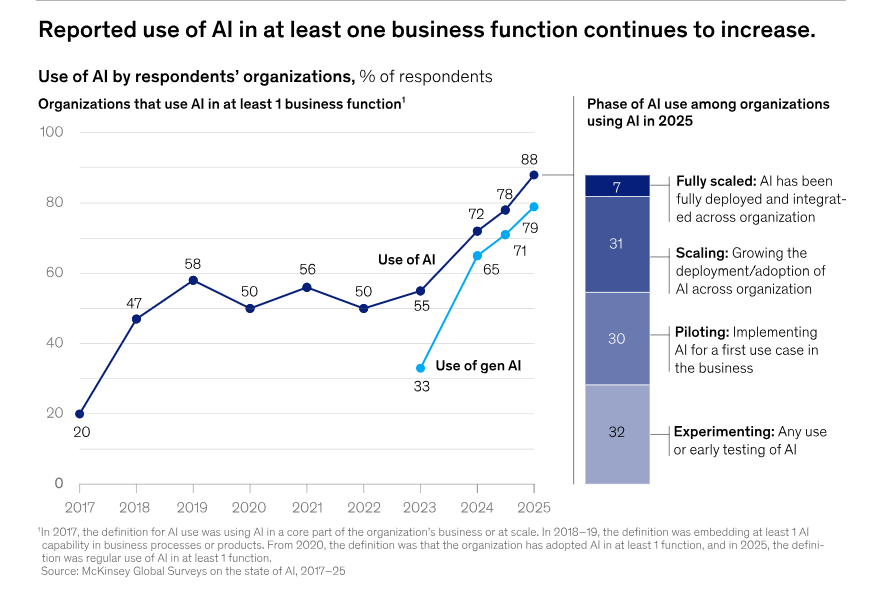
Artificial intelligence has become nearly ubiquitous in the business world, with 88% of companies now using AI in at least one department according to McKinsey's latest "State of AI" report. That's up sharply from 78% just a year ago - clear evidence that what began as experimental technology has entered the mainstream.

But here's the catch: most organizations still treat AI like a science project rather than a core business tool. About two-thirds remain stuck in trial phases, testing isolated applications without enterprise-wide deployment. Only about a third have progressed to scaling their AI initiatives across multiple functions.

"We're seeing widespread experimentation but limited transformation," notes one industry analyst familiar with the findings. "Companies are dipping their toes in the water rather than diving in."

The Scaling Divide
Image

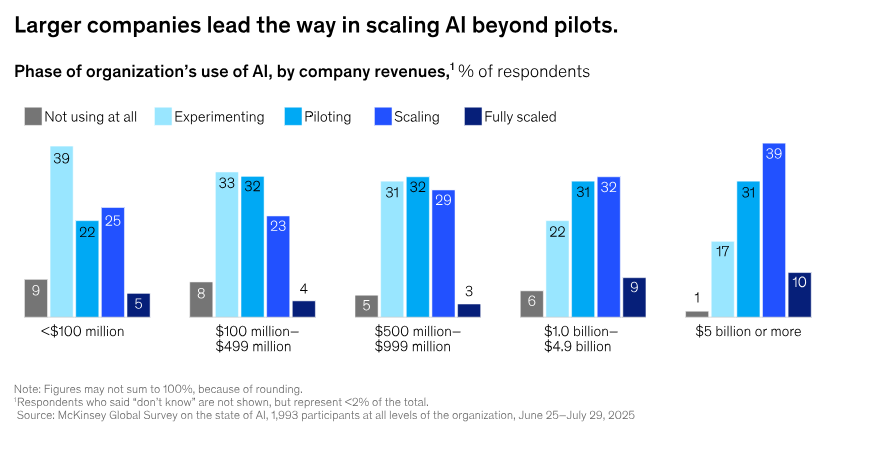
The report reveals a clear size advantage when it comes to AI implementation. Large enterprises (those with over $5 billion in revenue) are significantly more likely to have moved beyond pilots compared to their smaller counterparts. These corporate giants typically have deeper pockets for technology investments and more established data infrastructure - critical foundations for scaling AI.

Yet even among these early adopters, financial returns remain modest at best. Only 39% of respondents reported noticeable impacts on EBIT (earnings before interest and taxes), with most seeing effects below 5%. This performance gap suggests many companies haven't yet figured out how to translate technical capabilities into bottom-line results.

From Experimentation to Execution

The real challenge isn't getting started with AI - it's making it work at scale. As one tech executive put it: "Pilots are easy; production is hard." Successful scaling requires more than just technology - it demands workflow redesign, new governance models, and targeted talent investments.

Many organizations struggle with:

  • Integrating AI into existing business processes
  • Managing data quality and accessibility across departments
  • Developing internal skills to maintain and improve models
  • Measuring and tracking ROI from AI initiatives

The next frontier? Moving beyond isolated use cases to create enterprise-wide AI strategies that deliver consistent value. As the technology matures, competitive advantage will shift from who has AI to who uses it best.

Key Points:

  • 88% adoption rate: AI usage in business functions jumped 10 percentage points in one year
  • Scaling gap: Only 1/3 of companies have moved beyond pilot stages
  • Size matters: Large firms lead in implementation maturity
  • Financial impact limited: Just 39% see measurable EBIT improvements
  • Next challenge: Transforming workflows and governance for scaled deployment

Enjoyed this article?

Subscribe to our newsletter for the latest AI news, product reviews, and project recommendations delivered to your inbox weekly.

Weekly digestFree foreverUnsubscribe anytime

Related Articles

News

Nadella's Wake-Up Call: AI Won't Take Your Job – But Someone Who Uses It Might

Microsoft CEO Satya Nadella delivers a sobering message about AI's impact on careers. While acknowledging inevitable job disruptions, he argues the real danger lies in resisting skill upgrades. Nadella draws parallels to the PC revolution, emphasizing that understanding AI tools has become today's career lifeline. The article explores how AI lowers technical barriers while raising expertise demands, and why continuous learning separates future winners from obsolete professionals.

March 10, 2026
AI workforceFuture of workCareer development
News

Haier Smart Home Pioneers AI Workforce Transformation with New Competency Model

Haier Smart Home has introduced a groundbreaking AI competency framework that's reshaping how companies evaluate digital talent. Their innovative model assesses employees across six key dimensions with 24 specific indicators, already boosting team efficiency by 21%. Focusing initially on AI product managers and technical engineers, this approach bridges the gap between theoretical knowledge and practical application in smart home technology.

March 5, 2026
AI workforce developmentSmart home technologyDigital transformation
News

China's AI Boom: Enterprise Adoption of Large Models Triples

Chinese companies are racing to adopt AI large models at unprecedented speed, with usage skyrocketing 263% in just six months. Alibaba Cloud's Qwen leads the pack with a third of the market, while ByteDance and dark horse DeepSeek complete an emerging 'big three' reshaping China's AI landscape.

February 24, 2026
AI adoptionChinese techenterprise technology
News

AI Takes Center Stage as Hottest Lunar New Year Gifts

This Lunar New Year, artificial intelligence products have stolen the spotlight as must-have gifts. From smart glasses to household robots, tech-savvy consumers are embracing AI like never before. In Wuzhen Ancient Town, visitors experienced cultural traditions enhanced by cutting-edge technology, while nationwide AI applications saw record-breaking usage - especially among younger generations who've made AI-powered services their new holiday habit.

February 22, 2026
AI trendsLunar New Year techDigital transformation
News

Baidu's Digital Workforce Hits 1.3 Million as AI Agents Go Mainstream

Baidu's Qianfan platform has reached a significant milestone, powering over 1.3 million AI agents across industries. These digital workers are no longer experimental - they're handling millions of daily tasks in finance, manufacturing, and retail. With new model integrations and predictions of autonomous 'digital employees' by 2026, Baidu is leading China's AI commercialization race.

February 6, 2026
AI adoptionenterprise technologydigital transformation
News

AI Apps Surge: Monthly Users Jump by 200 Million

China's mobile internet landscape is buzzing with AI excitement. Recent data reveals AIGC apps added over 200 million monthly active users in December 2025, growing at a staggering 150% year-over-year. Meanwhile, AI plugins reached nearly 700 million users as smart tools become indispensable for work and daily life. This explosive growth signals how deeply artificial intelligence is reshaping digital experiences.

February 3, 2026
AIGCmobile trendsAI adoption